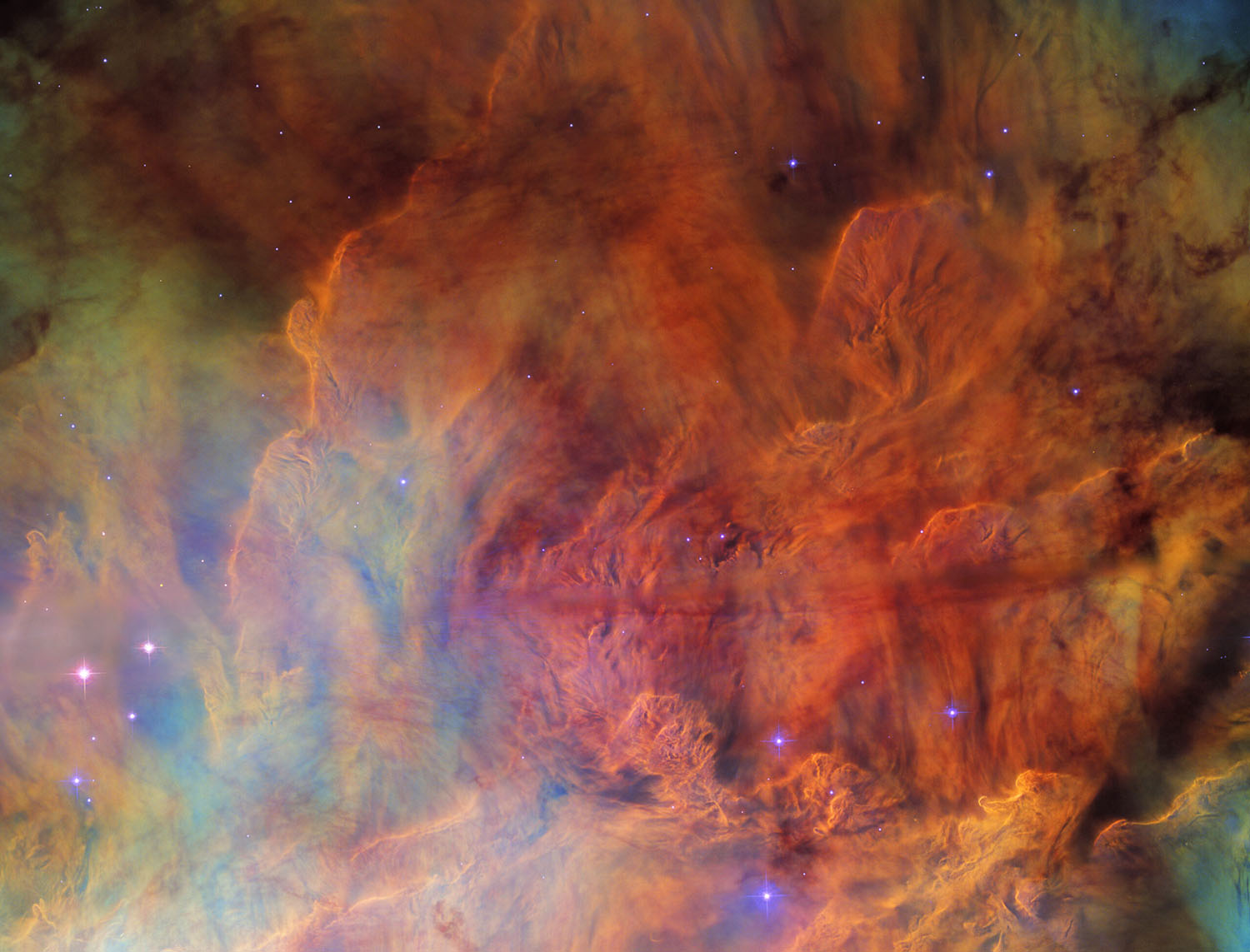
A portion of the open cluster NGC 6530 appears as a roiling wall of smoke studded with stars in this image from the NASA/ESA Hubble Space Telescope. NGC 6530 is a collection of several thousand stars lying around 4350 light-years from Earth in the constellation Sagittarius. The cluster is set within the larger Lagoon Nebula, a gigantic interstellar cloud of gas and dust. It is the nebula that gives this image its distinctly smokey appearance; clouds of interstellar gas and dust stretch from one side of this image to the other.Astronomers investigated NGC 6530 using Hubble’s Advanced Camera for Surveys and Wide Field Planetary Camera 2. They scoured the region in the hope of finding new examples of proplyds, a particular class of illuminated protoplanetary discs surrounding newborn stars. The vast majority of proplyds have been found in only one region, the nearby Orion Nebula. This makes understanding their origin and lifetimes in other astronomical environments challenging.Hubble’s ability to observe at infrared wavelengths — particularly with Wide Field Camera 3— have made it an indispensable tool for understanding starbirth and the origin of exoplanetary systems. In particular, Hubble was crucial to investigations of the proplyds around newly born stars in the Orion Nebula. The new NASA/ESA/CSA James Webb Space Telescope’s unprecedented observational capabilities at infrared wavelengths will complement Hubble observations by allowing astronomers to peer through the dusty envelopes around newly born stars and investigate the faintest, earliest stages of starbirth.[Image description: Clouds of gas cover the entire view, in a variety of bold colours. In the centre the gas is brighter and very textured, resembling dense smoke. Around the edges it is more sparse and faint. Several small, bright blue stars are scattered over the nebula.] Links Video of A Cosmic Smokescreen
Το Hubble τράβηξε μια εντυπωσιακή κοντινή φωτογραφία του Lagoon Nebula, μέσω των οργάνων Advanced Camera for Surveys και Wide Field Planetary Camera 2.
Το Lagoon Nebula (Νεφέλωμα Λιμνοθάλασσας), γνωστό και ως Μ8 ή NGC 6523, βρίσκεται στον αστερισμό του Τοξότη σε απόσταση 4.077 ετών φωτός από τη Γη. Το διαστημικό τηλεσκόπιο Hubble συνεχίζει να μας εκπλήσσει και η κοντινή αυτή λήψη του Lagoon Nebula, έγινε στα πλαίσια της έρευνας της περιοχής αυτής, για να δουν οι επιστήμονες αν υπάρχουν εκεί “proplyds” (ionized protoplanetary disk). Τα proplyds είναι ιονισμένοι πρωτοπλανητικοί δίσκοι που στην ουσία είναι φωτισμένοι φωτοεξατμιστικοί πρωτοπλανητικοί δίσκοι γύρω από νεαρά αστέρια.

Στη συγκεκριμένη κοντινή λήψη του Hubble, βλέπουμε μια συλλογή από πολλές χιλιάδες αστέρια που είναι ένα μικρό μέρος του Lagoon Nebula. Η NASA το περιγράφει ως ένα γιγάντιο διαστρικό σύννεφο αερίου και σκόνης. Δε μοιάζει με έργο τέχνης; Με πίνακα ζωγραφικής ίσως;
Η συντριπτική πλειονότητα των proplyds έχει βρεθεί μόνο σε μία περιοχή, στο κοντινό Νεφέλωμα Ωρίωνα. Αυτό καθιστά δύσκολη την κατανόηση της προέλευσης και της διάρκειας ζωής τους σε άλλα αστρονομικά περιβάλλοντα.
Στο Νεφέλωμα του Ωρίωνα έχουν ανακαλυφθεί περίπου 180 ιονισμένοι πρωτοπλανητικοί δίσκοι, η αλλιώς proplyds. Τώρα η NASA επεκτείνει την έρευνά της για να ανακαλύψει proplyds και σε άλλα νεφελώματα. Το Hubble, αν και παλιό διαστημικό τηλεσκόπιο, συνεχίζει να προσφέρει πολύτιμη βοήθεια στις σύγχρονες αστρονομικές επιστημονικές μελέτες.
Απέκτησε το Luminar με έκπτωση, με τον κωδικό pttl20, κάνε κλικ στην εικόνα

Είμαι ο Σπανουδάκης Γιώργος, φωτογράφος με έδρα την Αθήνα και έχω σπουδάσει μουσική και φωτογραφία (κάτοχος Bachelor of Arts). Ασχολούμαι επίσης με επεξεργασία φωτογραφιών και βίντεο. Εξειδικεύομαι σε φωτογραφίσεις κάθε είδους καλλιτεχνικών εκδηλώσεων και πορτρέτων. Όταν έχω χρόνο ασχολούμαι επίσης με αστροφωτογραφία, φωτογραφία τοπίου και λατρεύω να εκφράζομαι δημιουργώντας δικά μου φωτογραφικά concept.
Οι διαφημίσεις μάς βοηθούν να διατηρούμε το pttlgr δωρεάν, ανεξάρτητο και καθημερινά ενημερωμένο για φωτογράφους, βιντεογράφους και δημιουργούς εικόνας. Αν θέλεις, μπορείς να μας προσθέσεις στις εξαιρέσεις του ad blocker σου.