

Summary
- Hubble captured the star-forming region LH 95
- The region lies in the Large Magellanic Cloud
- Low-mass infant stars coexist with massive blue giants
- Glowing gas creates a striking crimson background
- Dark lanes of cosmic dust cross the image
Hubble captured a striking landscape of young stars, glowing gas and dark cosmic dust.
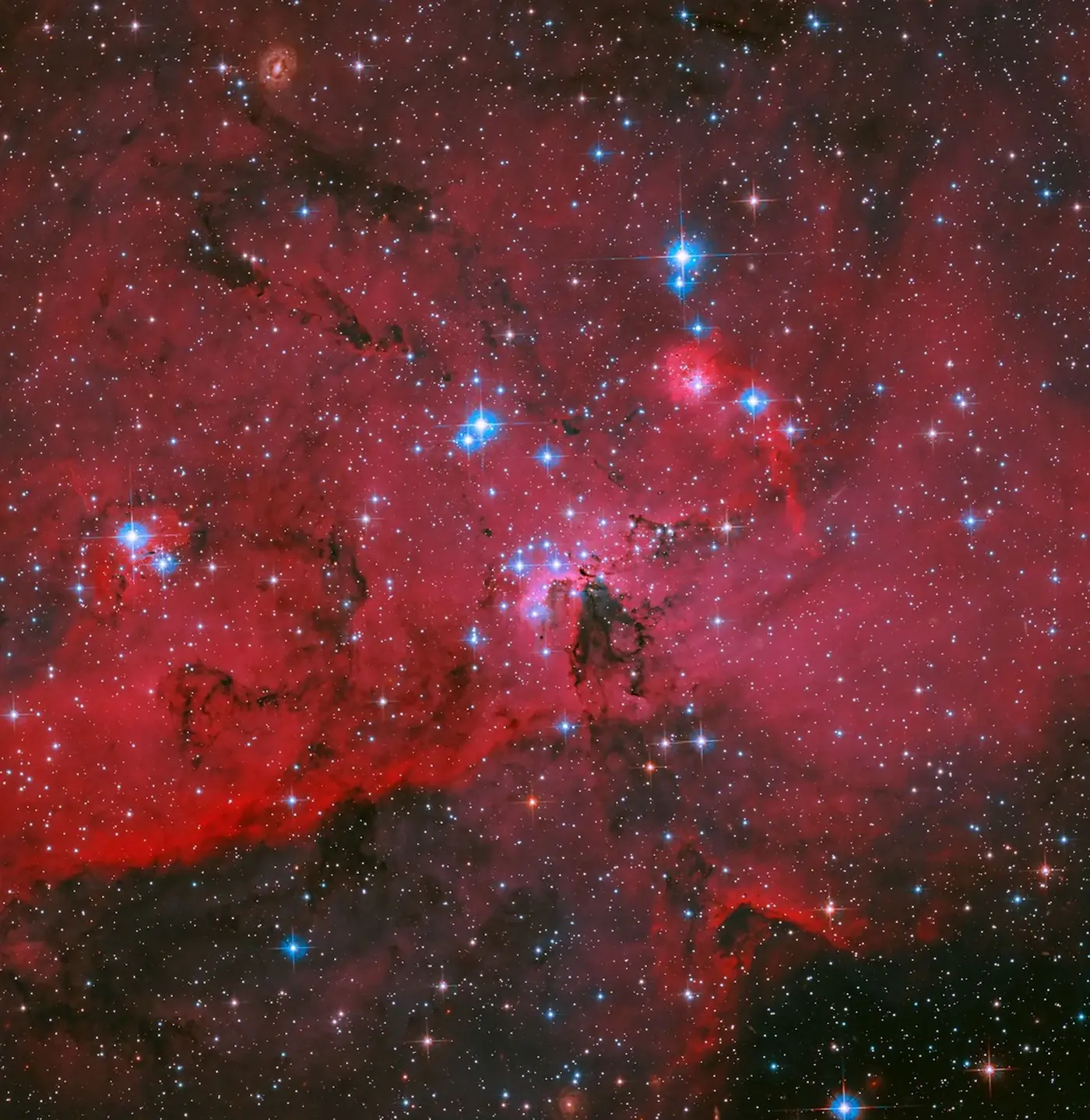
The new image shows the LH 95 region in the Large Magellanic Cloud, where blue and white stars stand out against a crimson background of illuminated gas. NASA published the image on July 14, 2026, while the observation is dated July 3, 2026.
The region is scientifically important because it contains stars with different masses and at different stages of development. Low-mass infant stars exist alongside much larger blue giants, giving astronomers a natural laboratory for studying stellar birth.
A stellar nursery near the Milky Way
LH 95 is located in the Large Magellanic Cloud, a dwarf galaxy that orbits the Milky Way. Its relative proximity allows space telescopes to observe star-forming regions in considerable detail.
In the image, bright stars are scattered through clouds of gas, while dark lanes of dust cross the field. The gas is heated and illuminated by intense radiation from young stars, producing the characteristic red hues.
Stars of different masses in the same region
LH 95 is classified as a stellar association, a relatively loose grouping of stars that formed in approximately the same region. Unlike dense star clusters, the members of such an association are not necessarily held tightly together by gravity.
The presence of small, newly formed stars beside massive blue giants helps researchers compare how stars of different masses evolve within the same cosmic environment.
The image and its processing
The data were collected by the NASA and ESA Hubble Space Telescope. Scientists N. Da Rio, G. De Marchi and D. Gouliermis contributed to the work, while Gladys Kober processed the image.
The colors and contrasts in the final image highlight the structures of the gas, dust and stars, revealing details that would otherwise be difficult to distinguish.
What we think
The image of LH 95 is another reminder that Hubble continues to provide not only spectacular views but also valuable data about the birth and evolution of stars. The ability to observe different stellar populations within the same region makes this field particularly important for astrophysics.
Frequently asked questions
What is LH 95?
LH 95 is a star-forming region and stellar association in the Large Magellanic Cloud.
Where is the Large Magellanic Cloud?
It is a dwarf galaxy near the Milky Way and one of its best-known galactic neighbors.
Why does the cloud appear red?
The gas is illuminated and heated by radiation from young, hot stars. Scientific image processing emphasizes this glowing emission with intense red tones.
What types of stars are found in the region?
LH 95 contains both young, low-mass stars and much larger, hot blue giants.
Which telescope captured the image?
The image was captured by the Hubble Space Telescope, a joint mission of NASA and ESA.