Summary
- IDC estimates that photo and video data will reach 144 zettabytes in 2026.
- The 2030 forecast is 234 zettabytes and includes captures, transmissions and copies.
- The story of Ofnibus highlights the need to preserve analog imagery.
- Archive organization and recovery are increasingly important for creators.
Photos and videos are expected to generate around 144 zettabytes of data worldwide in 2026. The estimate comes from IDC and was provided to the Associated Press by Adam Wright, a senior research manager at the company. By 2030, the forecast rises to 234 zettabytes, an increase of approximately 62.5% in four years.
That enormous figure does not represent a global hard drive containing every photograph we have ever taken. The estimate covers original captures, streaming, broadcasts and copies of files. A single video can therefore contribute to the total many times without a new original work being created.
How big are 144 zettabytes?
In decimal units, one zettabyte (ZB) equals 1,000 exabytes, one million petabytes or one billion terabytes. To put the figure in perspective, 144 ZB is equivalent to 144 billion TB, or the combined nominal capacity of 36 billion 4 TB drives. This is a comparison of units, not an estimate of the number of drives actually in use.
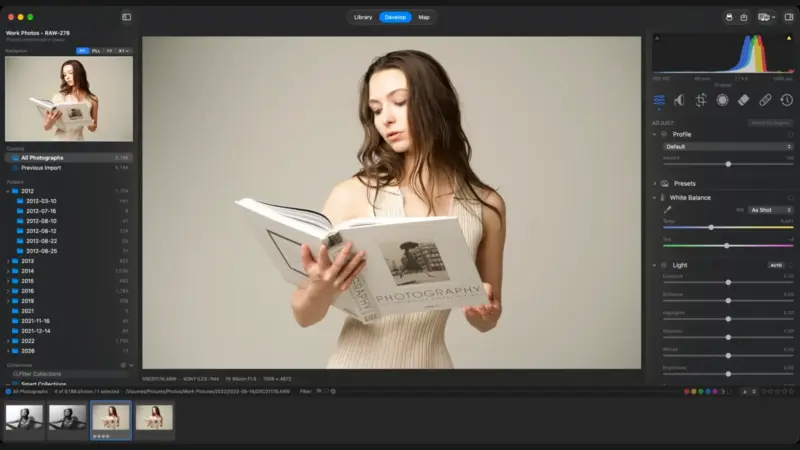
Consider a photographer’s workflow. At 40 MB per RAW file, 25,000 such files theoretically occupy 1 TB, before additional data and storage-system overhead. Actual RAW file sizes depend on the sensor, image content and compression. A library growing by 1 TB a year requires substantially more capacity once independent backups are included.
Data generation is not the same as storage
The wider picture is even more revealing. In an IDC analysis published on November 9, 2026, annual data generation across all activities is projected to exceed 274.4 ZB in 2026 and reach approximately 718.5 ZB in 2030. Installed global storage capacity, by contrast, is estimated at around 13 ZB in 2026 and more than 26 ZB in 2030.
The apparent contradiction reflects two different IDC measurements: the Global DataSphere tracks annual data creation, replication and consumption, while the Global StorageSphere measures installed capacity and its utilization. Only a small portion of the data generated is ultimately stored. A temporarily transmitted or replaced file does not require permanent new storage for every use.
According to IDC’s June 2026 forecast, around 90% of all data generated consists of replication and consumption. That percentage covers every data category, not just photographs and video. A video viewed millions of times can have a large data-traffic footprint even if platforms retain relatively few versions of it.
Smartphones, social media and artificial intelligence
Wright attributes the projected growth in visual content to higher-resolution smartphone cameras, the expansion of video-first platforms and AI-generated images and video. The photographic process no longer ends at capture: an image can go through automated editing, synchronization, multiple exports and publication on more than one network.
Google’s figures also illustrate the scale of everyday use. In 2025, on Google Photos’ tenth anniversary, the company reported more than nine trillion stored photos and videos and over 1.5 billion monthly users. These figures describe the number of files stored in one service, not IDC’s annual data volume.
AI adds a different dimension. In IDC’s 2026 Worldwide Data Utilization Survey, 81.7% of the 714 respondents using generative AI expected their organization’s data volume to grow over the next two years. The same analysis notes that some generated data is temporary and that certain AI applications can even reduce the need for source material.
In visual production, counting final files alone is therefore insufficient. A generative video project can involve dozens of motion and continuity tests, image variations, reference files, upscales and intermediate exports. Ease of creation increases the need for selection: which results have future value, and which can be deleted once production is complete?
The images that have yet to become data
Interestingly, IDC’s estimate appeared in a report about the opposite problem: rescuing old family films. While countless digital images are created, analog collections remain in storerooms and family drawers, often without functioning playback equipment. The abundance of digital files does not make older images any less valuable.
In Antibes, France, the Ofnibus team digitized 22 hours of amateur films and videos. Selected footage was presented in a 30-minute public screening. Such images help recover not only family moments but also the history of a town, changes in its landscape and customs that have disappeared.
The French association Ofnibus travels with equipment to view and digitize 8 mm, Super 8, 9.5 mm and 16 mm film, as well as VHS, Hi8 and MiniDV tapes. It records information such as the creator, location, date and medium, digitizes samples and works with local institutions to preserve the material. The originals remain in their place of origin.
The digitized regional heritage is made accessible through the association’s website and, since early 2024, the French Amorce platform. The process also faces a time constraint that better scanners cannot solve: as people who remember the events pass away, identifying the people, places and circumstances becomes increasingly difficult.
What this means for photographers and filmmakers
Professionals already know how quickly an archive grows. In video, for example, a codec with a constant bitrate of 400 Mbps records around 180 GB per hour, excluding separate audio and additional files. Ten hours of such footage amounts to 1.8 TB of originals alone. Three complete copies require 5.4 TB before proxies, project files, temporary renders and final masters are added. This is an illustrative calculation; actual sizes vary with codecs and settings.
Choosing storage is therefore an economic decision too. A fast SSD can serve editing, a large HDD or NAS can hold the archive, and an independent copy in another location protects against incidents affecting the entire studio. Cost extends beyond buying drives to hardware replacement, subscriptions, data transfers, electricity and management time.
A 3-2-1 storage and backup plan is more valuable than simply buying more terabytes. Important files need three copies on two types of media, with one off-site. NAS RAID helps protect against drive failures but does not replace an independent backup. Recovery should also be tested in practice.
The same applies to preserving photos and videos from a smartphone. Synchronizing a library with the cloud makes access easier, but a deletion can propagate to connected devices. For important material, an independent copy with the ability to restore an earlier version is more useful than a second device merely displaying the same library.
What we think
Data growth is not inherently a problem. A high-resolution photo or higher-bitrate video may be exactly what a production needs. The problem starts when deciding how to shoot comes before deciding how to preserve the material. We would not choose larger files simply because the camera allows them, but because they serve specific needs in capture, editing and final use.
The Ofnibus story shows why an image’s value cannot be measured in bytes. An imperfect shot of a family celebration may become an irreplaceable historical record. Hundreds of temporary render variations, on the other hand, may have no reason to be retained for a decade. We would therefore distinguish irreplaceable originals, finished works and their accompanying information from reproducible working files, taking each production’s contractual obligations into account.
For us, the right investment is an archive that can survive and be used again. That means consistent organization, descriptive metadata, independent copies, periodic checks and migration to newer media when needed. Especially for a documentary or a personal photographic archive spanning decades, finding a particular shot and understanding what it depicts matters just as much as being able to open the file. The real challenge in the coming years is not simply to produce more images, but to preserve the ones worth keeping.