Summary
- NASA published an image of gastric microtumors.
- Encapsulate-1 studies tumor samples aboard the ISS.
- The photograph was recorded before flight.
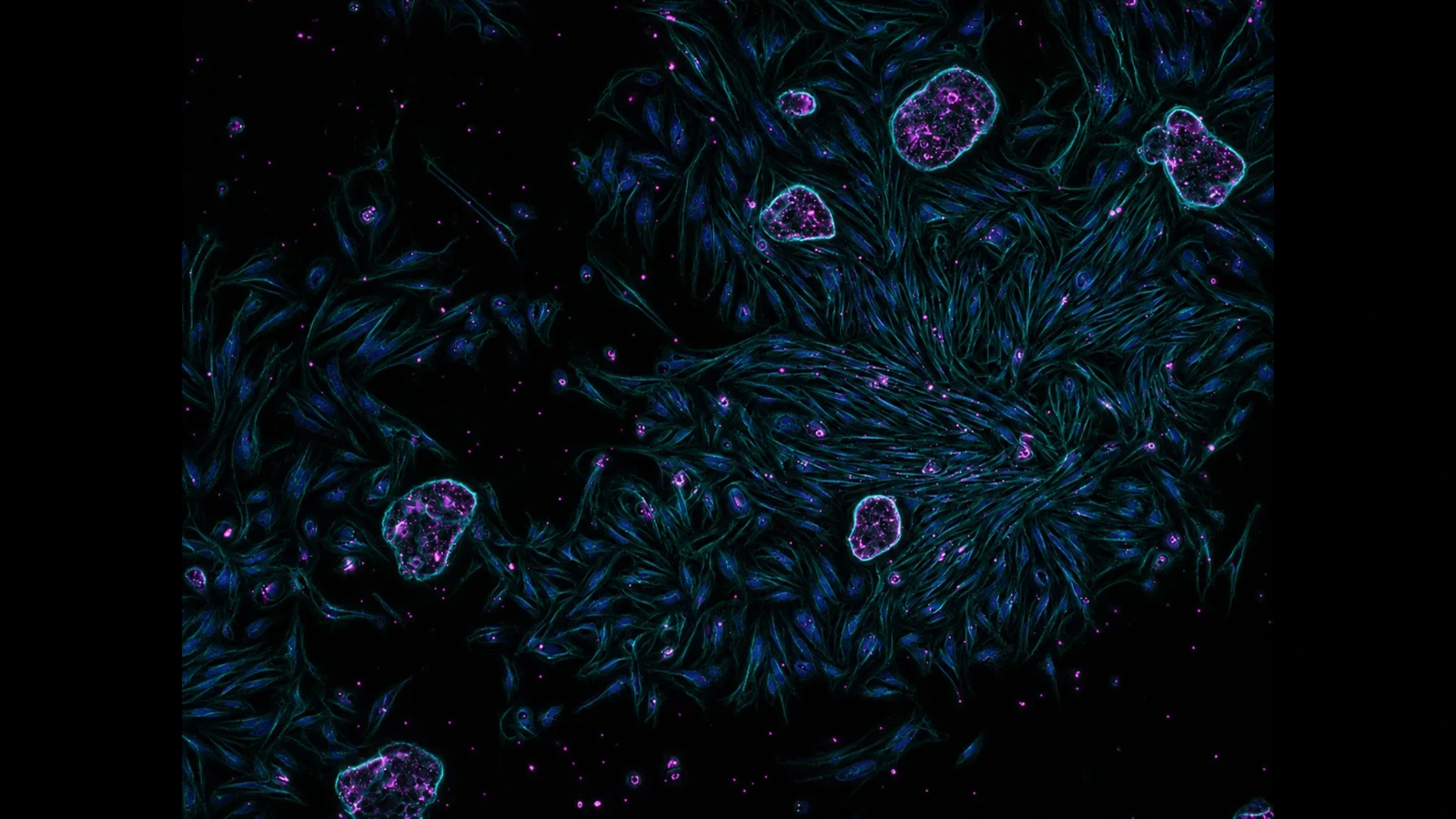
On November 23, 2026, NASA published a striking microscopic image of cancer cells, highlighting research that aims to use the unusual conditions of space to better understand cancer.
Dated November 19, 2026, the image shows gastric microtumors grown inside a specialized biochip developed by Encapsulate Inc.
Cancer research in microgravity
The Encapsulate-1 experiment studies patient-derived tumor samples on the International Space Station (ISS) to learn how cancer cells move and interact in microgravity.
NASA says the findings could inform the development of tests to assess metastatic risk and support more personalized treatments.
Orbiting more than 320 kilometers above Earth, the station provides researchers with an unusual laboratory environment for experiments of this kind.
Photomicrography as a scientific tool
Blue, cyan and magenta against a black background create an image that could easily be mistaken for a distant nebula.
Here, however, the subject is microscopic. Scientific imaging allows researchers to observe and record structures invisible to the naked eye.
The photograph itself is cataloged as a preflight image and accompanies the description of the research on the ISS.
Similarly striking uses of microscopic imaging can be seen in the award-winning photographs of Nikon Small World 2026, where photography meets biology, physics and scientific observation.
What we think
An agency that regularly brings us extraordinary photographs of galaxies and planets has turned its attention to an entirely different world: human cells.
What we love about photomicrography is its ability to turn a difficult scientific process into something we can observe and explore. The visual appeal of an image like this can draw people into the research behind it.
That is one of photography’s most meaningful applications: recording, documenting and communicating scientific knowledge.