

Summary
- Anil Menon photographed a massive typhoon from the ISS Cupola.
- The image was captured on August 2, 2026, using an iPhone.
- The storm system was most likely the powerful Typhoon Dolphin.
- NASA has allowed personal smartphones on its missions since February 2026.
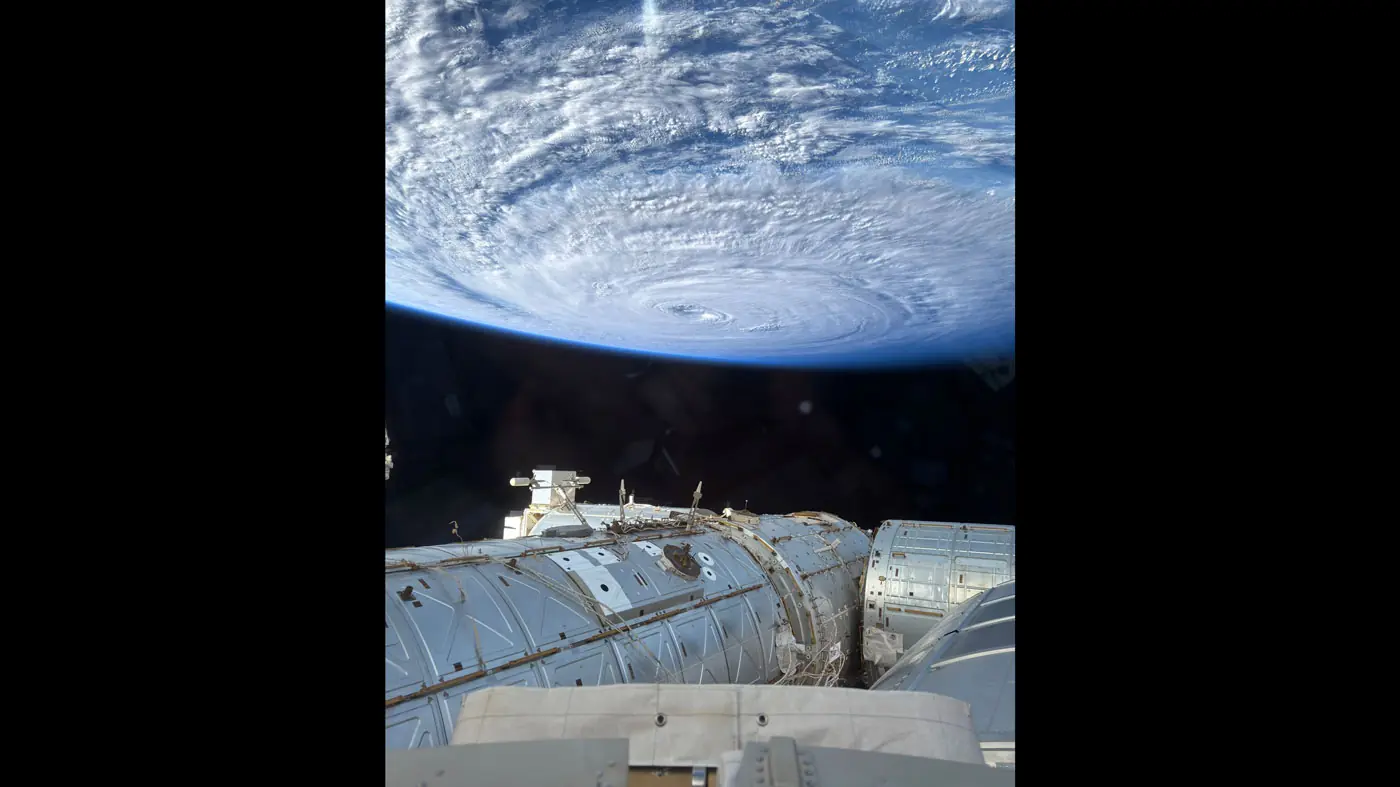
NASA astronaut Anil Menon used an iPhone to photograph an enormous typhoon swirling over the Pacific Ocean from the International Space Station.
The image was captured on August 2, 2026, through the ISS Cupola and was posted by Menon himself, who did not identify the exact weather system visible in the frame. Based on the available estimates, it was most likely the powerful Typhoon Dolphin.
The photograph is particularly notable because it was taken with an ordinary smartphone rather than the professional camera equipment normally used aboard the ISS. It is also one of the first prominent examples resulting from the new policy allowing NASA crews to carry personal smartphones into space.
The Pacific Ocean this morning from the cupola with an iPhone pic.twitter.com/YNrjAvaPMH
— Anil Menon (@astro_anil) August 2, 2026
The photograph from the Cupola
Menon captured the storm through the Cupola, the International Space Station’s domed observation area, which provides panoramic views of Earth and space through six surrounding windows and one central window facing the planet.
The photograph shows a vast spiral of clouds over the Pacific, with Earth’s curved horizon and the darkness of space forming the background. The astronaut said only that the image had been taken that morning from the Cupola with an iPhone, without revealing the phone model or the camera settings.
The storm was most likely Typhoon Dolphin
Although Menon did not identify the weather system by name, its position, date and appearance led observers to conclude that it was probably Dolphin. The typhoon had previously reached Category 5-equivalent intensity and was the fifth tropical cyclone of 2026 to reach that level.
In the days following the photograph, Dolphin was moving westward toward Japan, with forecasts taking it close to Okinawa. On August 5, United States weather services reported that the system was gradually weakening while still producing extremely powerful winds.
Menon’s first month in space
Anil Menon had been aboard the ISS for less than a month when he captured the photograph. His first space mission began on July 14, 2026, when he launched aboard Soyuz MS-29 with cosmonauts Pyotr Dubrov and Anna Kikina.
Menon is a NASA astronaut, physician and colonel in the United States Space Force. He serves as a flight engineer during Expedition 75. Before being selected as an astronaut, he worked as a flight surgeon for both NASA and SpaceX.
Smartphones are now permitted on space missions
Until early 2026, NASA crews were not permitted to freely carry and use their personal smartphones during missions. The policy changed in February, allowing astronauts to capture personal moments for their families and share photographs and videos more easily with the public.
Crews still have access to professional cameras, including Nikon Z9 bodies and an extensive range of lenses. A smartphone, however, provides a different advantage: it is immediately available and can be used within seconds. That can be important when the station is moving rapidly around Earth and a potential photograph may disappear almost immediately.
iPhones on the Artemis II mission
iPhones were also used during the Artemis II mission around the Moon in April 2026. It was the first time the devices had been approved for extended use on a crewed mission beyond low Earth orbit.
The astronauts used the phones for selfies and everyday photographs inside the Orion spacecraft, creating personal views of the mission alongside imagery captured by the official camera systems.
How photographs are transmitted from the ISS
Smartphones cannot connect to cellular networks from space. The ISS does, however, have a wireless network connection that allows crew members to use email, browse the web and make calls through internet-based communication systems.
The same infrastructure allows photographs and videos to be transferred to Earth, although the station’s communications rely on satellite systems and ground stations rather than a conventional cellular connection.
What we think
Anil Menon’s photograph demonstrates that the value of an image does not depend exclusively on sensor size or professional equipment. Immediate access to a camera can be crucial, especially in an environment where the viewpoint is constantly changing. An iPhone does not replace the ISS’s specialized cameras, but it adds a more spontaneous and personal way to document life and extraordinary sights in orbit.
Frequently asked questions
Who took the photograph?
The photograph was captured by NASA astronaut Anil Menon from the International Space Station’s Cupola.
Which iPhone model was used?
Menon said only that he used an iPhone. The exact model and camera settings were not disclosed.
Is the storm definitely Typhoon Dolphin?
No. The astronaut did not identify the typhoon. Its identification as Dolphin is an estimate based on the date, region and position of the weather system.