

Summary
A fabricated selfie of Mia Goth posted by a verified Instagram account with more than a million followers was treated as genuine news until the actor’s representative confirmed that the image was AI-generated.
The post appeared in early October, shortly after news broke that Goth had filed for divorce from Shia LaBeouf. According to her representative, Christine Tripicchio, the actor does not maintain personal social media accounts.
The photograph that was never taken
The @miagoth_ account shared what looked like an ordinary selfie featuring a white T-shirt reading “MY EX IS MY BIGGEST FAN”, accompanied by Beyoncé’s “Single Ladies (Put a Ring on It)”. The timing led viewers to read it as a personal response to her separation.
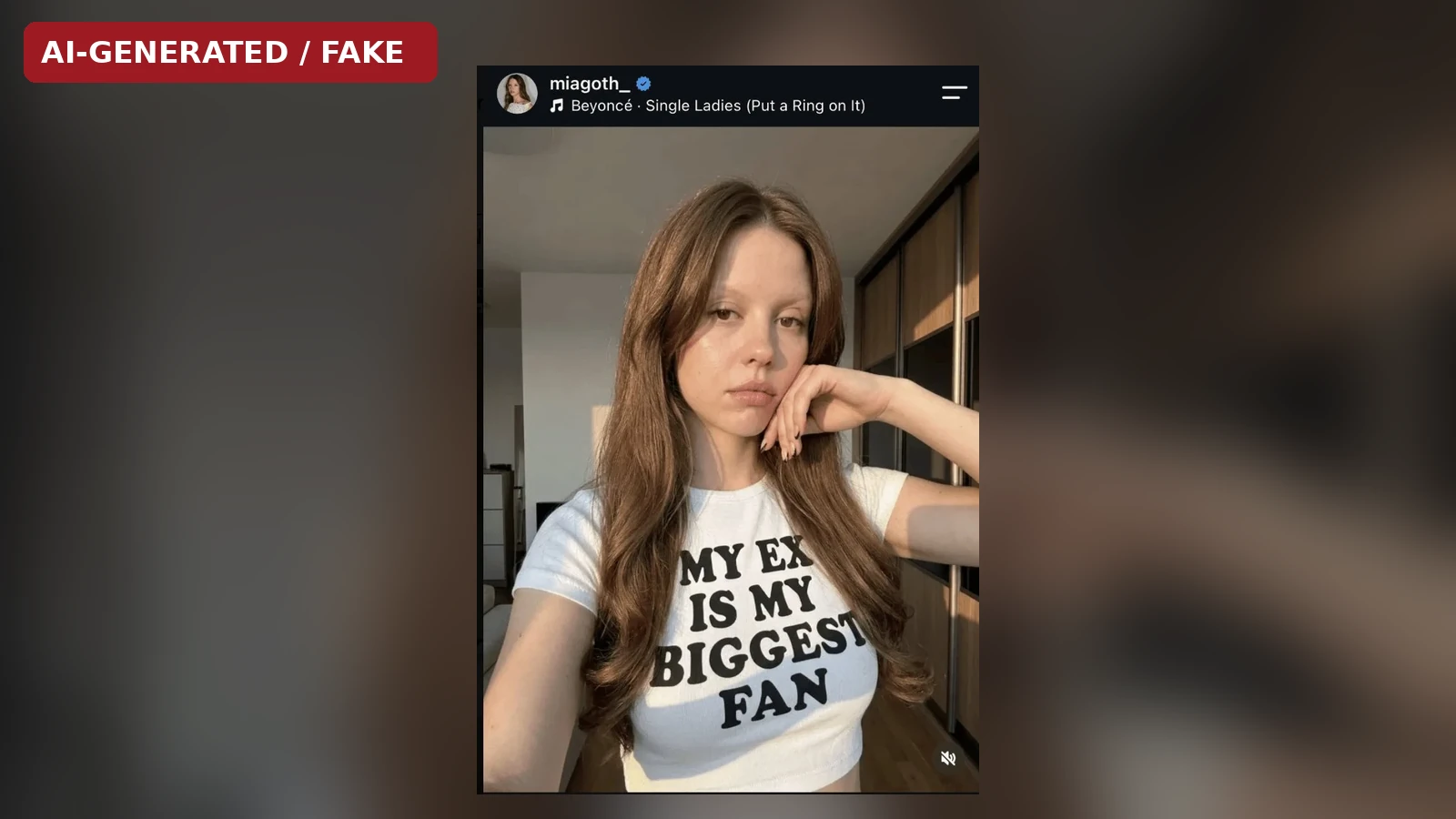
Although the profile described itself as a fan page, it carried a blue verification badge and had over one million followers. That combination gave the convincing image apparent credibility, and some outlets repeated it as though Goth had posted it. Account verification does not authenticate each image published by that account.
The complaint and Meta’s response
Tripicchio said Goth’s team had repeatedly asked Instagram to remove the account over counterfeit AI depictions of the actor. She questioned how such a fan account qualified for the blue badge and criticised the platform’s protection of Goth’s likeness.
A Meta spokesperson confirmed that the account was removed for impersonating a public figure. The identity of the image’s creator and the specific AI tool used have not been established. Removing the account also cannot undo copies that spread beyond the original post.
Why this matters to photographers and newsrooms
The failure was not merely that a synthetic image looked like a photograph. An image with no authenticated source was converted into an apparent public statement by a real person. For newsrooms, checking the publisher’s identity and obtaining independent confirmation matter far more than a verification badge.
AI labels are not a complete answer either. Cases in which real photographs received Instagram AI Content labels show the reverse problem: a label can mislead, while the absence of one does not prove that an image is genuine.
In Europe, AI transparency obligations concerning deepfakes and synthetic content add responsibilities for disclosure. But labels cannot replace editorial verification. File provenance, a subject’s consent and the context in which an image is published are distinct questions.
What we think
What makes this incident revealing is that the fake did not have to be visually flawless. It arrived at the right moment, depicted a recognisable person, offered an instantly shareable message and came from an account that looked credible enough for people to skip the checks. By the time everyone debates how to detect AI pixels, a false story may already have spread.
Meta eventually removed the profile for impersonation. Goth’s representative, however, was challenging what happened before that intervention: repeated complaints and the credibility granted by a verification badge. Platforms need to make clearer what those badges actually establish and respond more effectively when fabricated images are used to attribute words or actions to someone.
For photographers and editors, the practical standard is straightforward. A screenshot from a popular verified account is still only a screenshot. Unless the identity of the original poster, the image’s provenance and the claimed statement can be corroborated, it should not be presented as an authentic event.