

Summary
- Austin Bradley won Gold at the 2026 AOP Emerging Talent Awards.
- His 57-metre highline represents approximately one year of retreat at Sólheimajökull.
- Highline athletes, filmmakers and a glaciologist collaborated on the project.
- The footage is also intended for a documentary.
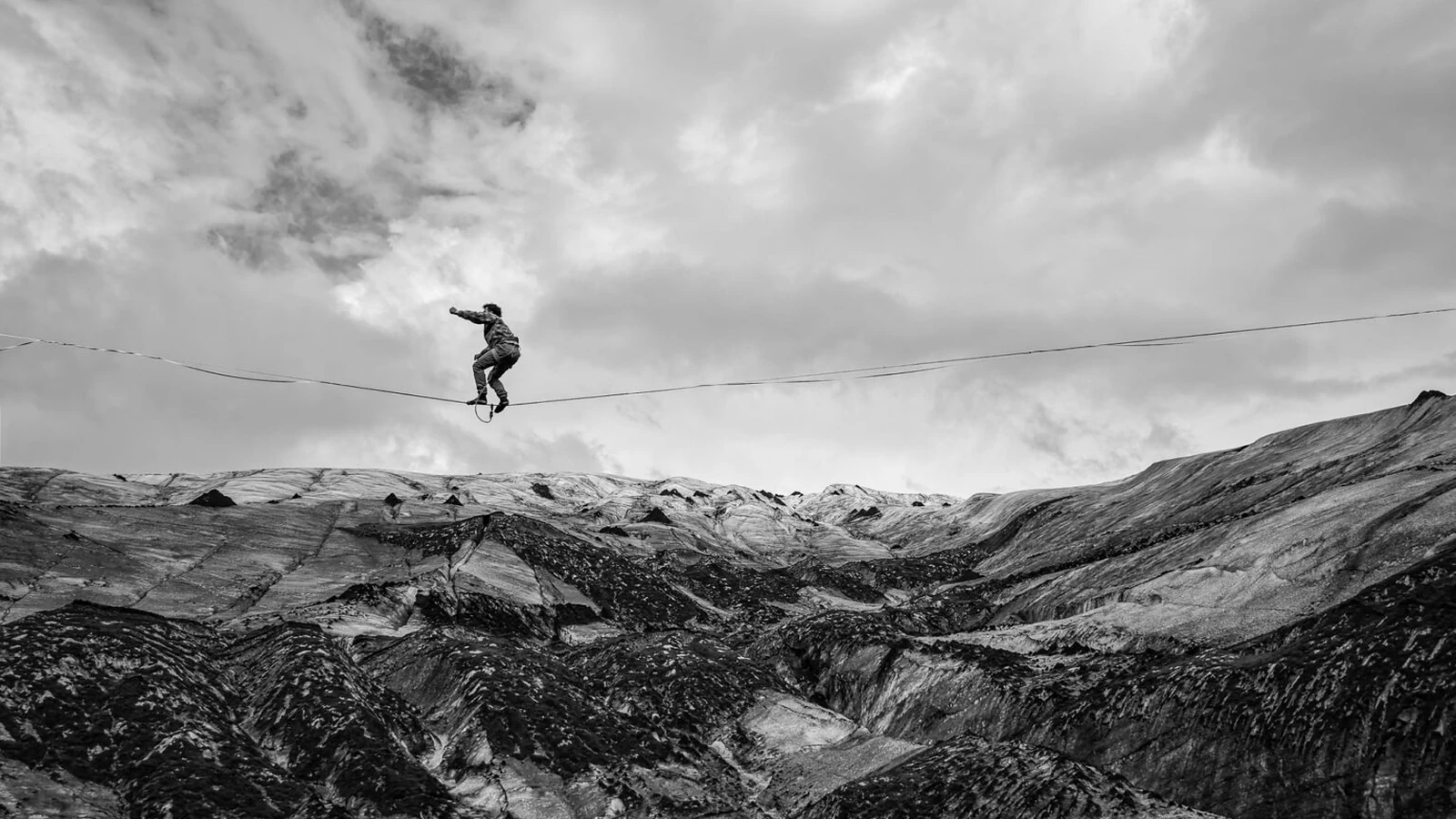
A 57-metre highline above an Icelandic glacier gave Austin Bradley the image that won Gold at the 2026 AOP Emerging Talent Awards.
In the award-winning black-and-white photograph, an athlete balances on a thin line, almost lost between an overcast sky and the deeply textured surface of Sólheimajökull. British photographer Austin Bradley wanted to make a change usually expressed in scientific figures visible and understandable.
Why exactly 57 metres?
The highline was not chosen merely for spectacle. According to the official Association of Photographers (AOP) announcement, its length represents approximately how far Sólheimajökull retreats in a year as the climate warms. It is a visual expression of an approximate rate, not a measurement of the glacier’s movement specifically in 2026, or a claim that retreat is identical every year.
Rather than showing ice alone, Bradley introduced a reference point that anyone can read immediately: a human body. The tiny figure gives the scene scale, while the dark grooves and textures beneath draw the eye back to the glacier, the actual subject of the story.
A team effort behind the photograph
The project 57 Metres: Iceland’s Shrinking Glacier involved highline athletes, a small film crew and a glaciologist. According to the AOP, the process was documented over several days, with the footage intended for a future documentary. No confirmed release date has been announced.
The collaboration with a glaciologist matters. The photographic concept relies on a numerical claim about the change occurring at one specific glacier. It becomes a more responsible visual metaphor when viewers understand what the figure represents, and what a photograph cannot establish on its own.
AOP Gold and the other award winners
The AOP announced the winners on 14 October 2026. Bradley took Gold in its Emerging Talent Award, which recognises image-makers who have been practising for fewer than three years. There were 15 finalists in the 2026 selection. Silver went to Ritchie Elder for Saturday School, a series about children from the Ukrainian community attending a Saturday school in Scotland.
Bradley’s work is scheduled to appear on BUILDHOLLYWOOD outdoor digital sites in London from 19 to 25 October. The AOP also reports a presentation of finalists’ work at the Wex Photo Video store in Putney. A different approach to visual evidence of ice loss appears in satellite images of ice breaking away from Greenland’s Petermann Glacier, where scientific observation is central to the image-making process.
What we think
Bradley made an interesting choice. Instead of looking for another sweeping landscape photograph, he placed a meaningful distance inside the frame. This is the kind of photographic thinking that can open up an environmental story to people who would never otherwise engage with glacier measurements.
The composition also works before we know its title. The person is tiny, the sky occupies a large part of the frame, and the ice does not feel like a decorative background for an extreme-sports performance. Once we learn what the 57 metres mean, the picture takes on a second layer.
We should not, however, mistake a visual explanation for scientific proof. The photograph cannot independently measure how far a glacier retreated during a given period. Its achievement is making viewers want to understand that measurement. For a photographer working with environmental stories, that is a meaningful result.