

Summary
- The EOS R8 Mark II adds IBIS and a joystick but retains a single UHS-II SD slot and no full mechanical shutter.
- The EOS R6 Mark II has dual UHS-II SD slots, a mechanical shutter up to 12fps, a larger battery and a more professional workflow.
- The Nikon Z5II, Sony α7 IV and Panasonic S5II address different priorities in photography, resolution and video.
- The real price gap on the day of purchase is critical when choosing between the R8 II and R6 II.
- The comparison at a glance
- R8 Mark II vs R6 Mark II: the biggest difference is not megapixels
- The R8 II clearly wins on portability
- For video, the R8 II is much more competitive
- Price: when the R6 II starts to become very tempting
- Nikon Z5II: a strong photographic rival to the R8 II
- Sony α7 IV: more resolution and a very mature lens ecosystem
- Panasonic S5II: the most video-centric package here
- Which camera fits which workflow
- What we think
- Frequently asked questions
The Canon EOS R8 Mark II moves much closer to the R6-series formula than the original R8, yet the older EOS R6 Mark II still offers several features that matter more in demanding photographic workflows.
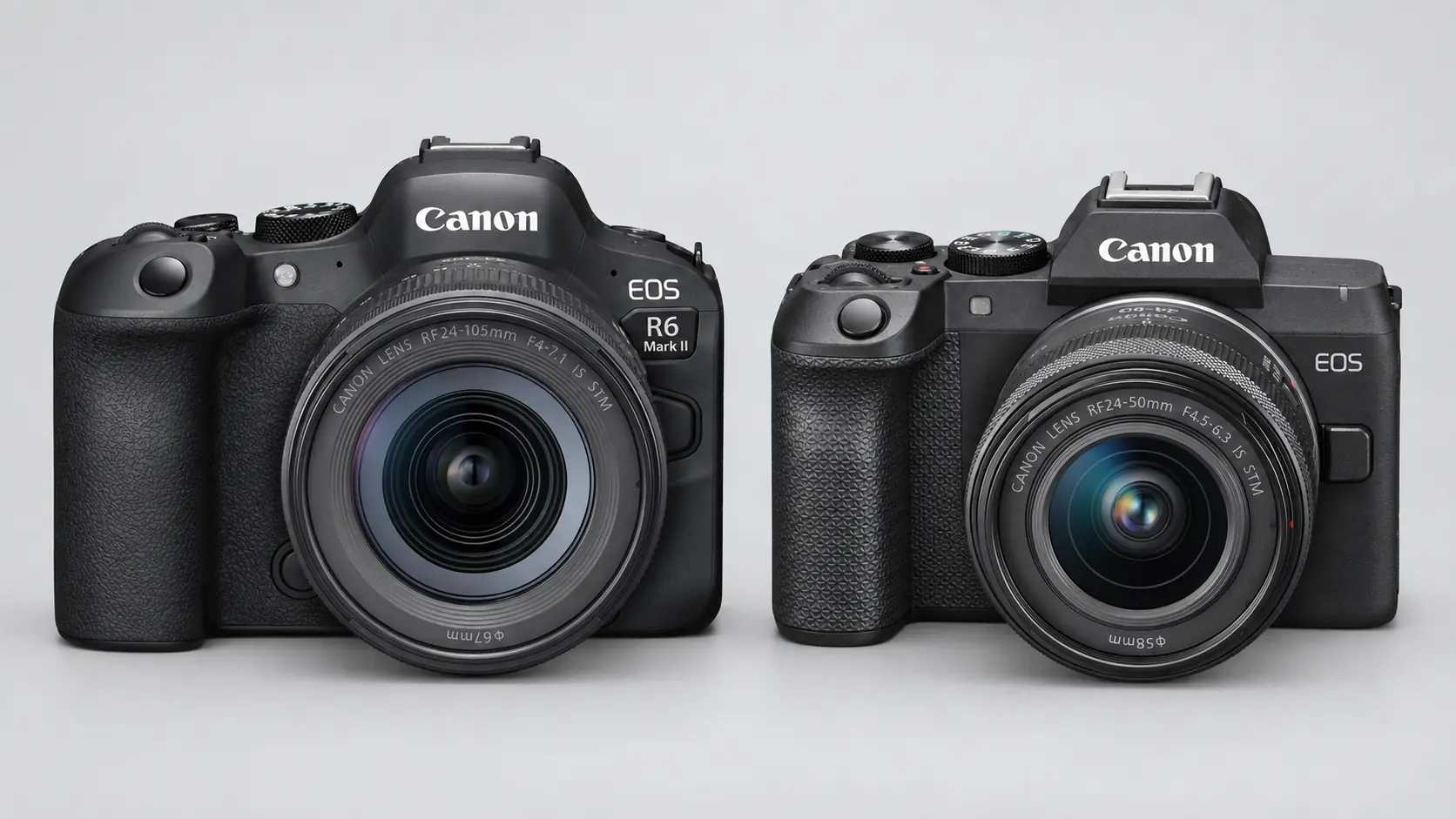
On headline specifications, the two Canons look similar: a 24.2MP full-frame sensor, up to 40fps with the electronic shutter, IBIS and uncropped 6K-oversampled 4K/60p. The EOS R8 Mark II is substantially smaller and lighter, while the EOS R6 Mark II retains dual memory-card slots, a full mechanical shutter and a larger battery.
To see whether the R8 Mark II is the obvious buy at its new price, we place it alongside not only the R6 Mark II but also the Nikon Z5II, Sony α7 IV and Panasonic LUMIX S5II: four full-frame alternatives built around different priorities in photography, video and professional use.
The comparison at a glance
| Feature | Canon EOS R8 Mark II | Canon EOS R6 Mark II | Nikon Z5II | Sony α7 IV | Panasonic LUMIX S5II |
|---|---|---|---|---|---|
| Sensor | 24.2MP full frame | 24.2MP full frame | 24.5MP BSI full frame | 33MP BSI full frame | 24.2MP full frame |
| IBIS | up to 7.5 stops at centre | up to 8 stops | up to 7.5 stops at centre | 5.5 stops | 5 stops / up to 6.5 with Dual I.S.2 |
| Burst | 6fps EFCS / 40fps electronic | 12fps mechanical / 40fps electronic | up to 14fps High-speed continuous (extended) / up to 30fps High-Speed Frame Capture+ | up to 10fps | 9fps mechanical / 30fps electronic |
| Cards | 1× SD UHS-II | 2× SD UHS-II | 2× SD | 1× CFexpress Type A/SD + 1× SD | 2× SD UHS-II |
| Shutter | EFCS + electronic, no full mechanical shutter | mechanical + EFCS + electronic | mechanical + EFCS | mechanical + electronic | mechanical + EFCS + electronic |
| Video | uncropped 6K-oversampled 4K/60p, FHD/180p, Canon Log 3 | uncropped 6K-oversampled 4K/60p, FHD/180p, Canon Log 3 | full-frame 4K/30p, cropped 4K/60p, internal 12-bit N-RAW | up to 4K/60p 10-bit, using Super 35/APS-C area at 50/60p | 6K 3:2 up to 30p, 4K/60p 10-bit in APS-C, V-Log |
| Weight with battery/card | 546g | about 680g | about 700g | 658g | 740g |
R8 Mark II vs R6 Mark II: the biggest difference is not megapixels
The R8 Mark II fixes two of the original R8’s biggest omissions by adding 5-axis IBIS and a joystick. It remains a different class of body, however. It has a single UHS-II SD slot, uses the small LP-E17 battery and does not have a full mechanical shutter. For stills it offers Electronic 1st-curtain at up to 6fps and electronic shooting at up to 40fps.
The R6 Mark II has dual UHS-II SD slots, a mechanical shutter at up to 12fps, electronic shooting at up to 40fps, the larger LP-E6NH battery and battery-grip support. Those differences are invisible in a simple resolution or autofocus comparison, but they matter directly for weddings, events, sport, flash work and any job where file redundancy and endurance matter more than minimum weight.
The R8 II’s electronic shutter is very fast at 40fps, but it does not replace a mechanical shutter in every situation. Canon itself does not allow flash with the fully electronic shutter, while an electronic rolling shutter can show banding under some artificial light sources. The R6 II’s mechanical shutter gives the photographer another dependable option when conditions require it.
The R8 II clearly wins on portability
At 546g with battery and card, the R8 Mark II is roughly 130g lighter than the R6 Mark II and lighter still than the Nikon Z5II and Panasonic S5II. For travel, street photography, hiking or gimbal use, that is meaningful, especially with compact RF lenses.
The trade-off is endurance and redundancy. Canon rates the R8 II at about 220 shots through the EVF in Power Saving mode or 340 with the LCD using the LP-E17. The R6 II uses the much larger LP-E6 family and supports a battery grip, while its two cards can be used for simultaneous recording or file separation.
For video, the R8 II is much more competitive
The R8 Mark II records uncropped 4K up to 60p oversampled from 6K and Full HD up to 180p, and includes Canon Log 3, supported 10-bit formats, false colour and four-channel audio with compatible accessories. The R6 Mark II also offers uncropped 6K-oversampled 4K/60p and Full HD/180p, but its larger body, bigger battery and dual cards make it a more comfortable base for longer productions.
For a hybrid creator who wants a small body, then, the R8 II is far more complete than the original R8. For professional coverage where recording to a second card is part of the workflow, the R6 II still has a clear practical advantage.
Price: when the R6 II starts to become very tempting
On September 16, 2026, Canon Germany listed the new R8 Mark II body at €1,799 and the R6 Mark II at €2,185. The official gap is therefore €386, enough for the R8 II to remain materially cheaper when comparing new bodies from the same channel.
The equation changes when discounts, cashback or used/refurbished R6 II bodies appear. Canon Germany itself listed a refurbished R6 Mark II at €1,849 during the same check, only €50 above the new R8 II, although this is obviously not a like-for-like new-versus-new comparison. For a buyer, the live price on the day matters: as the gap moves towards €200–300, the R6 II’s dual cards, mechanical shutter and larger battery carry much more weight.
Nikon Z5II: a strong photographic rival to the R8 II
The Nikon Z5II is arguably the most direct alternative for someone not tied to the RF system. It has a 24.5MP BSI sensor, up to 7.5 stops of central IBIS, dual SD slots, mechanical/EFCS shutter operation, nine-category subject detection and internal 12-bit N-RAW video. For stills, it offers a more work-oriented body than the R8 II without necessarily moving into a higher class.
The main video compromise is a 1.5x crop at 4K/60p, while 4K/30p uses the full-frame angle of view. Nikon’s 30fps figure also refers to High-Speed Frame Capture+ rather than the same RAW-burst proposition as Canon’s 40fps mode.
Sony α7 IV: more resolution and a very mature lens ecosystem
The Sony α7 IV remains a strong option thanks to its 33MP BSI sensor, dual storage slots —one of which also accepts CFexpress Type A—, mechanical shutter and very mature E-mount lens ecosystem. For photographers who need more resolution than the 24MP class of the Canon, Nikon and Panasonic bodies here, that is the most obvious distinction.
On the other hand, maximum burst speed is 10fps and 4K at 50/60p uses the Super 35/APS-C image area, so it offers neither the headline stills speed of the R8 II/R6 II nor their uncropped 4K/60p.
Panasonic S5II: the most video-centric package here
The Panasonic LUMIX S5II prioritises different tools: 6K 3:2 open-gate up to 30p, 10-bit video, V-Log, full-size HDMI, an active cooling fan, dual UHS-II SD slots and 30fps with its electronic shutter. For filmmaking, anamorphic work or productions where monitoring and long takes are core needs, its body offers advantages the small R8 II is not trying to replicate.
The S5II is also the heaviest camera in this group at 740g, and 4K/50p or 60p uses an APS-C image area. It follows a different philosophy from the compact Canon, but it is exactly the sort of alternative a video-first creator should consider before deciding by brand alone.
Which camera fits which workflow
Canon EOS R8 Mark II: for travel, everyday photography, portraits and hybrid creators who want RF full frame, very low weight, IBIS and uncropped 4K/60p without needing a second card slot or a full mechanical shutter.
Canon EOS R6 Mark II: for events, weddings, action, flash and paid work where dual recording, the larger battery and a mechanical-shutter option justify the larger body and cost.
Nikon Z5II: for photographers who want dual cards, strong IBIS and modern AF in an accessible full-frame body and can accept the crop at 4K/60p.
Sony α7 IV: for those prioritising 33MP resolution, the broad E-mount ecosystem and a mature hybrid workflow without needing very high burst rates.
Panasonic LUMIX S5II: for video-first use, 6K open-gate, full-size HDMI, active cooling and L-mount, accepting the larger body and the crop at 4K/60p.
What we think
The R8 Mark II is not simply a “cheap R6 II”: it prioritises portability and now adds IBIS, a joystick and capable video tools. But when the R6 Mark II can be found with only a small price gap, its dual cards, full mechanical shutter and larger battery are substantial benefits for professional photography. The right choice depends more on workflow than on which body is newer.
Frequently asked questions
Does the Canon EOS R8 Mark II have a mechanical shutter?
It does not have a full mechanical shutter. For stills it provides Electronic 1st-curtain and fully electronic shutter modes. Canon rates it at up to 6fps with EFCS and up to 40fps electronically.
Do the R8 Mark II and R6 Mark II have the same resolution?
Yes. Both are rated at 24.2MP full frame. That does not make them the same camera: shutter design, storage, battery, body and workflow differ significantly.
Which Canon offers more practical redundancy for professional work?
The R6 Mark II has dual UHS-II SD slots for redundant recording, a larger battery and a full mechanical shutter. Those are practical advantages for events and paid assignments.
Which is the lightest camera in this comparison?
The EOS R8 Mark II, at about 546g with battery and card. That is one of its strongest advantages against the other full-frame bodies compared here.
Which option has the broadest built-in video workflow?
The Panasonic S5II offers the most extensive video toolkit in this group, with 6K open-gate, full-size HDMI, active cooling and V-Log. The two Canons, however, have the advantage of uncropped 4K/60p.