Summary
- British Journal of Photography has paused its print edition after 172 years.
- The move follows rising production and international delivery costs.
- Its digital publication continues without a confirmed date for a print return.
- The decision comes as LIFE prepares its own return to print.
British Journal of Photography is suspending its print edition after 172 years, as the cost of producing and distributing the magazine internationally has become unsustainable.
The announcement was made on 19 October 2026 by Mick Moore, the historic publication’s CEO and creative director. BJP will continue publishing digitally, while publisher 1854 Media has not announced a date for a possible return to print.
Why the print edition is being paused
In a letter to readers, Mick Moore explained that the cost of printing issues and delivering them around the world has risen beyond what the publisher can currently sustain. The pause is presented as a way to safeguard the magazine’s future, rather than an end to its journalism or its work with photographers.
The word “pause” matters. BJP has not announced a permanent shutdown of its printed edition or a concrete timetable to restart it. For now, publication continues in digital form only. Detailed financial figures have not been released that would support attributing the decision to a single factor beyond the production and distribution costs identified by Moore.
A photographic history that began in 1854
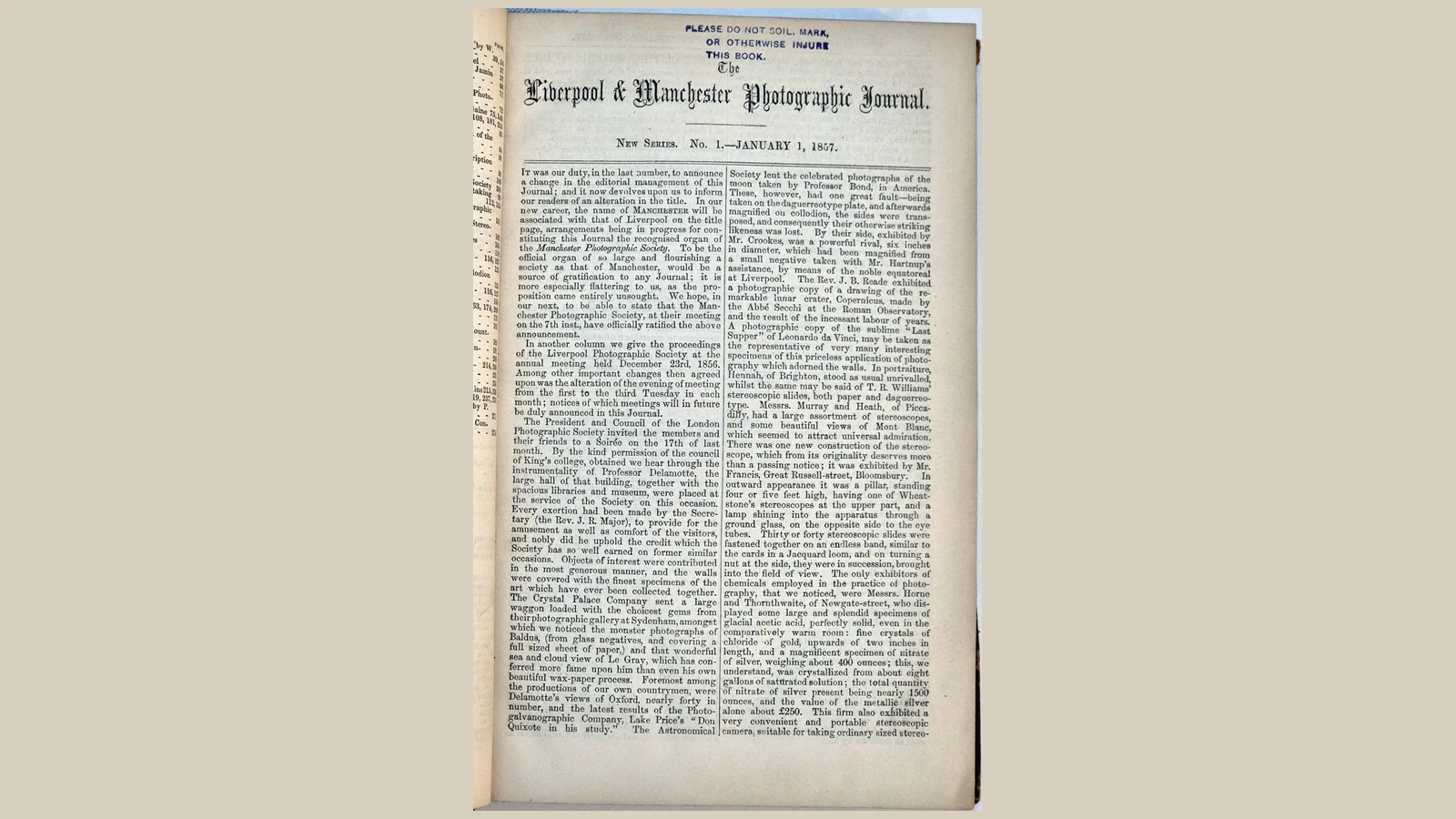
The magazine began in Liverpool in 1854 as the Liverpool Photographic Journal. It became the Liverpool & Manchester Photographic Journal in 1857, used the title The Photographic Journal in 1859, and adopted the British Journal of Photography name in 1860.
The archival page accompanying this article comes from the issue of 1 January 1857, labelled “New Series, No. 1”. It is the first issue of the new series under the 1857 name, not the magazine’s inaugural 1854 issue. The publication witnessed photography’s development from an emerging technical process into a worldwide language of art, news and visual expression.
For much of its history, BJP appeared weekly. In 2010 it moved away from that schedule and strengthened its identity as a magazine devoted to contemporary photography, photographic projects and carefully edited visual stories. Today it is published by 1854 Media, which also runs exhibitions, awards and other programmes for photographers.
There is an illuminating comparison with the Royal Photographic Society’s journal, which began in 1853 and also preserves an important archive of photographic history. It is a separate publication from BJP, and its story underlines how important photography journals have been as records of their times.
Digital BJP and LIFE’s move in the opposite direction
BJP is not establishing its digital presence from scratch. In 2025, it already launched a digital edition through Exact Editions, giving subscribers and institutions access to an archive of issues dating back to 2020. What is being suspended is the physical magazine, not the publication’s first move online.
Meanwhile, LIFE is returning to print in November 2026 with a quarterly, collector-oriented edition. The contrasting decisions show there is no single business model for photography magazines: a large, premium printed object can support one relaunch, while international distribution may be too expensive for another title, however historic.
What we think
For a photography magazine, paper is more than another screen. The texture, the scale of a photograph, the movement from one spread to another and the art director’s decisions all shape the experience. That is why BJP’s print pause matters to people who care about photography and visual storytelling.
Then there is the hard financial reality. An international print edition has to pay for paper, printing, storage and shipping before it even reaches the reader. Going digital allows BJP to remain active, but for now it removes a setting in which photographic stories could be experienced at a different scale and pace.
What matters most is protecting the work photographers do: commissions, fully realised projects, thoughtful interviews and editing that gives images their context. BJP has supported generations of image-makers. The priority is for it to keep doing so, even if that means leaving the printing press behind for a while.