Summary
- Researchers have located where the shoe shiner and his customer stood in Daguerre’s 1838 photograph.
- The investigation combined archives, a three-dimensional reconstruction and three surviving buildings.
- A bronze plaque now marks the spot at Place de la République.
The shoe shiner and his customer in Louis Daguerre’s famous photograph now have a specific place on the map of modern Paris, following two years of research.
The location is at Place de la République, along the continuation of Rue du Faubourg-du-Temple. Since October 15, 2026, a bronze plaque titled “Un détail imprévu” (“An Unexpected Detail”) has marked where the two figures stood in the 1838 image.
The following video explores the photograph’s history.
Three buildings connected the Paris of 1838 with today
Filmmakers Maximilien Van Aertryck, Axel Danielson and Kalle Boman combined historical archives, old maps and a three-dimensional reconstruction of the area. Their aim was to establish where the two people stood in a neighbourhood that has changed dramatically.
They first had to correct the daguerreotype’s mirror orientation. Three buildings surviving from the scene provided reference points, while architecture firms Rumlab in Sweden and Mater Studio in France independently calculated the location using different methods.
Why the street looks empty
Daguerre photographed Boulevard du Temple from his workshop window. The exposure lasted several minutes: moving pedestrians and horse-drawn vehicles did not register clearly, while the shoe shiner and his customer remained still enough to appear on the silver-plated copper plate.
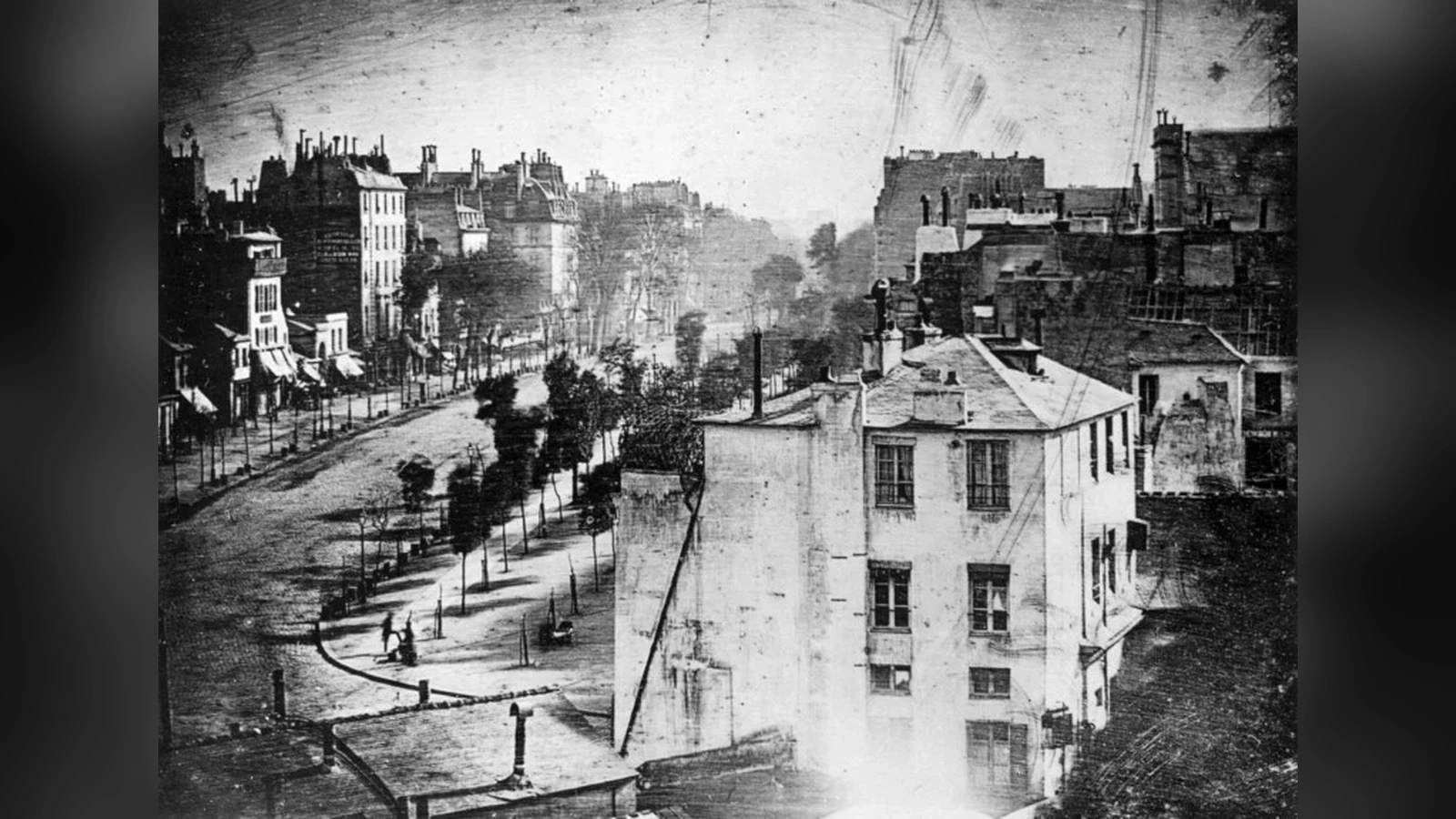
The image ranks among the earliest known photographs showing people and has become a landmark in photographic history. The claim to absolute priority remains a subject of historical discussion. The new research concerns the figures’ location; their identities remain unknown.
The image survived through a reproduction
Daguerre presented the plate to Ludwig I of Bavaria in 1839. The original, held by the Bavarian National Museum in Munich, suffered severe damage from humidity and an inappropriate conservation treatment. Familiar reproductions are based on a photographic copy from the 1930s associated with historian Beaumont Newhall. The search for that copy’s negative continues.
The plaque forms part of the celebrations marking 200 years of photography, bringing an everyday scene from 1838 into today’s public space.
What we think
If we find ourselves at Place de la République, this small stop is worth making. We can look at the photograph and then at the space around us, trying to connect the scene to a real distance and a real position. It is an appealing way to revisit an image we are used to seeing in books.
One particularly photographic detail stays with us: the exposure time determined which part of everyday life would reach us. When we look at that apparently empty street, we need to remember how much movement could have existed beyond what the plate managed to retain.