Summary
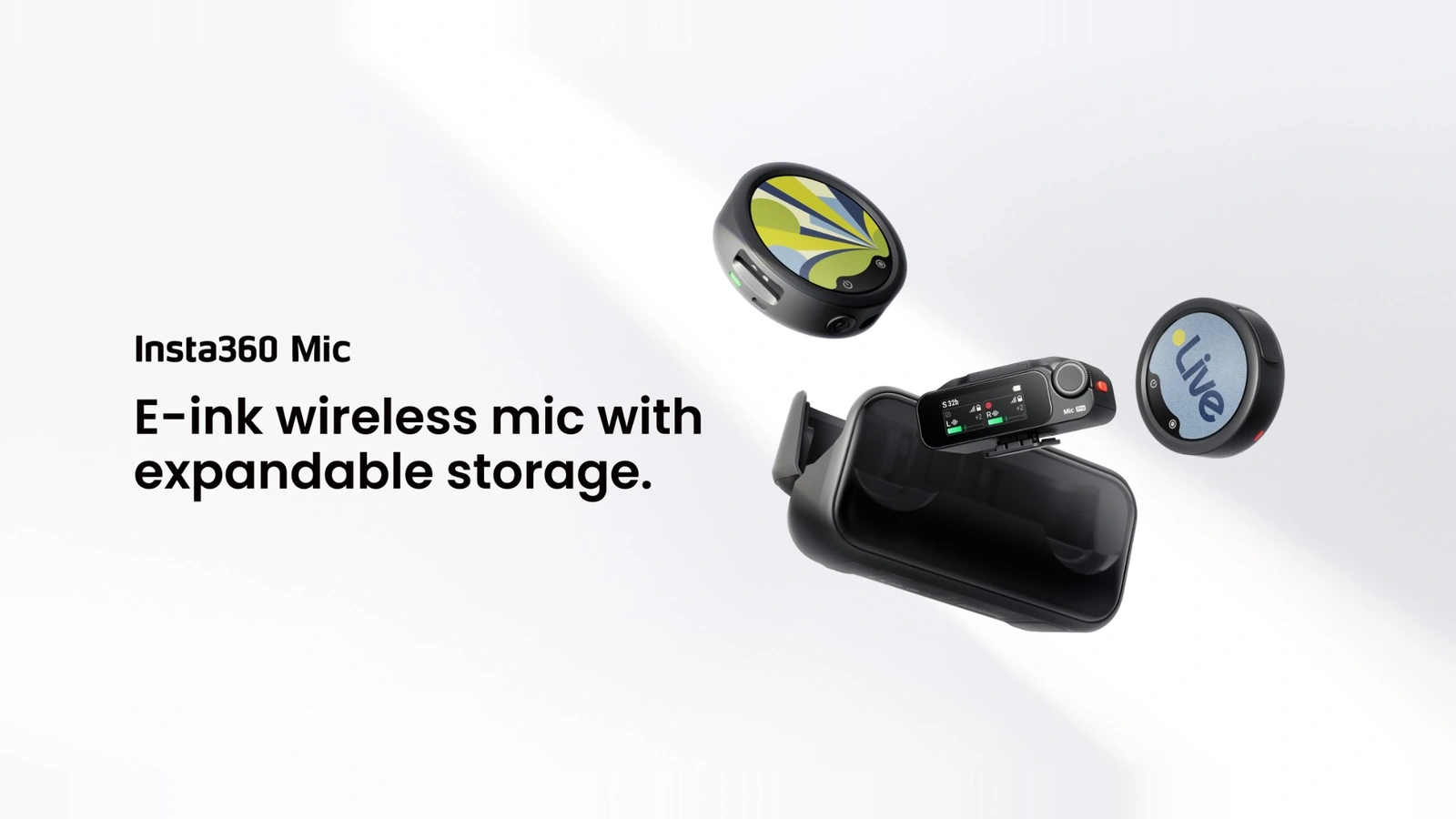
Insta360 has introduced Mic, a new wireless microphone with a customizable E-Ink display and local 32-bit float recording to microSD, with the two-transmitter kit priced at US$249.99, US$80 below the equivalent Mic Pro kit.
The model sits between Mic Air and Mic Pro and goes on sale on October 22, 2026. Removable media changes how recordings are managed, while a simpler microphone design comes with longer rated battery life.
microSD changes how recordings are stored
Each transmitter has a microSD slot instead of the Mic Pro’s 32GB of built-in memory. With a card inserted, it can operate as a standalone recorder or keep a local copy of audio sent to the camera. The card is sold separately.
Internal recording supports 24-bit and 32-bit float, with a new file created automatically every 30 minutes. The latter provides more room to adjust levels in post and applies exclusively to files recorded on the transmitter; selecting it does not turn the wireless feed to a camera into 32-bit float audio.
Without a microSD card, Mic still transmits audio through its receiver or a compatible direct Bluetooth connection. Local files can be exported by connecting the transmitter to a computer or phone over USB-C.
What stays and what changes from Mic Pro
The 1.22-inch color E-Ink display remains, allowing a logo, name or other graphic to be uploaded through the Insta360 app. A clip or magnet provides different ways to attach the transmitter to clothing.
The main audio capture difference is a single omnidirectional microphone, replacing the three-microphone array and selectable pickup patterns of Insta360 Mic Pro. A dedicated AI/NPU chip handles noise reduction, alongside two automatic gain modes and three voice tone presets.

Up to four speakers on one receiver
One receiver supports up to four transmitters, including a mix of Mic and Mic Pro units. Multicamera productions can also use two transmitters with up to four receivers, distributing the same audio to several camera bodies.
Four independent output channels require select compatible Sony cameras and the official Camera Adapter, sold separately. In stereo output with more than two transmitters, TX1/TX3 are combined on the left channel and TX2/TX4 on the right. The receiver also supports timecode input and output for synchronization; Insta360 excludes the US market from this feature.
Connecting to a camera or phone
Direct Connect delivers 48kHz audio without a receiver to X6, X5, Luna Ultra, Luna Pro, GO Ultra and Ace Pro 2. Insta360 X6 and Luna cameras support two directly connected transmitters. Over Bluetooth, the transmitter can also start and stop recording on a compatible Insta360 camera.
Other cameras and smartphones use the receiver, USB-C adapter or 3.5mm cable. Direct Bluetooth pairing with a phone works with third-party apps at 16kHz and does not support the phone’s native camera app.
Up to 13 hours per transmitter
Insta360 rates each transmitter for up to 13 hours, extending to 34 hours with the charging case, compared with 10 and 30 hours respectively for Mic Pro. Mic’s figures were measured with internal recording and noise cancellation switched off.
The quoted maximum range of 400 meters applies to transmitter-to-receiver operation in open, unobstructed conditions without interference. Insta360 quotes approximately 100 meters for direct Bluetooth pairing with X5 under comparable conditions.
More information here.
Price and availability
Insta360 Mic is available from October 22, 2026 through the official store, Amazon and authorized retailers. Announced US prices are:
| Package | US price |
|---|---|
| One transmitter | US$79.99 |
| One transmitter and one receiver | US$139.99 |
| Two transmitters, one receiver and charging case | US$249.99 |
The US$80 difference applies to the two-transmitter kit compared with the equivalent US$329.99 Mic Pro kit. An official European price for the new Mic was not found.
What we think
For interviews and small crews, being able to swap a card rather than offload built-in memory is useful. We can hand over one shoot’s recordings and continue on another card, keeping jobs separate. That makes checking the card and enabling local backup part of the routine before rolling.
Choosing between Mic and Mic Pro largely depends on how the transmitter will be used. If it stays on the speaker and we want a local backup file, the more affordable Mic makes sense. Selectable pickup patterns or stereo internal recording still give the Pro a specific role for creators who use those features.
For group shoots, we would check the signal path to the camera first: the number of connected transmitters and the number of independent recorded channels are separate setup decisions. Compatibility with existing Mic Pro transmitters also lets a system grow gradually without buying another complete kit.