Summary
- GSC president Giorgos Frentzos discusses the Greek Society of Cinematographers, founded in 2012 and now comprising 54 regular members.
- He describes the film-camera workshops completed by 87 trainees and the importance of hands-on education.
- The interview covers the GSC Awards, IMAGO membership and recognition of cinematographers as creative contributors.
- Frentzos also discusses the Society’s Thessaloniki event and plans to train DITs and colorists.
The Greek Society of Cinematographers (GSC) was founded in 2012 to bring professional directors of photography closer together, encourage collaboration and promote their creative contribution to cinematic images.
Today GSC has 54 regular members and runs film workshops, masterclasses, cinematography awards and international collaborations through IMAGO.
In this interview with PTTL, GSC president Giorgos Frentzos discusses the Society’s history and work, cinematographers’ professional rights, the importance of hands-on education and its priorities for the coming years. More information about its members and activities can be found on the official GSC website.
The interview
How did the idea of the Greek Society of Cinematographers arise, who drove the initiative, and when was GSC officially formed?
The fertile exchange of ideas and the determination to tackle together the many problems facing the cinematography profession were among the founding principles of the Greek Society of Cinematographers (GSC). Earlier attempts to establish similar associations of directors of photography had not succeeded, but they made clear the common wish among Greek DoPs to build a collective that would bring them closer and strengthen them professionally and artistically.
2012 was the year we finally managed to set aside competition among ourselves, overcome our professional isolation, put our individual egos aside and give prominence to the “we”. In the years that followed, when GSC had weathered struggles and storms and grown from a group of friends into an organization to be reckoned with, that established sense of community kept us active and united, despite the crises and the loss of members we experienced. The road was never smooth or easy. At the same time, we ensured that nobody’s individuality, as a professional or a creator with a distinct body of work, was ever called into question.
What needs in Greek cinema did the Society originally seek to address, and how have its aims changed since then?
Before GSC was created, we Greek directors of photography rarely came into contact with one another. We might meet at a festival, but even then the atmosphere was competitive. We needed uninterrupted, collegial contact: to help each other and exchange opinions and knowledge. We believed that this would raise the standard of cinematography and firmly establish its importance to the aesthetic and creative side of a film.
After the Society was founded, our early meetings centered on screenings at the Greek Film Archive, technical tests of new cinema equipment, and events and cinematography award ceremonies at film festivals.
As the years have passed, we have continued working toward the aims set out in our Articles of Association, with particular emphasis now on the education of our younger and future colleagues.
How many members does the Society have today, which professions does it include, and what are the conditions for joining? What does a cinematographer, established or emerging, gain from membership?
Our Society has four distinct membership categories: Honorary, Regular, Candidate and Associate.
Our community currently has 54 Regular Members, all of whom are active cinematographers and directors of photography. Admission to this category is subject to particularly strict qualitative and artistic criteria.
Candidate Membership, by contrast, is designed for emerging creators taking their first steps in the profession.
Associate Membership is open to any professional in the broader audiovisual sector whose specialization is directly or indirectly connected with cinematography and the creation of moving images.
Being part of GSC gives our members the opportunity to follow and take an active part in all our activities and events. For a detailed account of the membership requirements, please see the Society’s Articles of Association: https://gsc.com.gr/katastatiko/
Does GSC focus mainly on the artistic and technical advancement of cinematography, or does it also address professional working conditions, rights and the production environment in Greece?
The Greek Society of Cinematographers was founded along the lines of established international organizations, such as the American ASC and British BSC. Its core statutory objectives include promoting the art of cinematography, securing institutional recognition for the DoP’s role, and protecting their intellectual property rights. At the same time, we work to safeguard high standards in the presentation of audiovisual works, consistently seeking constructive cooperation with the relevant organizations.
GSC is strongly outward-looking and is an active member of IMAGO, the international federation bringing together more than fifty cinematographers’ societies worldwide. Our regular participation in the federation’s international conferences allows us to help shape discussions about working conditions around the world, copyright and the profession’s contemporary challenges.
Workshops and masterclasses are an important part of GSC’s work. How are they planned, what response have they received, what partnerships exist with film schools, and how can an emerging filmmaker who is not yet a member participate?
One of the Society’s fundamental statutory aims is the continuing education of its members, as well as other specialists whose work is directly or indirectly related to cinematography. Today more than ever, training new professionals is an urgent priority. The Greek Society of Cinematographers has therefore taken an active role by planning and delivering a series of educational initiatives.
GSC has taken a decisive step to strengthen the domestic film industry through an innovative series of professional, hands-on workshops. These sessions, with a high technical and educational standard, were designed to bridge the gap between theoretical knowledge and the demanding requirements of contemporary international productions.
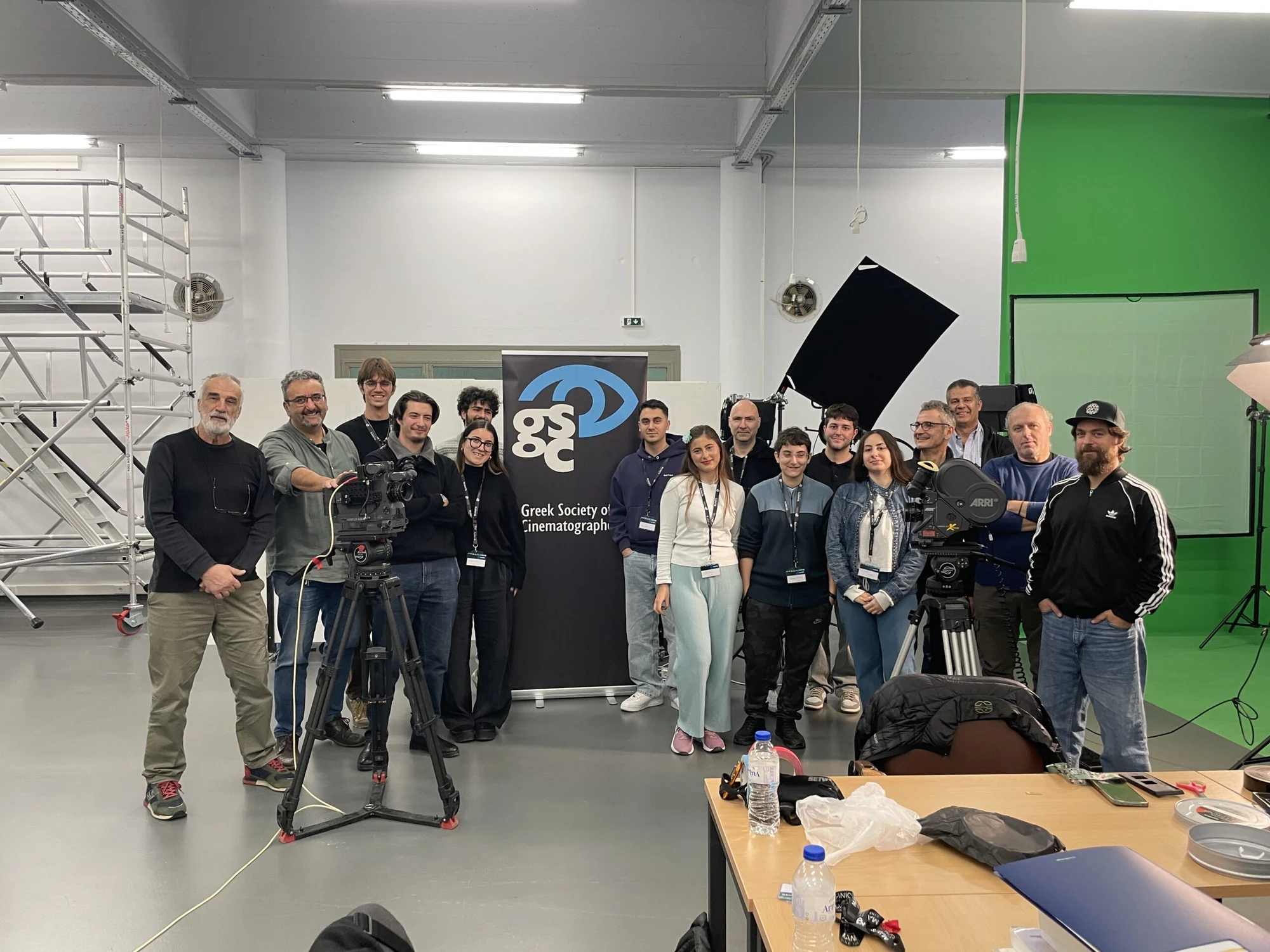
We have completed a training program devoted specifically to film-camera assistants. This is a crucial specialty on any film set, calling for absolute precision, composure and an in-depth understanding of equipment.
The workshops were conceived around four main principles:
Immediate and Lasting Results: We wanted to give participants the greatest possible immediate benefit, while equipping them with skills that would remain valuable throughout their careers.
The Return to Film (35mm and 16mm): Despite the dominance of digital media, film remains, in our view, the epitome of the cinematic craft. The workshops provided specialist training in both professional formats used internationally, 35mm and 16mm.
Comprehensive Training for First and Second Assistants: The program addressed both levels of the camera-assistant profession, preparing both first and second assistant camera operators.
A Link to the Real Market: Training was based on equipment that is actually available in Greece and at the same time fully meets international standards.
The response from the community was remarkable. The workshops took place over approximately a year, giving trainees enough time to absorb the material and practice. A total of 87 participants successfully completed the classes.
An undertaking on this scale calls for strong partnerships. The second cycle of workshops was organized with the institutional cooperation of EKKOMED (the Hellenic Film and Audiovisual Center – Creative Greece), whose involvement as Institutional Partner emphasized the significance of this initiative for Greece’s audiovisual industry.
Just as essential to the program’s success and quality was the substantial practical support of GSC’s sponsors, who backed the Society’s vision of continually improving film education in Greece.
With this cycle completed, GSC has shown that investing in people and specialist knowledge is fundamental to an outward-looking, competitive Greek film industry.
One of the workshops was held at the University of Athens’ Department of Digital Arts and Cinema in Psachna, Evia.
For two days, the Greek Society of Cinematographers worked with the department’s president, Professor Ioannis Skopeteas, to introduce students at the school to the “magical world” of film.
A similar visit to the film school in Thessaloniki remains pending, through no fault of our own.
One of our latest masterclasses was given by cinematographer Lol Crawley BSC, ASC on Sunday, May 31, 2026, in the packed main auditorium of the Greek Film Archive. Recently honored with an Oscar and a BAFTA for The Brutalist, the cinematographer held the audience’s attention for more than two hours. The discussion was expertly moderated by journalist and film critic Poly Lykourgou (Flix.gr), whose perceptive questions and observations led Crawley into a detailed exploration of his creative career.
Lol Crawley shared rare behind-the-scenes stories from his work with leading directors and analyzed his visual approach to memorable scenes, focusing on the art of shooting on film.
All the activities mentioned above were open to the public.


How familiar are young audiovisual professionals with GSC’s work, and are there plans for more events and workshops outside Athens?
Over time, we believe we are gaining greater participation, recognition and trust.
For better or worse, audiovisual production is centered in Athens, and so are most of the people who work in it. It is therefore natural for much of our activity to take place here, although we are seeking more opportunities outside Athens through regional festivals.
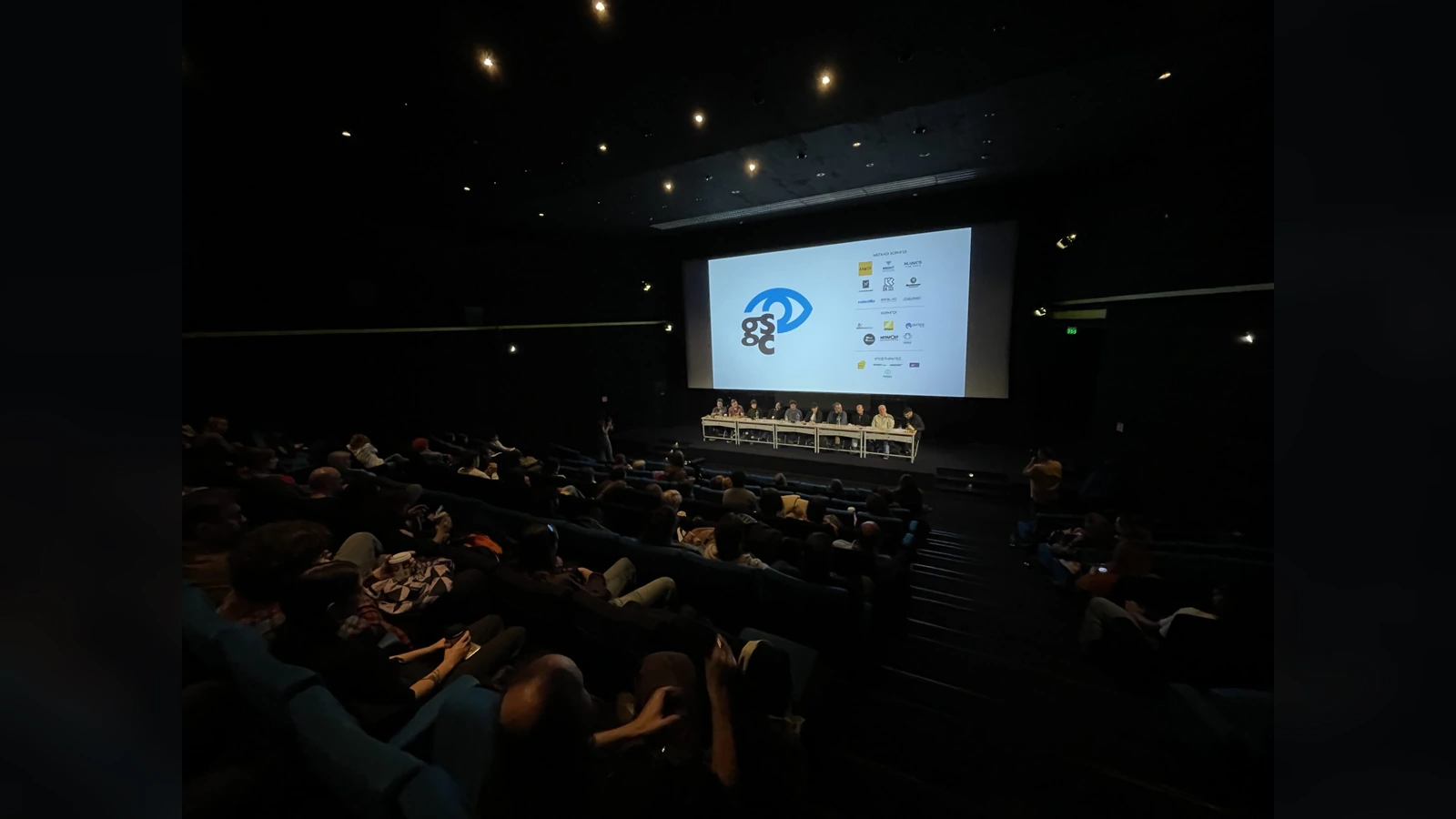
In Thessaloniki, as part of the 67th Thessaloniki International Film Festival, we will host an open discussion entitled “Cinematographers Illuminate Greek Cinema”. Its purpose is to invite the audience behind the cameras and create an opportunity to speak and interact directly with the people who shape the images.
The panel will feature established cinematographers whose films are included in this year’s official festival program. Film critic Poly Lykourgou (Flix.gr) will moderate the public discussion. It will be held in Greek, with simultaneous interpretation into English available.
The event will take place in the Pavlos Zannas auditorium on Friday, November 13, 2026, at 11 a.m.
During 2026 we are also preparing a camera test, the results of which we will screen, present and discuss with interested participants.
In early 2027, responding to the needs of the domestic market, we plan a new specialist workshop for Digital Imaging Technicians (DITs) and colorists.
How were the GSC Awards established, on what criteria is a film’s cinematography judged, and how does the selection and awards process work?
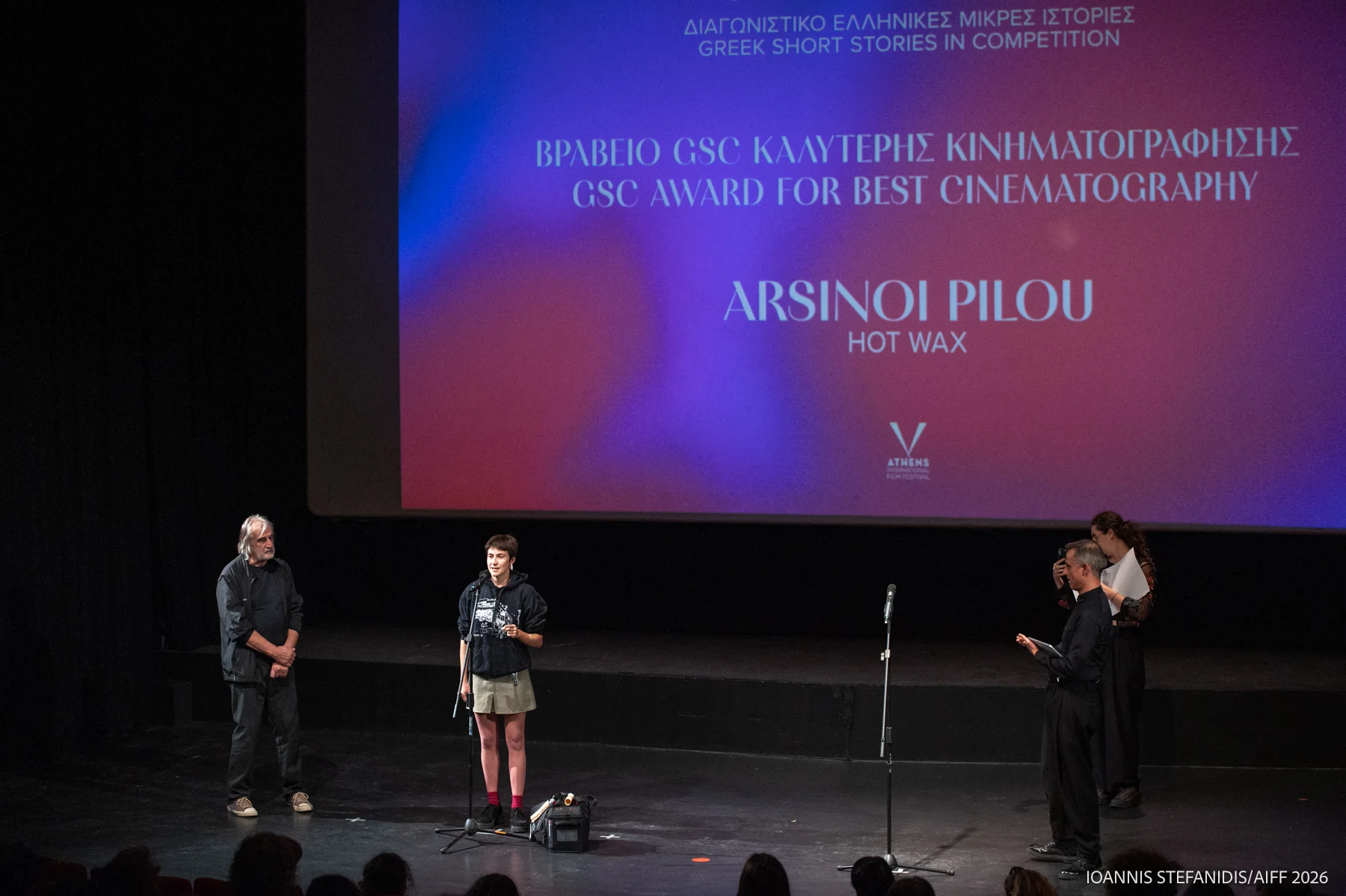
The GSC Award for Best Cinematography began in 2016 and soon became an annual institution. Eligible participants include Society members, regardless of the production on which they worked, as well as Greek cinematographers who are not members and international cinematographers who have worked on a Greek production.
The need to reward and showcase the work of both new and experienced cinematographers in the particularly demanding short-film format led us to introduce the GSC Short Film Award in June 2026.
We believe it matters that we can watch and assess one another’s films and have an opportunity to meet and discuss them at the awards ceremony. It also matters that the Best Cinematography Award is decided by people who understand visual storytelling, giving it the standing it deserves. For these reasons, all Regular and Honorary GSC Members take part in the assessment and voting for the GSC Award.
Do you believe that cinematographers in Greece are sufficiently recognized as creative partners in shaping a film’s visual identity? Have the awards helped change that perception?
Within our immediate professional circles, our contribution is taken for granted. For the wider public and often in broader cultural discussion, however, filmmaking continues to be associated almost exclusively with directors and actors. A director of photography is not simply a technician following instructions; they are the person who translates the emotion, style and screenplay into light and image.
We believe that, as the years pass, recognition of our artistic contribution and our role in co-creating a film’s visual identity is steadily growing.
Institutions such as the GSC Awards, the Hellenic Film Academy awards and international film awards help in several ways:
• They bring our profession into the spotlight, giving audiences and critics a chance to focus on and appreciate a film’s visual storytelling.
• They act as a mark of quality, adding to a professional’s standing and helping them seek better conditions and greater artistic freedom on future projects.
• They motivate a new generation by showing that dedication to the craft of moving images is recognized and rewarded.
Awards alone, however, are not enough. Recognition is earned every day through continuing information, openness and public discussions, such as those organized by GSC, which teach audiences to look beneath the surface of the cinema screen.
What does GSC membership in the international federation IMAGO mean in practice for Greek cinematographers, and what opportunities does this connection provide?
GSC’s membership of IMAGO is an important institutional and artistic milestone, connecting Greek directors of photography to the international cinematography community.
In practice, it is a bridge to the wider world, giving Greek creators tangible advantages and opportunities:
• GSC representatives actively take part in IMAGO’s Annual General Assemblies (IAGA), including the latest gathering in Vienna, working alongside leading societies such as ASC, BSC and AFC to help shape international trends and policies in the profession.
• It makes it easier to communicate with colleagues overseas and broadens the professional network of Greek cinematographers interested in international productions and co-productions.
• IMAGO’s platforms, including social-media takeovers, articles and newsletters, bring the work of Greek cinematographers to a large international audience.
• Greek DoPs gain opportunities to participate in international panels, committees and even urgent international initiatives within the profession.
• IMAGO campaigns internationally to have the cinematographer recognized as a co-author of a film. GSC’s participation strengthens Greek professionals’ positions and their legal and employment-related arguments in domestic and European negotiations.
• Sharing information about working conditions, working hours and safety on sets in other countries helps us adopt best practices in Greece as well.
How does the Society use events such as the Thessaloniki International Film Festival to bring its members’ work to a wider audience?
Looking at just the past five years, our consistent cooperation with and participation in the following events is worth noting:
• The Thessaloniki International Film Festival (TIFF), where we organize introductions to participating cinematographers and DoPs, conversations with the public, and cinematography seminars for students and general audiences.
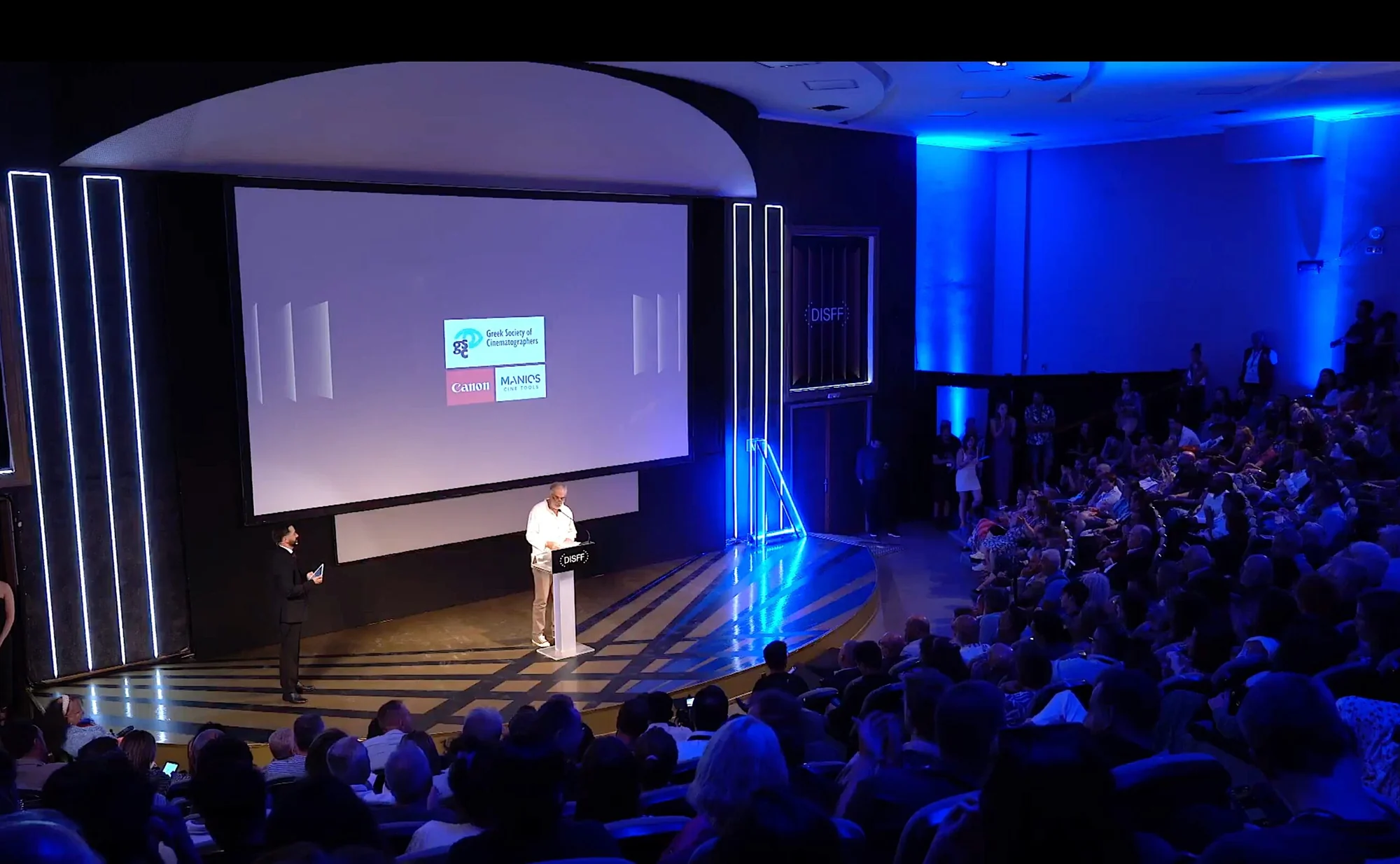
• The Drama International Short Film Festival (DISFF), where we present an annual GSC commendation to an emerging cinematographer. Our activities there have included a theoretical and practical workshop on photochemical cinematography, using film, in 2025.
• Athens International Film Festival (AIFF), known as Opening Nights, where we present the GSC Award for Best Cinematography.
• The “Theodoros Angelopoulos” International Short Film Festival, where we present a GSC Best Cinematography Award and host masterclasses with our members, including A. Sinanos, D. Katsaitis, G. Frentzos and G. Karvelas.
What are the current Board’s main priorities for the years ahead?
GSC’s future is directly tied to the future of Greek cinema itself. We directors of photography are known, at least on set, for our calmness and optimistic outlook. As long as cinema continues to exist, whether in theaters—which, sadly, are becoming fewer—in the growing number of streaming platforms or in packed festival auditoriums, the Society will remain present and active.
The Greek Society of Cinematographers began, and remains, a group of professionals, colleagues and friends who love what they do. Different generations have come together to reconsider their relationship with moving images, keep up with technological developments and exchange experiences.
We will continue working together on feature films, short films, fiction and documentaries, television series and theater productions.
We will maintain contact with comparable societies abroad and continue participating in festivals, events and discussions. Above all, we will stand by our younger colleagues as they find their feet.
The Greek Society of Cinematographers is, and will remain, open to everyone.
Can you share a specific example of how solidarity among GSC members has made a real difference to a cinematographer or production?
Behind our professional identity is always the human side of the Society, expressed through practical solidarity. When a colleague became ill and could no longer work, our members came together to support him.
The Society organized a special photography exhibition and donated all proceeds from sales of the works to help him financially. Through this effort, and with the invaluable assistance of our sponsors, we stood by him and offered every support we could at a time of great need.
How important is the choice of cameras, anamorphic or spherical lenses, and LED lighting in shaping a cinematographer’s personal visual signature today?
Choosing the right “tools” is certainly important if a cinematographer is to serve the needs of a screenplay.
But they are always a necessary condition, not a sufficient one, for an artistic result.
For many of us, choosing the right colleagues in the various departments is even more important: it makes the work faster, more efficient and more enjoyable. Cinema and visual storytelling have existed for 130 years. A camera, a lens and three lights may still be enough to shape a cinematographer’s personal “visual signature” today.
How do you see filmmaking technology evolving, from large-format sensors and virtual production to artificial intelligence in post-production and color grading? What is GSC’s role in keeping members informed?
Cinema—and audiovisual work more broadly—and technology have always been intertwined. No cinematographer can therefore disregard technical developments that affect their work.
GSC rejects the demonization of technology, but equally avoids glorifying every new development in audiovisual production. We believe that genuinely understanding how the tools work creates the best conditions for cinematography itself to evolve.
We also believe that the best way to understand what comes “after” is sometimes to look back at what came “before”.
For all these reasons, we will continue organizing educational activities for all our members and everyone else interested.
What legacy would you like GSC to leave on Greek cinema over the next ten years?
GSC is a community of professional cinematographers and directors of photography with a clear understanding of its purpose and capabilities.
We intend to continue with the central goal of welcoming and convincing younger colleagues to join our community. We firmly believe this can only benefit our small yet remarkably significant Society. Today’s young generation of cinematographers, and those who follow them, have a Society that is here for them. Together, we can—and want to—take Greek cinematography a little higher and a little further than it is today.
Who are the members of the current Board of Directors?
Everything mentioned above would have been impossible without the close cooperation, countless hours of discussion and work, and valuable ideas of the members of our Board of Directors. I feel the need to name them and thank them publicly for their commitment, and for our shared effort to give the Society and its members the place they deserve in the film community.
Kostas Stamoulis, Member; Fotis Mitsis, Treasurer; Christos Alexandris, General Secretary; Christina Moumouri, Vice-President.
My warmest thanks!
Giorgos Frentzos, President of GSC.
Greek Society of Cinematographers — institutional biography
The Greek Society of Cinematographers (GSC) is a community of Greek professional cinematographers and directors of photography working in film production in Greece and abroad.
Established in 2012 following the model of comparable societies overseas, it is an active member of IMAGO, the International Federation of Cinematographers.
Among its statutory aims are promoting cinematography and recognizing cinematographers’ contributions to audiovisual expression; providing continuing education to its members and others interested in technical and aesthetic developments across audiovisual production, particularly cinematic images; and advancing the creative practice of cinema without an ideological, racial or religious agenda.
To pursue these aims, the Society organizes and participates in educational initiatives and seminars, tests and presents equipment from the audiovisual industry, awards cinematography prizes at film festivals in Greece and internationally, and takes part in international conferences and meetings of cinematographers’ societies.
Website: https://gsc.com.gr/
Instagram: https://www.instagram.com/gscine/
Facebook: https://www.facebook.com/greeksocietyofcinematographers/
What we think
What stands out in GSC’s story is its insistence on working together. When a director of photography talks about the importance of colleagues before discussing lenses and lighting, that is something worth remembering on every set: images are made by people who know how to work as a team.
The commitment to hands-on education is particularly valuable. The 87 people who completed GSC’s film-camera assistant workshops show a real appetite for skills that take time and practical experience to develop. Plans for a future workshop aimed at DITs and colorists bring that same approach into the needs of today’s productions.
Just as important is the effort to make cinematographers more visible to audiences. The more viewers understand who shaped a film’s light and images, the easier it becomes to appreciate cinema as a collective art. The open discussion in Thessaloniki offers a welcome opportunity to make that connection.