

Summary
- Global astrophotography competition organised by the Royal Astronomical Society.
- Entries open on 1 November 2026 and close on 15 January 2027.
- Free entry, up to 5 photographs per person and 5 thematic categories.
- The overall winner receives £2,000 worth of equipment and each category winner £500.
- AI-generated images and images taken with publicly or privately operated remote telescopes are not permitted.
Event Details
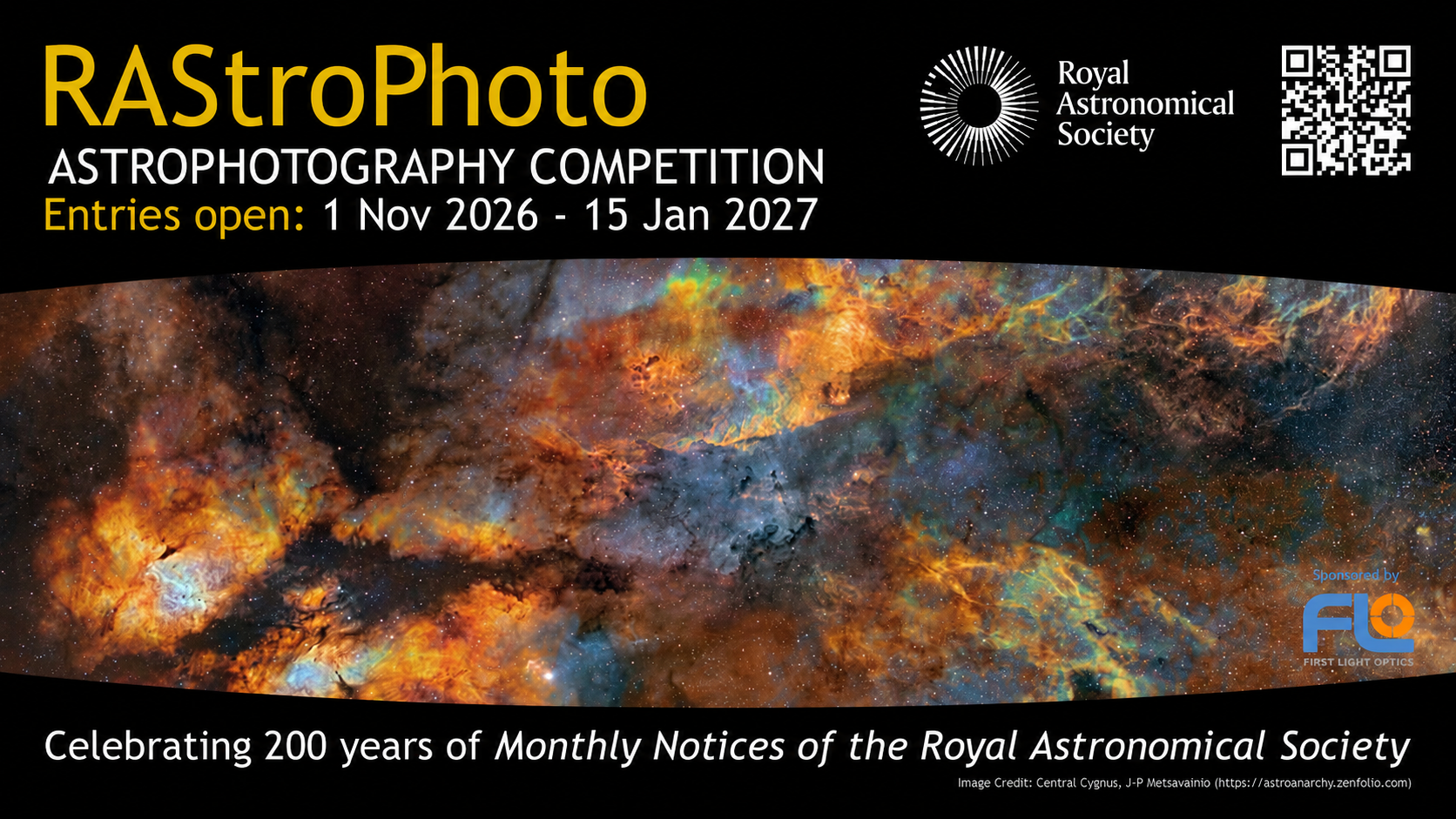
The Royal Astronomical Society (RAS) is launching the global RAStroPhoto astrophotography competition, with free entry for photographers worldwide and five thematic categories.
The competition has been created to celebrate the bicentenary of the scientific journal Monthly Notices of the Royal Astronomical Society (MNRAS). Entries open on 1 November 2026 and close on 15 January 2027, while the winners will be announced in July 2027 at the National Astronomy Meeting and on the official competition website.
Who can enter
RAStroPhoto is open worldwide, free to enter and does not require professional equipment. Each entrant may submit up to five photographs, with each image entered into one category only.
Photographs must have been taken within five years of the competition opening date and must not have previously received an award in another competition before 1 November 2026.
The five categories
- Our Solar System: the Sun, Moon, planets, satellites, comets and asteroids.
- Deep Sky: objects beyond the Milky Way, including galaxies and galaxy clusters.
- Our Galaxy: stars, nebulae, star clusters and supernova remnants within the Milky Way.
- Earth & Space: photographs combining Earth and the night sky, including landscapes, cityscapes, aurora, the Milky Way, star trails and meteors.
- Observing Astronomers: astronomers in action, equipment, observatories and observing events.
Technical requirements and processing rules
Each file must be no larger than 10 MB, have a minimum resolution of 300 dpi and be submitted as JPEG, PNG or TIFF. Watermarks, borders and signatures are not permitted. Finalists will be required to provide RAW files or the original untouched JPEG/TIFF files.
Entries must be the entrant’s original work and must be constructed from real astronomical light captured photographically. Images taken using publicly or privately operated remote telescopes are not permitted.
Basic edits such as tone, contrast, cropping, sharpening, dodging, burning, noise reduction and minor clean-up are allowed, as are HDR, stitched panoramas, stacking and focus stacking under the competition rules. AI tools are permitted only for denoising and deep stacking. AI-generated images, composites, digital illustrations, scientific visualisations and alterations that misrepresent reality are not allowed. The rules also specifically prohibit BlurXTerminator.
Judging, prizes and judges
Entries will be judged on technique, composition, aesthetics and storytelling. The awards will include one overall winner, five category winners and five runners-up, with honourable mentions possible at the judges’ discretion.
Each category winner will receive £500. The overall winner will receive £2,000 worth of astronomy equipment from official sponsor First Light Optics. Winners will also receive a one-year Friends membership of the Royal Astronomical Society, including a free subscription to Astronomy & Geophysics.
The five judges are Chrysa Avdellidou, David Kaplan, Claudia Maraston, J-P Metsävainio and Mike Peel.
Entry dates
Entries open on 1 November 2026 at 00:00 GMT and close on 15 January 2027 at 23:59:59 GMT. Submissions must be made through the official RAStroPhoto website.
More information and the full rules are available on the official RAStroPhoto website.
What we think
RAStroPhoto stands out for combining worldwide access, free entry and clearly defined authenticity rules. Of particular interest is the explicit distinction between permitted machine-learning use for denoising/deep stacking and AI-generated imagery, which is excluded.
Frequently asked questions
When do entries open?
On 1 November 2026 at 00:00:01 GMT.
When is the deadline?
15 January 2027 at 23:59:59 GMT.
How many photographs can each entrant submit?
Up to five photographs, with each image entered into one category only.
Are AI-generated images allowed?
No. Limited use of AI tools is allowed only for denoising and deep stacking, subject to the official rules.
What is the overall prize?
The overall winner will receive £2,000 worth of equipment from First Light Optics.