

Summary
- Report URI found 188 infected Optimizely snippets associated with 178 organisations.
- The script replaced cryptocurrency addresses and could skim payment-card and browser data.
- It attempted to deliver exploit kits to iPhones and iPads, with no confirmed device-infection count.
- All identified snippets had been cleaned by late 16 November.
Visitors to websites including the BBC, CNN and Zoom were served malicious code through a service those sites normally relied on.
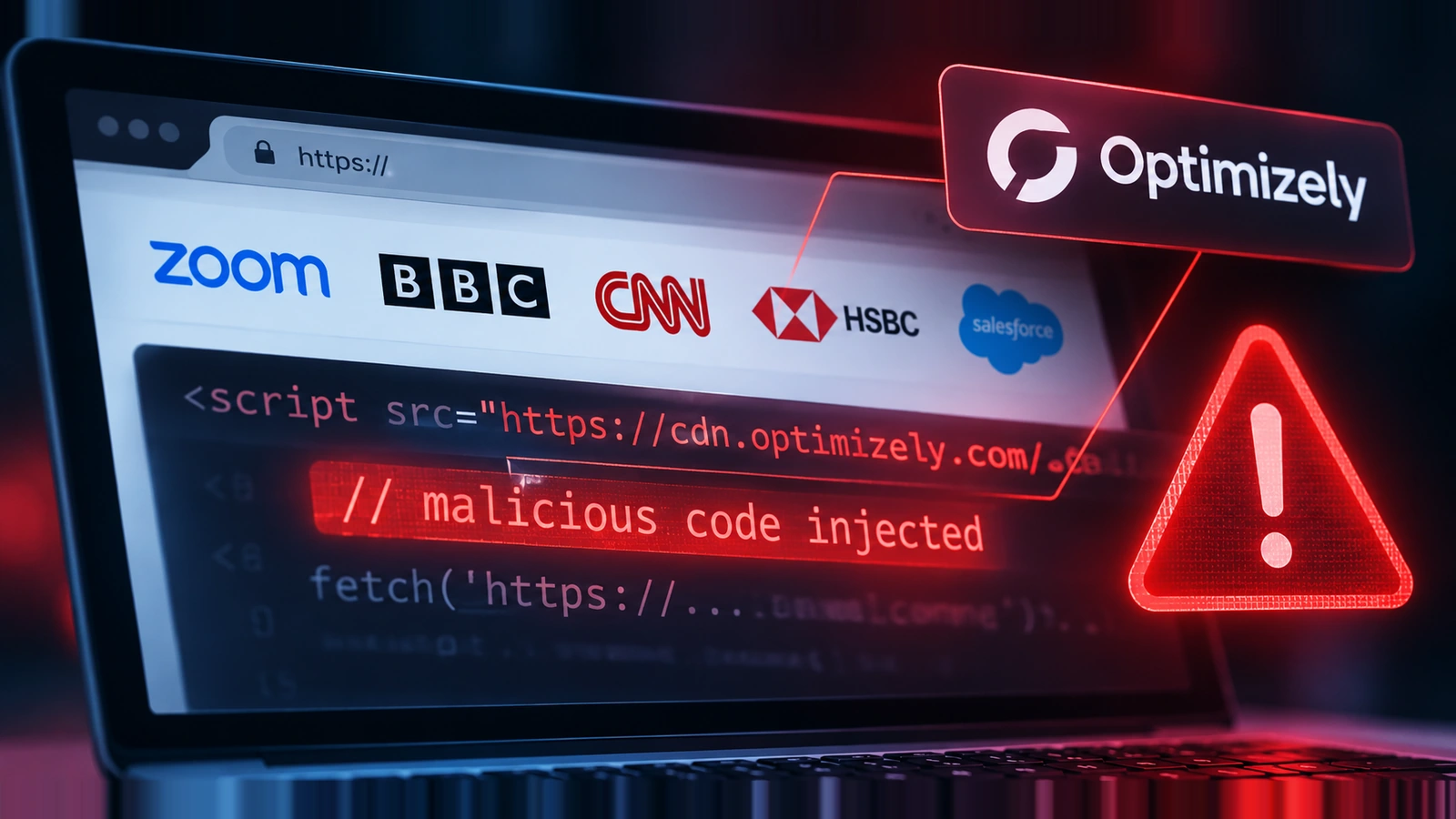
On 16 November 2026, Report URI identified 188 infected JavaScript snippets associated with 178 organisations after inspecting 1,611 Optimizely scripts. The affected organisations spanned news, banking, technology and retail, including the BBC, CNN, Zoom, Salesforce, GitLab, IKEA, HSBC and Equifax.
This does not establish that the internal systems of all 178 organisations were breached. The common point of exposure was third-party JavaScript loaded by their sites, allowing malicious instructions to run in visitors’ browsers.
How the code arrived through Optimizely
Optimizely helps organisations run website experiments and optimise pages. Customers load JavaScript from its trusted infrastructure, and a field called Project JavaScript allows custom code to run across a project. The malicious additions were inserted there, so they could reach visitors from Optimizely’s normal domain without an attacker having to alter every website’s own source code.
Report URI traced the first observed injection to a BBC snippet at 04:21 UTC on 16 November. How the attacker gained write access to so many different customer projects was still unresolved in the investigation. In an update on 17 November, the researchers said all the infected files they had identified had been cleaned by 23:11 UTC the previous day, and Optimizely had acknowledged the incident on its service-status page.
Cryptocurrency, card details and browser data
The script looked for cryptocurrency wallet addresses and replaced them with addresses controlled by the attacker, including in page content, form fields, links and clipboard operations. Later on 16 November, it gained a payment-card skimmer able to collect card numbers, expiry dates and CVVs from forms the script could read. Details entered into isolated third-party payment iframes were not accessible in the same way.
In certain circumstances, it could also transmit cookies not protected by HttpOnly, replaced wallet addresses and a screenshot of the page. Report URI found on-chain payments worth more than $7,000 to wallets associated with the attack. The number of payment cards or browser records potentially stolen is unknown.
What happened on iPhones and iPads
On Apple mobile devices, the malicious code attempted to load additional exploit chains. Researchers identified Coruna targeting older iOS 13–17 releases and DarkSword targeting iOS 18 versions. They also observed a separate device-fingerprinting route for iOS 26, not evidence of a confirmed successful exploit against that version.
Delivering an exploit does not prove malware was successfully installed on every iPhone visiting an affected site. Researchers have not published a confirmed count of compromised iPhones or iPads. The incident again underlines the importance of security updates, as did the earlier urgent iOS patch for an image-processing vulnerability.
What visitors and site operators should check
Anyone who visited an affected website on 16 November should update their iPhone or iPad to the latest available version, verify the destination of any cryptocurrency transfer and watch for unusual card activity if they entered payment details. Visiting a site alone is not proof of device compromise.
For creators handling confidential reporting material, client files or source communications, mobile-device security is part of professional practice. Apple’s notifications about targeted spyware concern a separate detection mechanism, but illustrate why higher-risk creators need clear, evidence-based security procedures.
Organisations using Optimizely should inspect custom JavaScript in their projects, review permissions and API tokens, rotate sensitive credentials when warranted, and enforce a restrictive Content Security Policy (CSP). A script coming from a trusted domain is not automatically safe.
What we think
What makes this attack so unsettling is that visitors did not need to land on an obviously suspicious page. They might simply have opened a familiar news website or an everyday service while code from a seemingly trusted supplier ran in their browser.
For photographers, filmmakers and photojournalists, a phone often holds work contacts, account access and payment tools alongside pictures and footage. Keeping the system updated, checking payment destinations and not treating a famous website as an automatic security guarantee are practical habits worth taking seriously.
There is a lesson for site owners too: third-party services need continued scrutiny rather than blind trust. The rapid clean-up is welcome, but it does not tell us how many visitors may already have been affected.
Frequently asked questions
Were all 178 organisations’ own systems hacked?
Not necessarily. The investigation confirmed malicious JavaScript in snippets used by 178 organisations, not an independent breach of each organisation’s internal infrastructure.
Was every iPhone visiting an affected site infected?
No. The code attempted to deliver exploit kits to devices running vulnerable iOS versions, but the number of successfully compromised devices has not been established.
Has the attack stopped?
According to Report URI’s 17 November update, all the malicious snippets it had identified were cleaned by 23:11 UTC on 16 November. That does not rule out consequences from earlier exposure.