


Summary
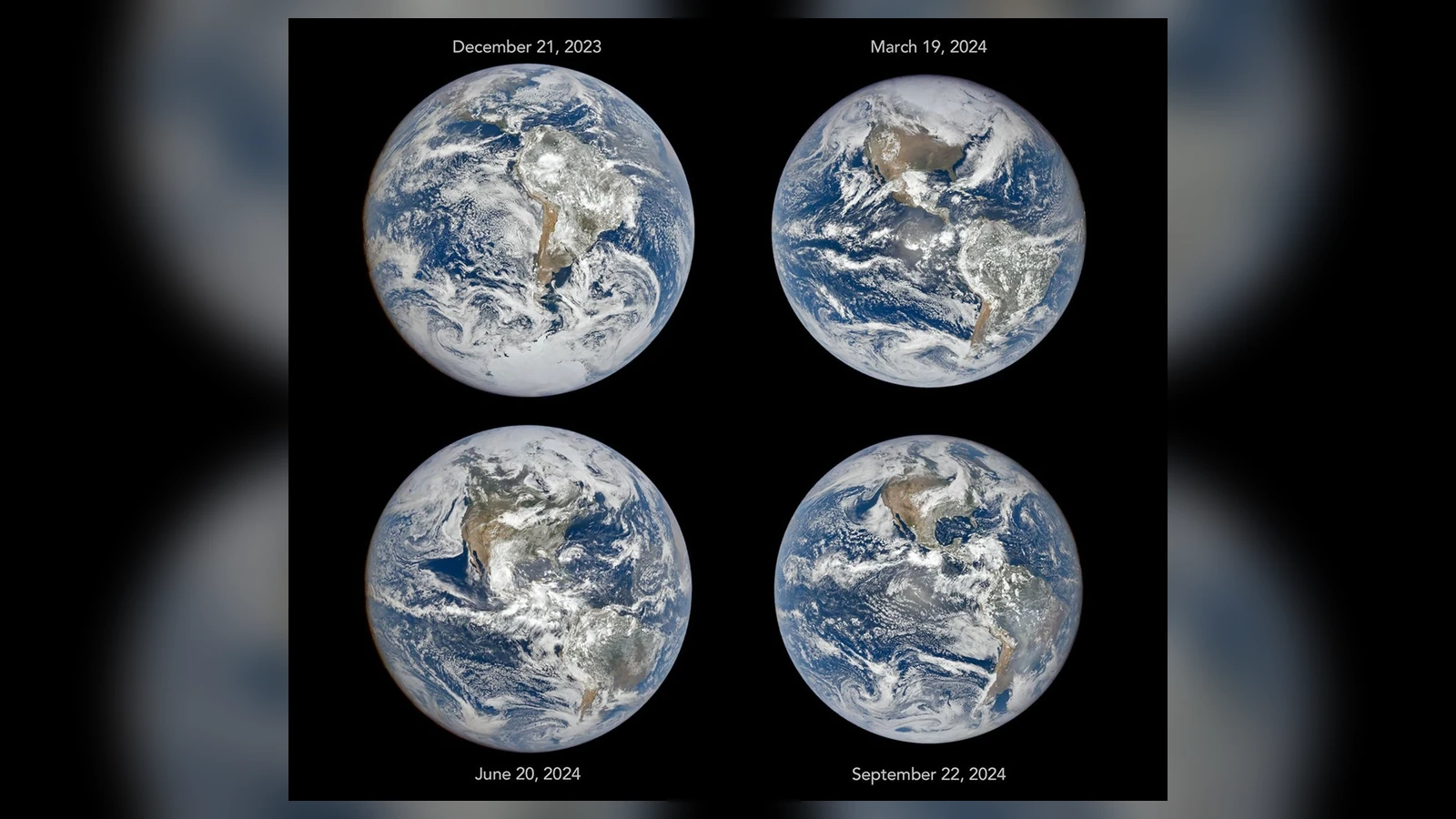
- Four NASA images show how Earth's axial tilt changes the apparent position of the continents through the seasons.
- DSCOVR's orbit also affects the apparent size and illumination of the planet's disk.
Four images of Earth captured by DSCOVR’s EPIC camera show at a glance how the planet’s axial tilt changes its appearance through the seasons.
On September 22, 2026, NASA Earth Observatory published a comparison of four views of Earth’s sunlit side, captured near the two solstices and two equinoxes. The images come from the Earth Polychromatic Imaging Camera, or EPIC, aboard the Deep Space Climate Observatory (DSCOVR).
Four moments, one planet
The composite includes images from December 21, 2023, March 19, 2024, June 20, 2024, and September 22, 2024, all taken at roughly the same time of day. The comparison makes the changing position of the continents in the frame immediately visible as the seasons progress.
In the December view, South America sits near the centre of the disk and much of Antarctica is visible, while North America is partly out of view. In June, the situation reverses: the Northern Hemisphere and North America move closer to the centre, Arctic sea ice comes into view, and Antarctica disappears from the frame.
EPIC continuously watches Earth’s sunlit side
DSCOVR operates near the Sun-Earth Lagrange point 1, between the Sun and Earth, roughly 1.6 million kilometres from our planet. From this vantage point, EPIC has an almost continuous view of the sunlit hemisphere and records full-disk images every few hours.
This perspective is especially useful because it turns a concept usually shown with diagrams — Earth’s axial tilt of about 23.5 degrees — into a direct photographic comparison. Around the solstices, it is easier to see which hemisphere is tilted towards the Sun, while the equinox views sit between those seasonal extremes.
Why Earth looks slightly smaller at the equinoxes
The four images differ not only in the apparent position of the continents. Earth looks slightly smaller in the March and September views, not because of the season itself but because DSCOVR was farther away.
On December 21, 2023, the spacecraft was 1,447,327 kilometres from Earth, compared with 1,561,901 kilometres on September 22, 2024. The difference comes from DSCOVR’s three-dimensional Lissajous orbit around the L1 region, rather than from Earth’s axial tilt.
Even the fullness of the disk changes
Orbital geometry also affects the shape of the illuminated disk. The Sun-Earth-DSCOVR angle varies from about 2 to 12 degrees, with smaller angles making Earth appear more fully illuminated and larger angles giving it a slightly more gibbous appearance, similar to a phase of the Moon.
For the September 22 image, the angle was 8.1 degrees, compared with 10.3 degrees on December 21. That subtle difference helps explain why the September disk looks slightly fuller.
More than a decade of Earth observations
EPIC’s value goes well beyond striking full-disk images. With more than a decade of data, the mission has tracked daily and seasonal cycles in vegetation, clouds, ice, snow, ultraviolet radiation, ocean colour, and aerosols.
What we think
The strength of this series lies in its simplicity: four frames are enough to make a complex piece of orbital geometry visually understandable. For photographers and image-makers, it is also a clear reminder of how dramatically a subject can change when the observer’s position changes.
Frequently asked questions
Which dates are shown in the composite?
The four images were captured on December 21, 2023, March 19, 2024, June 20, 2024, and September 22, 2024, near the two solstices and two equinoxes.
What is EPIC?
EPIC is DSCOVR’s Earth Polychromatic Imaging Camera. From its vantage point near L1, it records full-disk views of Earth’s sunlit side every few hours.
Why do the continents shift in the images?
The main reason is Earth’s axial tilt of about 23.5 degrees. As Earth moves around the Sun, the hemisphere tilted more directly towards the Sun changes through the year.
Why is Earth not exactly the same size in every frame?
DSCOVR does not remain at a perfectly fixed distance from Earth. Its Lissajous orbit near L1 changes that distance, so the apparent size of the Earth disk varies slightly.