

Summary
- Perseverance captured Earth passing behind Phobos on July 2, 2026.
- The observation was made with Mastcam-Z on the mission’s 1,907th sol.
- Earth appears in the images as a very small bright dot.
- The black background of the main composite resulted from processing designed to enhance detail.
- NASA also presented the approximate true appearance of the Martian twilight 40 minutes after sunset.
NASA’s Perseverance rover captured Earth passing behind Phobos from the surface of Mars, producing a remarkable sequence of images of the Martian sky.
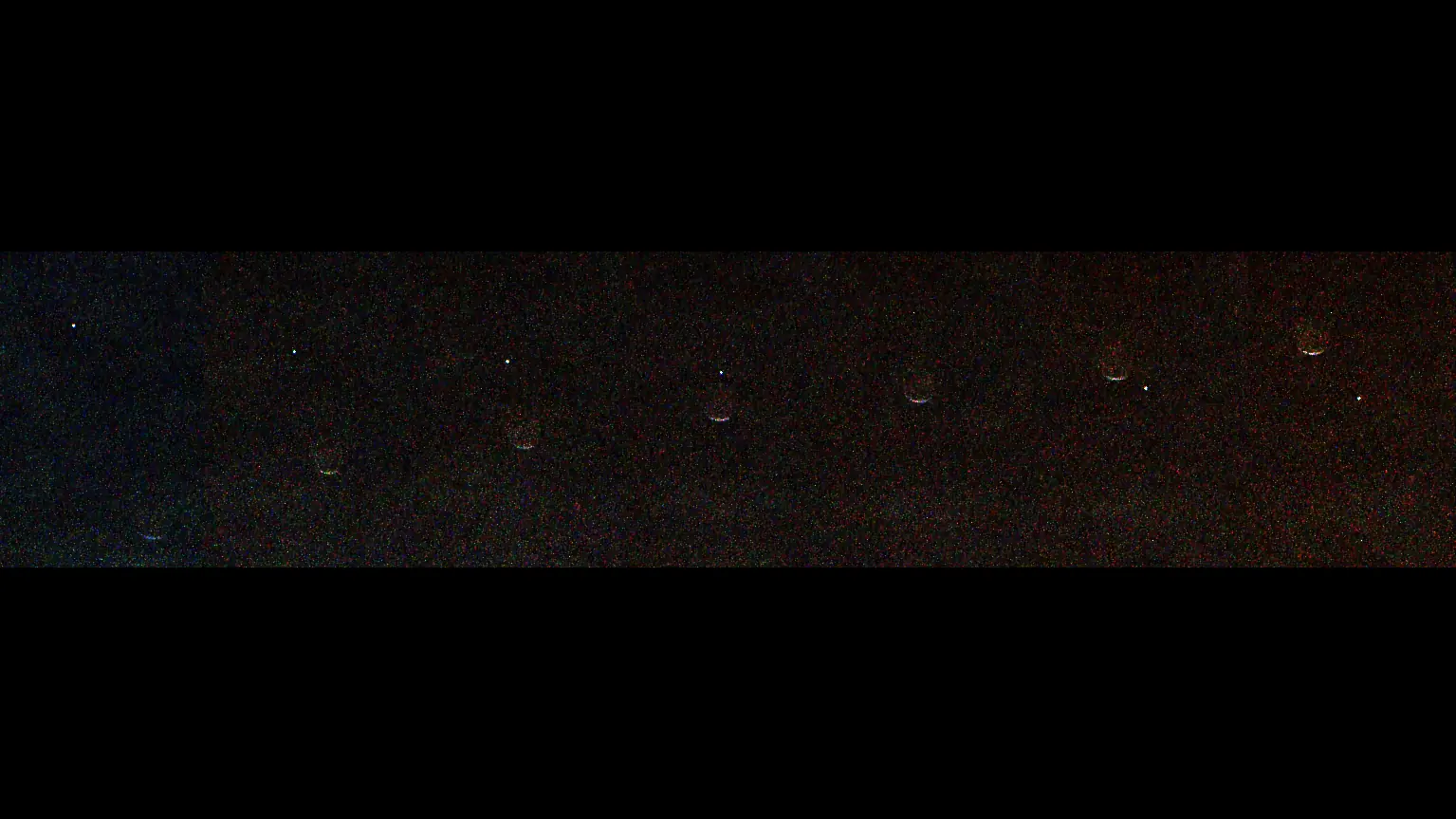
The observation took place on July 2, 2026, during the 1,907th Martian day, or sol, of the Perseverance mission, using the rover’s Mastcam-Z instrument. In the seven-image composite, Earth appears as a very small bright dot moving from the upper left toward the lower right before passing behind the Martian moon Phobos.
The image provides an unusual perspective of Earth from another planet while also highlighting Perseverance’s ability to make precise astronomical observations from the Martian surface. NASA added the material to its Photojournal on August 5, 2026.
Earth as a tiny bright dot
The main composite combines seven images captured by Mastcam-Z. Earth can be seen as a tiny luminous point, while the sequence records its apparent motion until it passes behind Phobos.
NASA notes that the black background in this particular composite does not represent the actual appearance of the Martian sky. It is the result of image processing that removed extraneous background light in order to make the details of the observation easier to see.
What the detailed Figure A composite shows
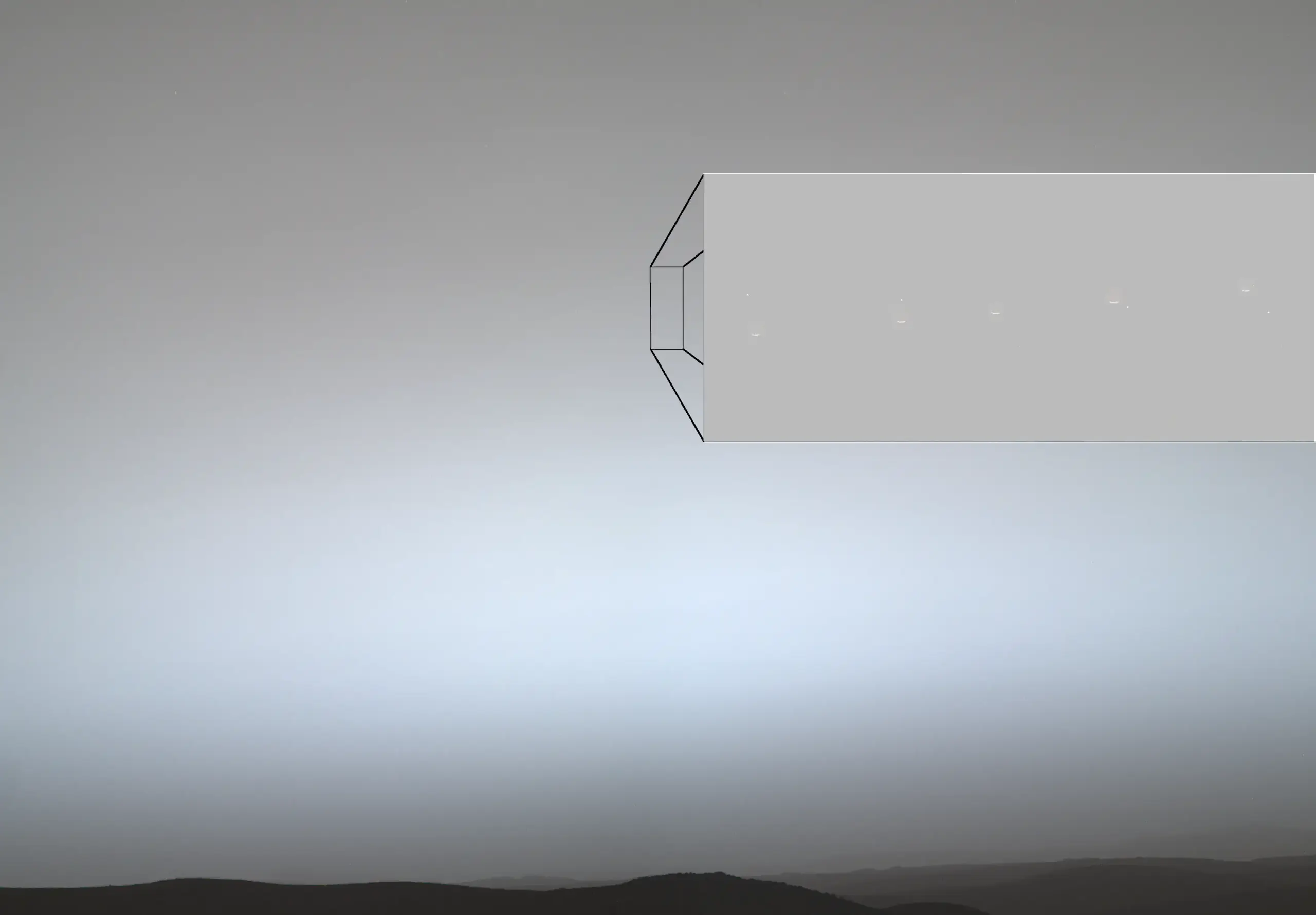
NASA also presented Figure A, an annotated composite of nine images taken on the same day. An inset in the upper-right portion uses five images to specifically show Earth passing behind Phobos.
The wider image marks the small patch of sky that was repeatedly photographed to capture the event. The individual observations are arranged chronologically from left to right, with Phobos moving upward while Earth moves downward.
The true colors of Martian twilight
One particularly interesting aspect of Figure A is its representation of the Martian sky. According to NASA, the gray coloring approximates the true colors of twilight about 40 minutes after sunset on that sol.
Closer to the horizon, where the sky is brighter, its appearance is blue-gray, while higher portions of the sky take on a more reddish-gray tone.
Figure B and the timing of the observation
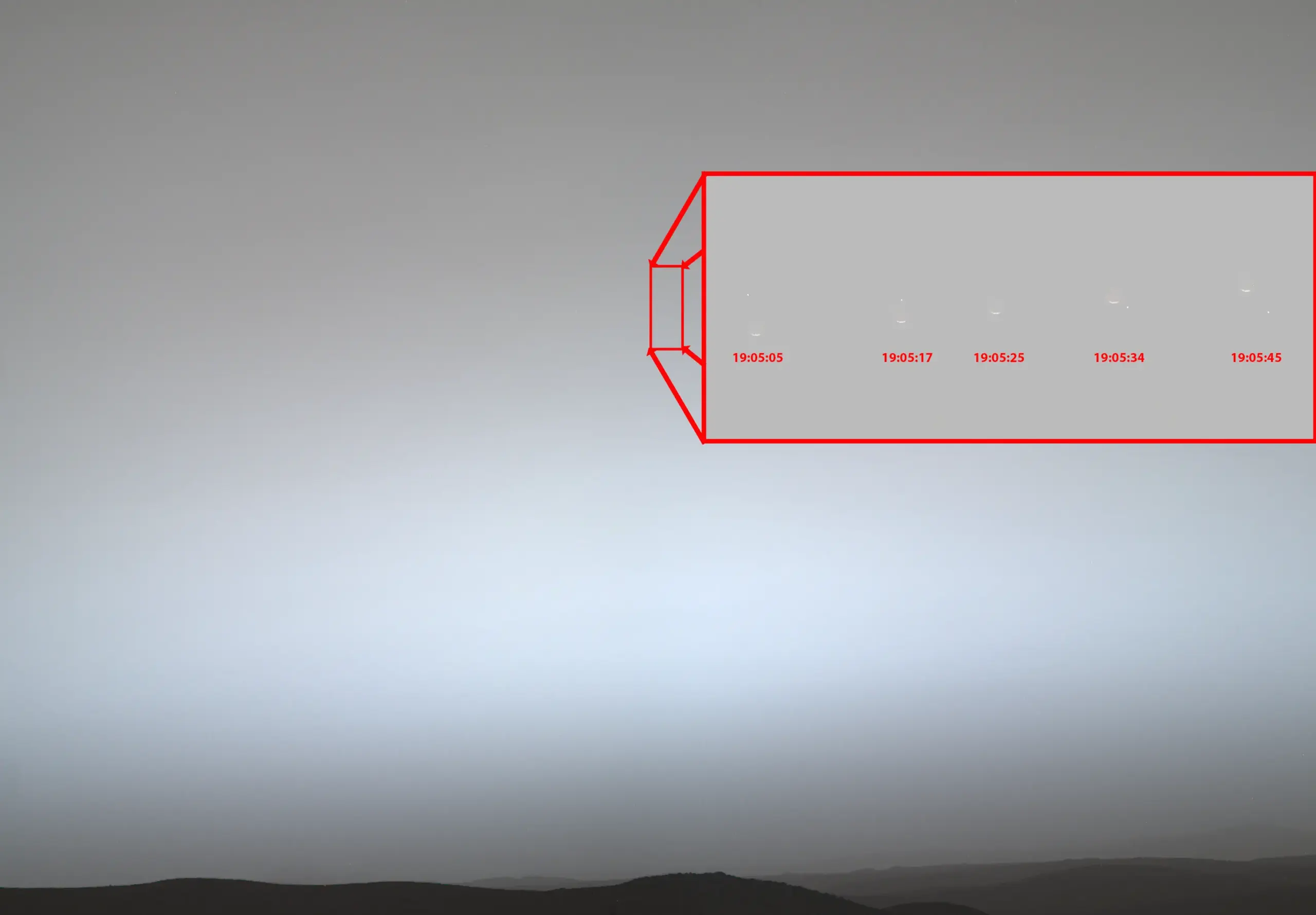
In Figure B, NASA added annotations showing the local solar time on Mars for each of the five individual images that captured Earth’s occultation by Phobos.
This allows the sequence to show not only the geometry of the event but also to place each frame accurately within the local Martian timeline.
Mastcam-Z and the Perseverance mission
NASA’s Jet Propulsion Laboratory in Southern California, managed by Caltech, built Perseverance and manages rover operations on behalf of the agency’s Science Mission Directorate as part of NASA’s Mars Exploration Program.
Arizona State University leads operations of the Mastcam-Z instrument, working with Malin Space Science Systems in San Diego on the design, fabrication, testing, and operation of the cameras.
What we think
This sequence is a striking example of how different the Solar System can look from the surface of another planet. Earth is reduced to a tiny bright point next to Phobos, while the observation also demonstrates the precision with which Mastcam-Z can monitor events in the Martian sky. NASA’s clarification about the processed black background is equally important, preventing the enhanced composite from being confused with the actual appearance of twilight on Mars.
Frequently asked questions
When did Perseverance capture Earth behind Phobos?
The images were taken on July 2, 2026, during the Perseverance mission’s 1,907th sol on Mars.
Which camera made the observation?
The sequence was captured with Mastcam-Z, the camera system mounted on Perseverance’s mast.
Why is the background of the main composite black?
The black background is the result of image processing. NASA removed extraneous background light to make details easier to distinguish.
What did the Martian sky actually look like?
About 40 minutes after sunset, the sky had gray tones, appearing more blue-gray lower down and more reddish-gray higher up.
How does Earth appear in the images?
Earth appears as a very small bright dot moving across the camera’s field of view before passing behind Phobos.