

Summary
- Roman’s Wide Field Instrument has been successfully activated in space.
- The 300MP camera captured its first photons of starlight before final focusing.
- All 18 infrared detectors are operating and cooling toward roughly -183 °C.
- Roman’s first science images remain expected in early 2027.
NASA’s Nancy Grace Roman Space Telescope has captured its first photons of starlight with the Wide Field Instrument, its primary 300-megapixel infrared camera.
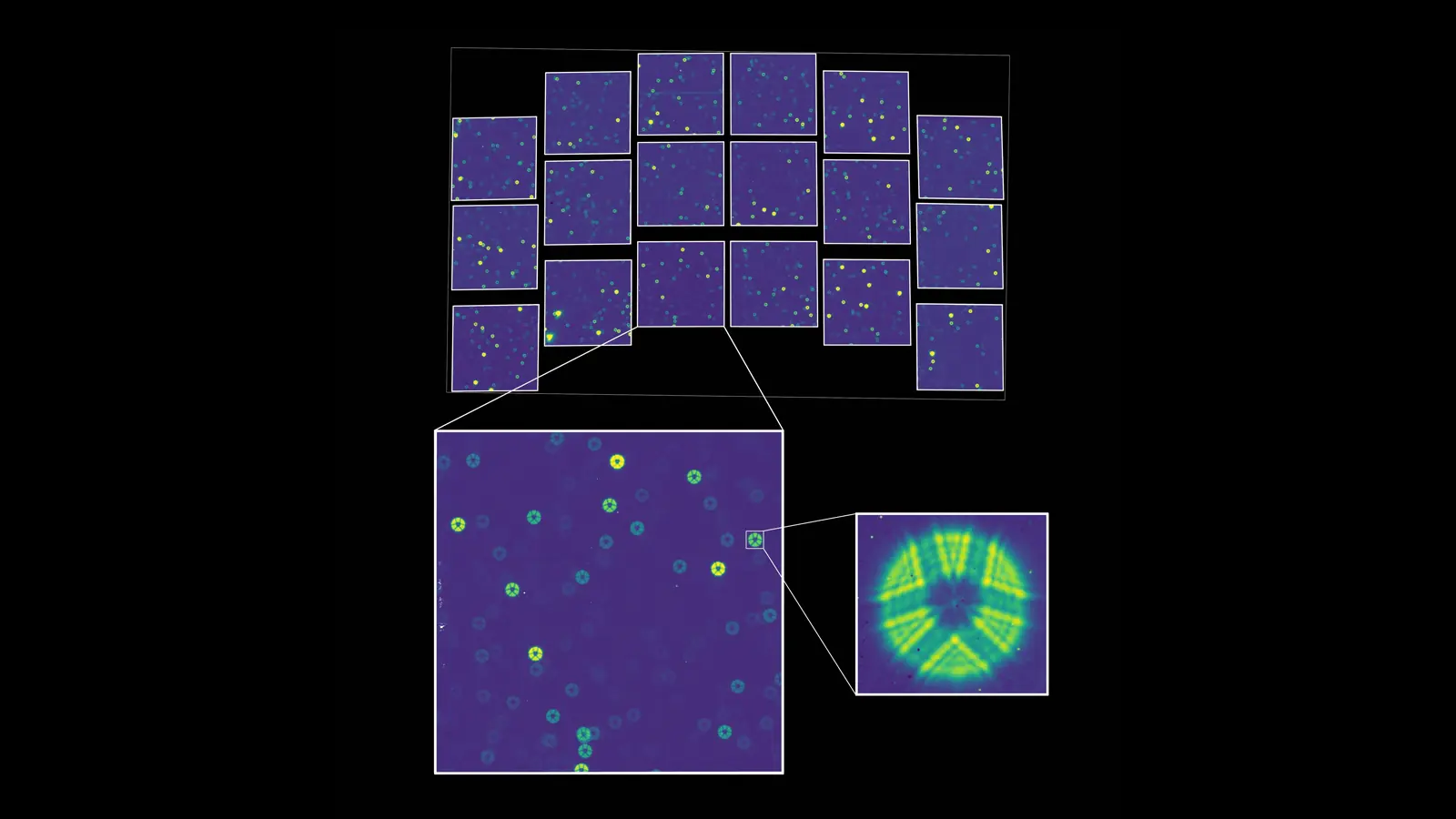
This is not yet the mission’s polished “first science image.” It is a commissioning test exposure taken with the detector array still in its launch configuration and far from best focus. That is why the stars appear as large, blurry, ring-like structures rather than crisp points of light. NASA is using the frame as a baseline for optical alignment and focusing.
The milestone comes shortly after Roman launched and began its journey toward L2, following the earlier activation of the Coronagraph Instrument.
The WFI’s first test image
NASA says the exposure records the first photons of starlight ever to reach the Wide Field Instrument in space. The image shows one detector and then zooms further into an individual star.
The strong defocus is expected at this stage. Each star’s light spreads across thousands of pixels, producing broad rings. As focusing proceeds, these distributions will contract into much sharper points and the observatory will approach its designed image quality.
18 infrared detectors and 300 megapixels
The WFI uses 18 infrared detectors that together form a roughly 300-megapixel camera for wide-area sky surveys. Their combined sensing area is about the size of a laptop screen, unusually large for a space-based science instrument.
Each exposure will cover a patch of sky larger than the apparent size of the full Moon. NASA says Roman’s field of view is at least 100 times larger than Hubble’s widest imaging while maintaining similar sensitivity and infrared resolution.
Activation followed detector cool-down
Before activation, the WFI spent 10 days drying out and decontaminating with its detectors held near -65 °C. On September 11, heaters were switched off and the instrument cooled to around -143 °C, allowing the 18 detectors to be activated.
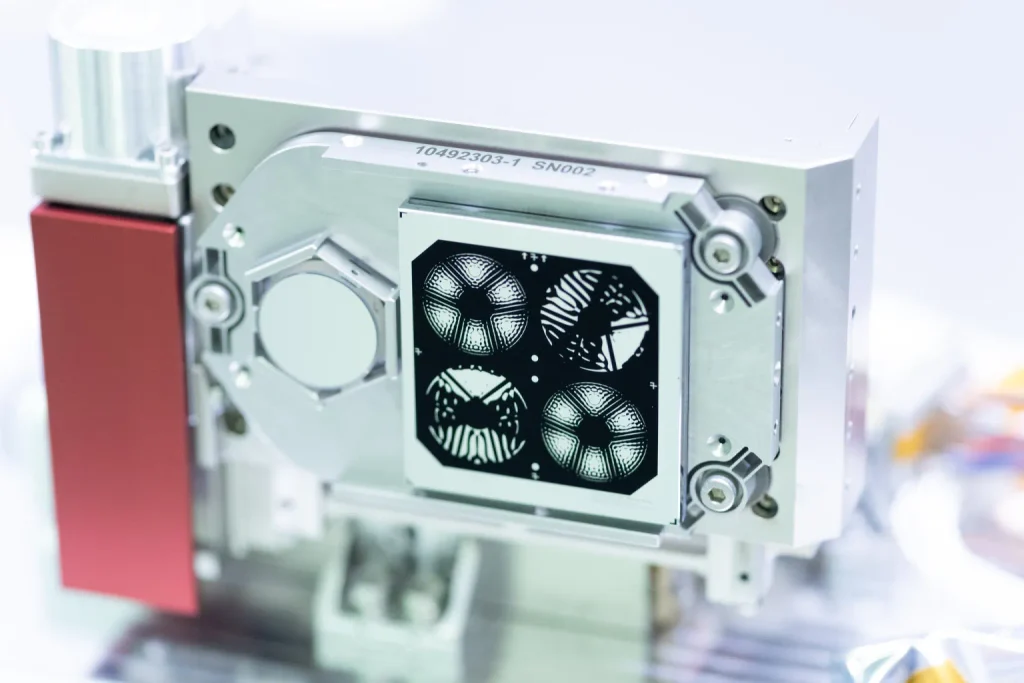
The calibration system was then powered up and test data began flowing to Earth. Engineers also tested the element wheel and the focus mechanism. The detectors continue cooling toward their final operating temperature of about -183 °C.
What happens before normal science images
The next major step is activation of the fine-guidance system so Roman can lock accurately onto targets. Focusing, optical alignment and WFI calibration will continue in parallel.
NASA says all WFI assessments so far confirm the instrument is operating as expected. The first fully focused science images remain scheduled for release in early 2027.
Why Roman changes the scale of astronomical imaging
Roman’s advantage is not simply the resolution of a single frame, but the combination of high detail and an enormous field of view. The WFI is designed for deep infrared surveys covering vast areas of sky, producing data at a scale that is impractical for narrower-field instruments.
This will support studies of dark energy, dark matter, galaxy evolution and exoplanets. From an imaging perspective, Roman is also an extreme example of how a 300MP focal plane, cryogenic operation and precise alignment turn very faint photon signals into measurable scientific information.
What we think
This image is not visually spectacular, and that is precisely what makes it useful: it is a technical frame showing the observatory before final focus. If alignment proceeds as planned, Roman’s first normal images will demonstrate what Hubble-like detail looks like when paired with a dramatically wider field.
Frequently asked questions
Is this Roman’s first science image?
No. It is the WFI’s first test detection of starlight during commissioning, before final focus and calibration.
Why do the stars look like rings?
Because the telescope is still far out of focus, spreading each star’s light over thousands of pixels.
What is the WFI resolution?
The Wide Field Instrument is a roughly 300-megapixel camera built from 18 infrared detectors.
When will the first normal images arrive?
NASA continues to target early 2027 for the first science-image release.
What will Roman study?
Its surveys will address dark energy, dark matter, galaxy evolution and exoplanets, among many other topics.