

Summary
- The Nancy Grace Roman Coronagraph Instrument powered on successfully on 1 September 2026
- The initial power and checkout procedure ran from 7:27 to 8:22 a.m.
- EDT
- The instrument will use masks, deformable mirrors and sensors to suppress starlight
- Its goal is a technology demonstration for directly observing giant exoplanets and dust discs
- Months of calibration come before a total of three observing months during the first 18 months
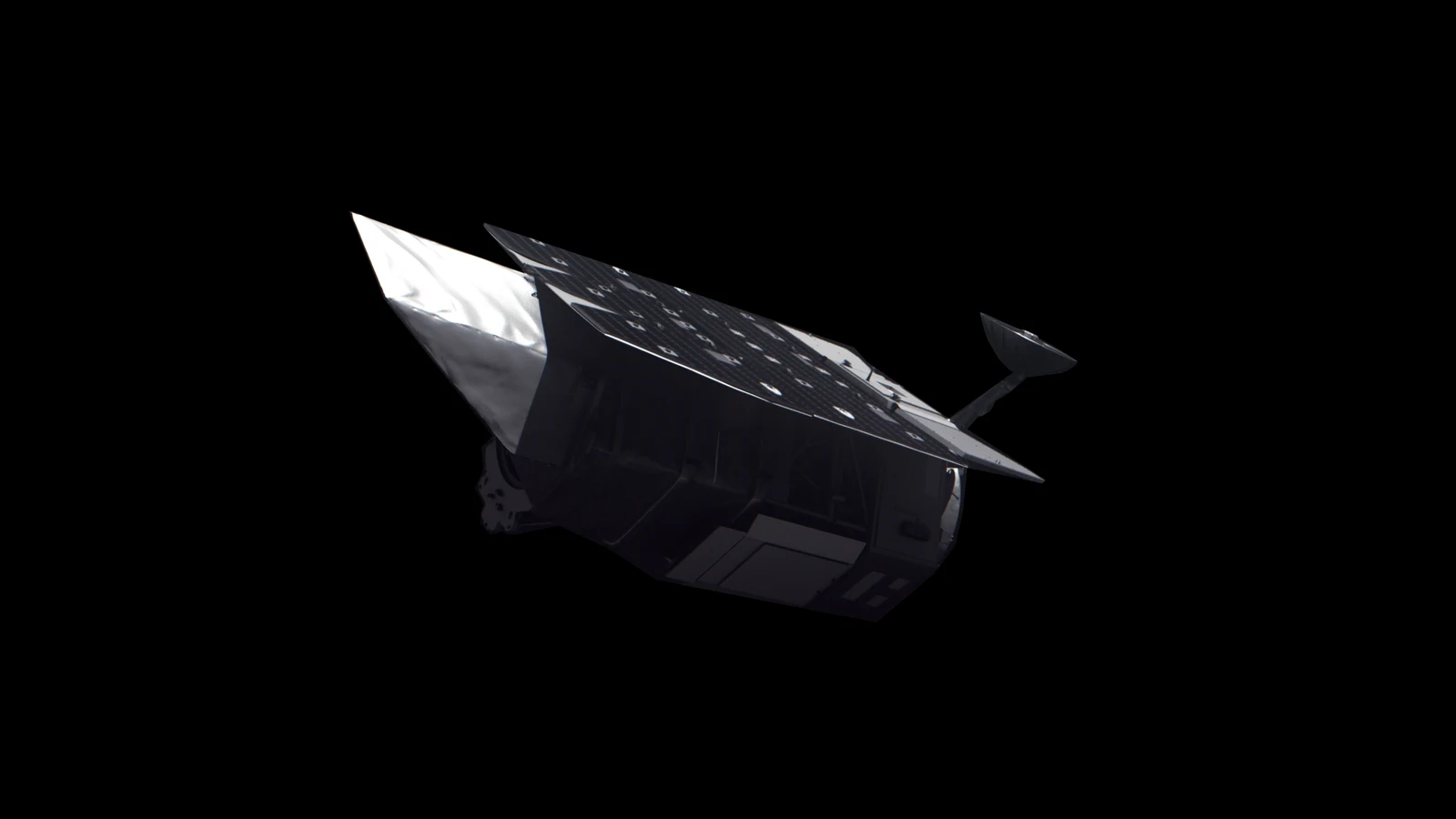
The Nancy Grace Roman Space Telescope’s Coronagraph Instrument has powered on successfully, beginning the process that will let it suppress the blinding light of stars and isolate much fainter planetary systems.
NASA completed the instrument’s first power-up on 1 September 2026. The procedure ran from 7:27 to 8:22 a.m. EDT and confirmed that its basic electrical systems responded after launch. Months of subsystem activation, alignment, calibration and testing now follow.
The milestone matters because the coronagraph is not simply another Roman camera. It is a technology demonstration in extreme precision: it must control the wavefront and reduce scattered light enough for a giant planet or dust disc to emerge beside a star that is vastly brighter.
How it “switches off” a star
The instrument combines specialised masks, mirrors, detectors and algorithms. A primary mask blocks the central starlight, while deformable mirrors change shape at extremely small scales to correct imperfections in the optical wavefront.
Sensors measure the remaining light and the system repeats corrections in a closed loop. The goal is not a spectacular total disappearance, but the creation of a very dark region around the star where faint objects can be detected.
The technique becomes much harder in space when the target is a planet at small angular separation from its host star. Even minute thermal or mechanical changes can create speckles that mimic or bury a planet’s signal.
What kinds of planets it can see
Current ground- and space-based direct-imaging systems mainly detect young, hot and very large planets orbiting relatively far from their stars. Roman aims to test observations of older, colder giants on tighter orbits through the light they reflect.
It is not designed to photograph a second Earth. Its performance will serve as a bridge to future observatories seeking even greater contrast and smaller angular separations. It can also examine dust discs that reveal the structure and evolution of planetary systems.
What follows the first power-up
The first success confirms only that the instrument received power and communicated correctly with the spacecraft. Teams will gradually activate mechanisms, detectors and electronics, check thermal behaviour and align the optical elements.
NASA has allocated roughly three months of Coronagraph Instrument observations in total, distributed across the mission’s first year and a half. That limited programme is enough to measure the technology under real conditions and deliver scientific data, without making the coronagraph Roman’s primary survey camera.
Its relationship with the Wide Field Instrument
The Wide Field Instrument is Roman’s primary science instrument and will map large areas of the infrared sky. It will find exoplanets mainly through gravitational microlensing and transits, methods that do not produce a direct image of the planet itself.
The coronagraph complements that census with a different technique: it attempts to separate real light from individual planetary systems. NASA expects to power the Wide Field Instrument in the coming weeks, while the observatory completes roughly three months of commissioning before public first images in early 2027.
From launch to instrument activation
The power-up follows Roman’s successful launch and first course correction towards L2. The high-gain antenna and telescope visor/aperture cover have also deployed, providing essential communications and thermal control.
The spacecraft continues towards its orbit around L2. Each successful deployment removes a different risk, but true scientific readiness will be judged only after both instruments have been fully aligned and calibrated.
What we think
The first power-up is a small step compared with the precision the coronagraph must achieve, but it is essential and time-critical. If Roman proves that deformable mirrors and starlight control can operate stably in space, the instrument’s greatest legacy may not be one particular image but the technology that lets a future mission search for genuinely Earth-like worlds.
Frequently asked questions
What is Roman’s Coronagraph Instrument?
It is a technology demonstration using masks and deformable mirrors to suppress starlight and observe fainter planets or dust discs.
Has it already imaged exoplanets?
No. The first power-up confirmed basic electrical systems. Months of calibration and testing now follow.
Will it photograph an Earth-like planet?
That is not its design goal. Roman will test technology on giant exoplanets and pave the way for more powerful future missions.
How much observing time will the coronagraph receive?
NASA has planned about three months of observations in total during the mission’s first 18 months.