

Summary
- Hubble imaged the spiral galaxy NGC 1827 almost edge-on.
- The galaxy lies approximately 37 million light-years away.
- Dark dust lanes and blue patches reveal its structure and possible sites of new star formation.
- The observation is part of a wider survey of low-mass satellite galaxies.
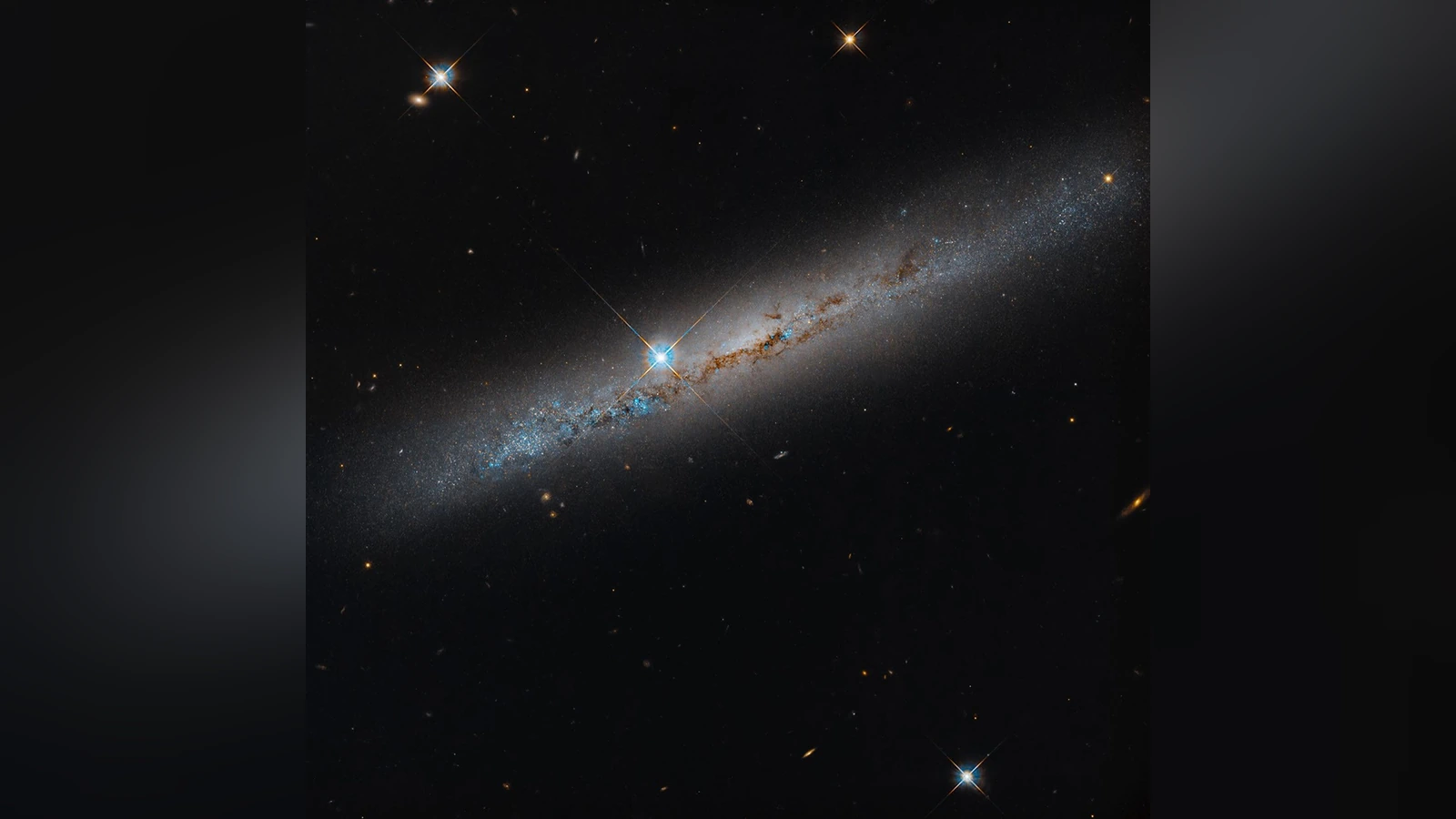
A new Hubble image shows the galaxy NGC 1827 almost edge-on, with dark dust lanes cutting across its bright disk some 37 million light-years away.
NASA published the image on October 16, 2026. NGC 1827 is an intermediate spiral galaxy in the constellation Columba. The nearly edge-on viewing angle makes the dust lying in front of the galaxy’s stars especially prominent.
A photograph with several layers
Rust-brown dust lanes run along the galactic disk, while bright blue patches point to locations where new stars are likely forming. Their arrangement helps astronomers study how dusty material relates to active star-forming regions.
The brilliant star just to the left of the galaxy’s central bulge is not part of NGC 1827. It is a foreground star in our own Milky Way. Its four pointed spikes are diffraction effects caused by the supports of Hubble’s secondary mirror. Faint, more distant galaxies also appear in the dark background.
The camera behind the observation
Hubble captured the scene with its Advanced Camera for Surveys (ACS). The observation records fine structure in the narrow galaxy disk while preserving a broader field filled with objects at different distances.
For photographers, the distinction is worth noticing: the spikes around the foreground star are not physical structures in space but an imprint of the telescope’s optics. The dark bands in the galaxy, however, trace actual material absorbing some of the starlight behind it.
Why astronomers are studying NGC 1827
The image is part of a survey of 260 satellite galaxies around 22 larger galaxies similar to our Milky Way. NASA says the host galaxies in this survey lie within a radius of about 32 million light-years of Earth; that survey radius should not be confused with the reported 37-million-light-year distance to NGC 1827.
Hubble has already observed 111 of the 260 targets. The remaining 149 are expected to require one additional Hubble orbit each. Studying low-mass galaxies helps researchers test how well cosmological models predict the properties and distribution of these smaller systems.
This viewing angle is also revealing in the image of NGC 4388, a different galaxy where Hubble records prominent dust lanes and extended gas. At another scale, the N44 star-forming region shows how Hubble observations can examine places where stars are born.
What we think
What makes this image compelling is how dramatically one viewing angle changes what we can learn from a galaxy. Seen face-on, its spiral arms might be easier to follow. Here, the nearly side-on view lets the dust structure dominate the composition.
It also demonstrates why astronomical images need careful interpretation. The bright foreground star appears to sit within the galaxy, though it is much closer to us. Its spikes are an optical effect, not evidence of an explosion or any actual structure around the star.
For photographers, separating a subject from the signature of the imaging system is a familiar and useful discipline. For astronomers, the larger payoff lies in consistent survey data: a striking picture is also one small part of a much bigger effort to understand how galaxies form and evolve.
Frequently asked questions
How far away is NGC 1827?
It is approximately 37 million light-years from Earth, in the direction of the constellation Columba.
Does the bright star near the center belong to the galaxy?
No. It is a foreground star, much closer to Earth than NGC 1827. Its four spikes are diffraction features produced by Hubble’s optical structure.