


Summary
- N44 is located in the Large Magellanic Cloud, about 160,000 light-years away.
- Its central superbubble measures roughly 210 by 140 light-years.
- Hubble helped catalog nearly 500,000 stars in the region and along its foreground.
- Nearly 30,000 of the cataloged objects are pre-main-sequence stars.
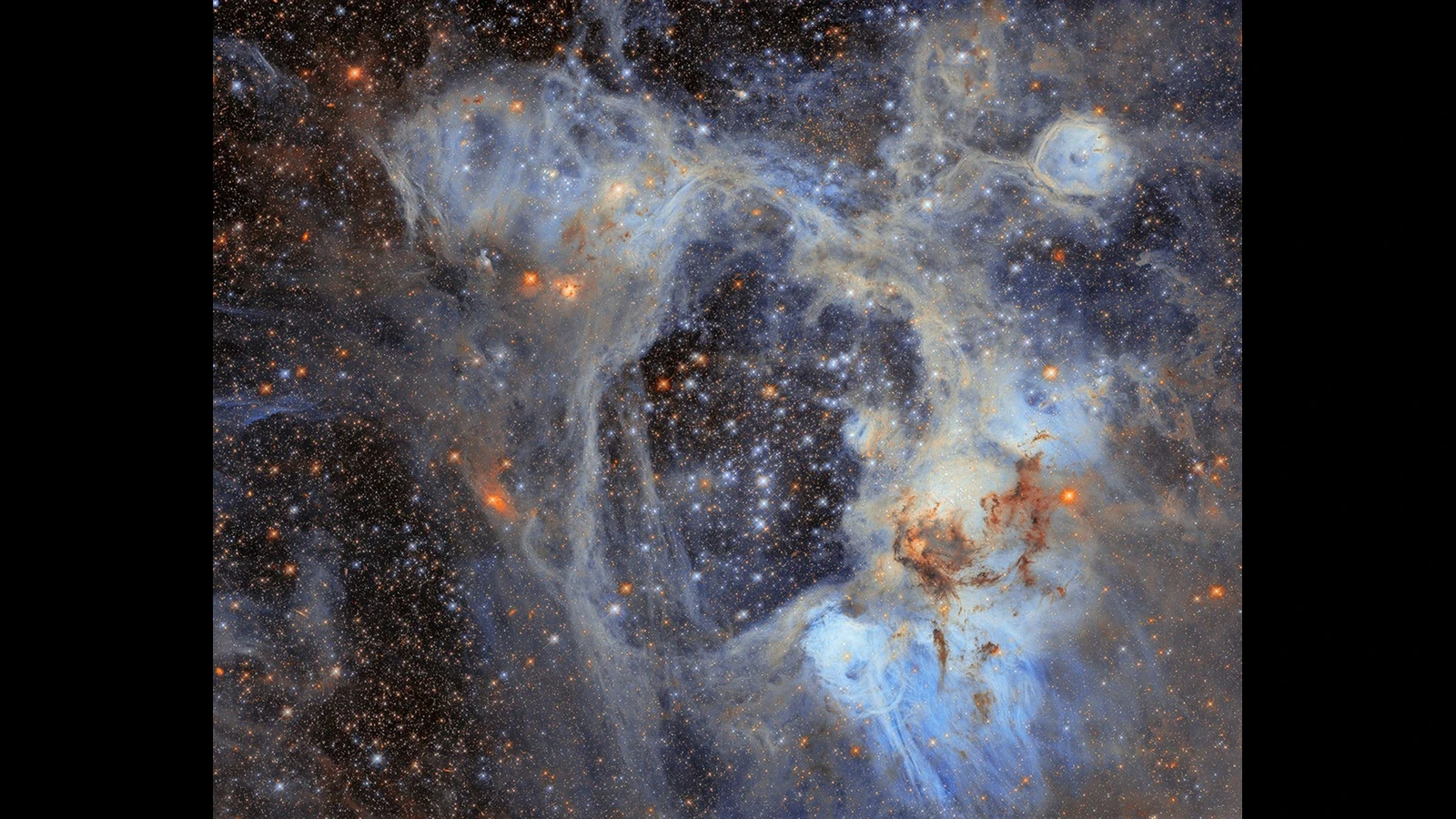
Hubble has captured N44 in the Large Magellanic Cloud, where a giant superbubble is surrounded by dense clouds of gas and thousands of young stars.
NASA and ESA have released a new image of the nebula LHA 120-N44, better known as N44. The region lies in the constellation Dorado, within the Large Magellanic Cloud, about 160,000 light-years from Earth.
N44 is a valuable laboratory for studying how stars are born. A vast cavity dominates its center, while compressed gas around it forms a dense shell in which new stars are taking shape.
A superbubble 210 by 140 light-years across
N44’s central superbubble spans roughly 210 by 140 light-years. It was created by the bright stars inside it: powerful stellar winds and supernova explosions expelled much of the gas from which those stars had formed.
That material did not disappear. It accumulated and was compressed around the cavity, creating the dense shell visible in the image. New episodes of star formation are unfolding within this gas, allowing astronomers to study the journey from the collapse of a cold cloud to the start of nuclear fusion in the core of a newborn star.
Ultraviolet radiation from massive stars energizes the shell’s gas and makes it glow. This highlights the different structures across the wider N44 complex, which astronomer Karl Henize systematically cataloged in the 1950s.
A census of nearly 500,000 stars
The data in the image comes from observing program 14689, led by principal investigator Dimitrios Gouliermis. Hubble was used to catalog nearly 500,000 stars in the region, together with foreground stars located between the telescope and N44.
Nearly 30,000 of the cataloged objects are pre-main-sequence stars. These young stars have not yet begun converting hydrogen into helium in their cores. Hubble’s sensitivity and fine spatial resolution make it possible to distinguish such faint objects even within exceptionally crowded stellar fields.
Observations of N44’s lower-mass stars are particularly valuable because the Large Magellanic Cloud contains fewer elements heavier than helium than the Milky Way. Similar conditions prevailed in galaxies in the early universe, when heavier chemical elements were still less abundant.
N44 in Hubble’s official video
In the latest episode of Space Sparks, the ESA/Hubble team presents the structure of the superbubble and explains how stellar winds and supernova explosions shaped N44.
The smaller N44F bubble
N44F, a smaller interstellar bubble, appears near the upper-right corner of the image. In this case, the structure was formed by the intense winds of a single hot, massive star. Its radiation and streams of particles have sculpted the surrounding gas and created pillars of cosmic dust.
The large superbubble, N44F and the active star-forming regions show at different scales how stars transform their surroundings. The same energy that clears gas from one area can compress it nearby and help fuel the next generation of stars.
What we think
The new image combines Hubble’s visual power with an unusually rich scientific dataset. The census of young stars allows researchers to examine the birth of stars of different masses within the same environment, while the shape of the gas records the effects of stellar winds and supernovae. More than three decades after its mission began, Hubble continues to deliver observations that unite fine detail, broad scientific value and images with immediate impact.
Frequently asked questions
Where is N44?
N44 is located in the Large Magellanic Cloud, a small galaxy orbiting the Milky Way. It is about 160,000 light-years away and appears in the direction of the constellation Dorado.
What is a superbubble?
A superbubble is a vast cavity in interstellar gas created by the combined action of powerful stellar winds and supernova explosions. The cavity in N44 measures roughly 210 by 140 light-years.
How many stars were cataloged in N44?
The observing program cataloged nearly 500,000 stars in the region and along its foreground. Nearly 30,000 of them are in the pre-main-sequence stage.
Why is the Large Magellanic Cloud important for this study?
Its lower abundance of elements heavier than helium provides a relatively nearby environment for studying star formation under conditions that more closely resemble those in galaxies in the early universe.