Summary
- Hubble photographed two distorted images of the same distant galaxy.
- A foreground elliptical galaxy acts as a gravitational lens.
- The distortions help scientists investigate dark matter.
- The images support preparations for observations with Roman.
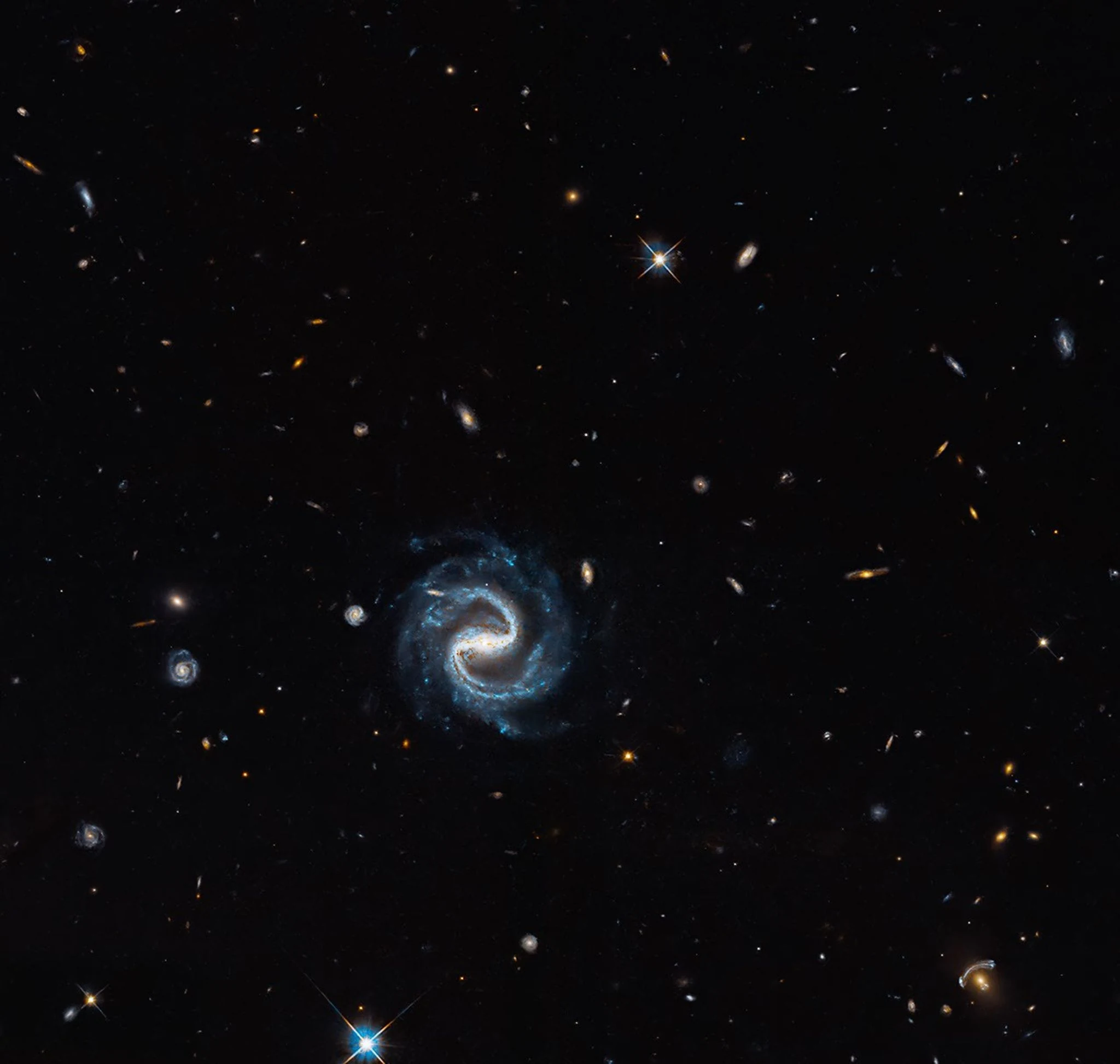
In a Hubble image, two bright blue arcs around a galaxy reveal how gravity can distort and magnify light from a much more distant world.
NASA published the image on October 22, 2026. The large blue spiral near the centre is galaxy Z 43-83, but the key phenomenon lies at the lower right: the gravitational-lens system DESI J194.5345+03.5358. There, light from a galaxy behind another galaxy has been bent enough to appear in two different places.
Two blue arcs, but only one galaxy
The enlarged inset reveals a warm, reddish elliptical galaxy roughly 4.5 billion light-years away. A large blue arc curves above and to its left; a second, smaller, flipped arc appears below and to the right. These are not two separate galaxies. They are two images of the same background galaxy, about eight billion light-years from Earth.
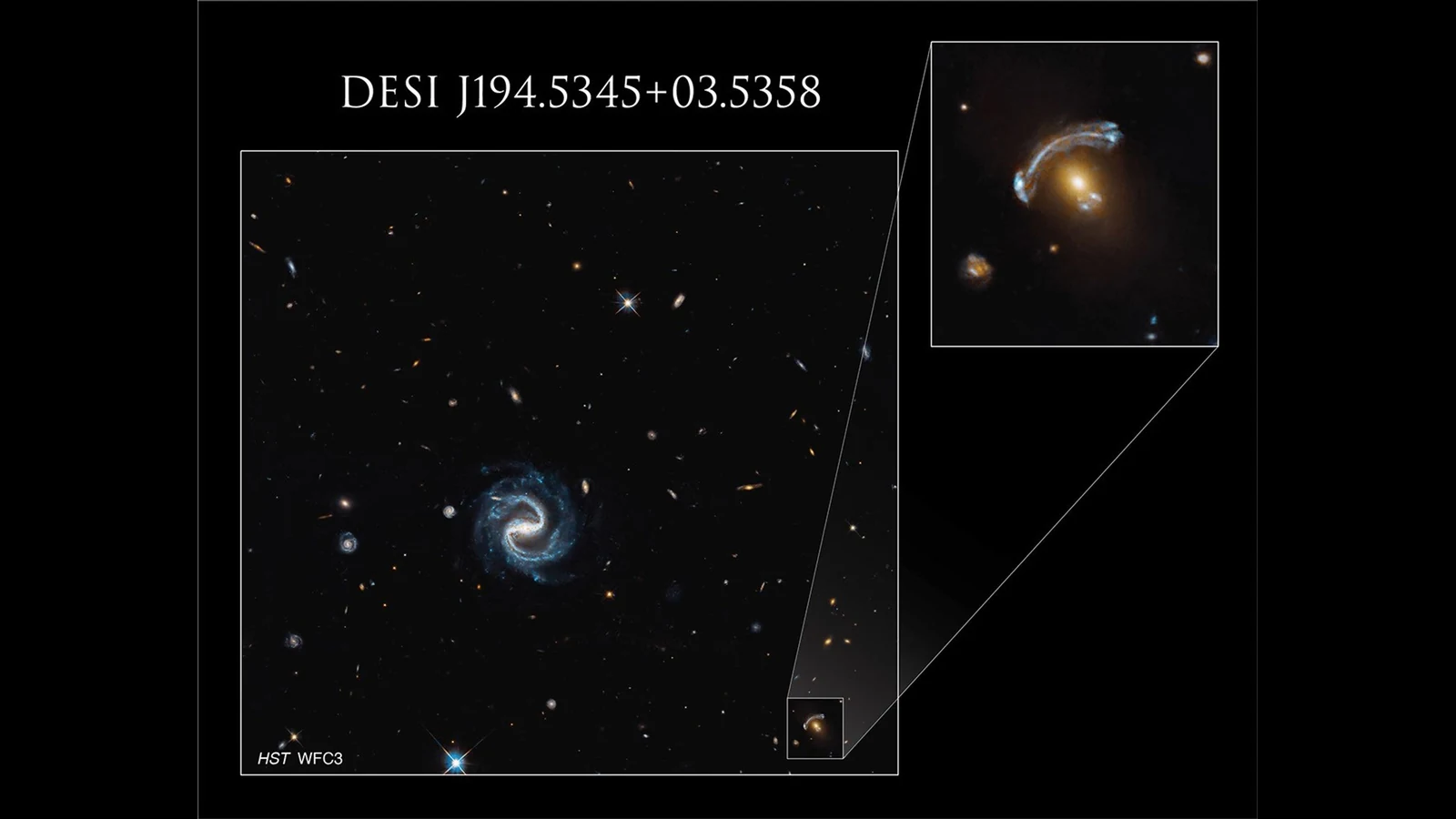
This arrangement is known as an arc-counterarc pair: two distorted views of one source appearing on opposite sides of the foreground lens galaxy. The pattern occurs because the foreground and background galaxies happen to lie close to the same line of sight.
How gravity creates a natural lens
According to general relativity, mass curves spacetime. Light from a distant galaxy follows that curvature as it passes a massive foreground object. Given the right alignment, observers see magnification, distortion or multiple images — precisely what happens to the blue arcs in this photograph.
The distortion also becomes a measuring tool. By analysing how strongly the light bends, astronomers can estimate the total mass of the lens galaxy. Visible matter alone cannot account for all the deflection, making these observations valuable for investigating the distribution of dark matter.
What else is visible in the Hubble image
The striking Z 43-83 at the centre is a barred spiral galaxy, with arms extending from an elongated bar of stars in its core. NASA says it is comparable in size to the Milky Way, while the smaller spiral to its left may be a satellite galaxy. Most other tiny objects in the frame are galaxies as well, with only a handful of foreground stars.
Gravitational lenses have already shown how nature can make otherwise challenging targets accessible to telescopes. For comparison, the James Webb image of galaxy cluster MACS J0454.1-0300 presents a separate example in which a whole cluster produces multiple images of much more distant galaxies.
Why this image matters for the Roman telescope
The observation is part of the preparations for science with the Nancy Grace Roman Space Telescope. Hubble delivers highly resolved views of individual targets, primarily in visible and ultraviolet light with some infrared coverage. Roman will mainly observe infrared light while surveying far wider areas of sky, helping astronomers find many more gravitational lenses.
Researchers are using Hubble images to develop computer models of the distortions caused by dark matter. Those models will aid the analysis of Roman’s wide-field images, while Hubble can follow up particularly interesting systems at much finer detail.
What we think
At first glance, your eye goes straight to the big spiral. Yet the most revealing part of the frame is a handful of blue pixels near its edge. That is one of the fascinating things about space imaging: the most eye-catching shape is not always where the story actually happens.
For photographers, it is especially striking that this distortion is neither a lens flaw nor an editing effect. The distortion is the measurement. The positions, shapes and reversal of the arcs tell astronomers something about the mass of a galaxy they cannot simply weigh.
There is also a neat imaging parallel here. Hubble provides the close-up precision to study a tiny patch of sky, while Roman adds scale. Think of pairing a carefully resolved detail shot with a vast panorama, except the goal is to map matter that does not emit light.
Frequently asked questions
Are the two blue arcs different galaxies?
No. The larger blue arc and the smaller flipped arc are two images of the same background galaxy, seen around a foreground elliptical galaxy.
Which galaxy produces the gravitational lens?
The foreground elliptical galaxy about 4.5 billion light-years away. The large spiral Z 43-83 in the centre shares the field of view but is not responsible for the two blue arcs.
Is the distortion real, or was it added during processing?
It is a real astronomical phenomenon caused by gravity bending light. Image processing presents the observational data; it does not invent the multiple images.