

Summary
- James Webb captured galaxy cluster MACS J0454.1-0300 with dramatic gravitational-lensing effects.
- The image contains two rare regions where distant galaxies appear four or more times.
- Some bright knots are magnified by more than a factor of 300.
- Compared with Hubble’s 2014 view, Webb reveals hundreds of additional galaxies thanks to its infrared sensitivity.
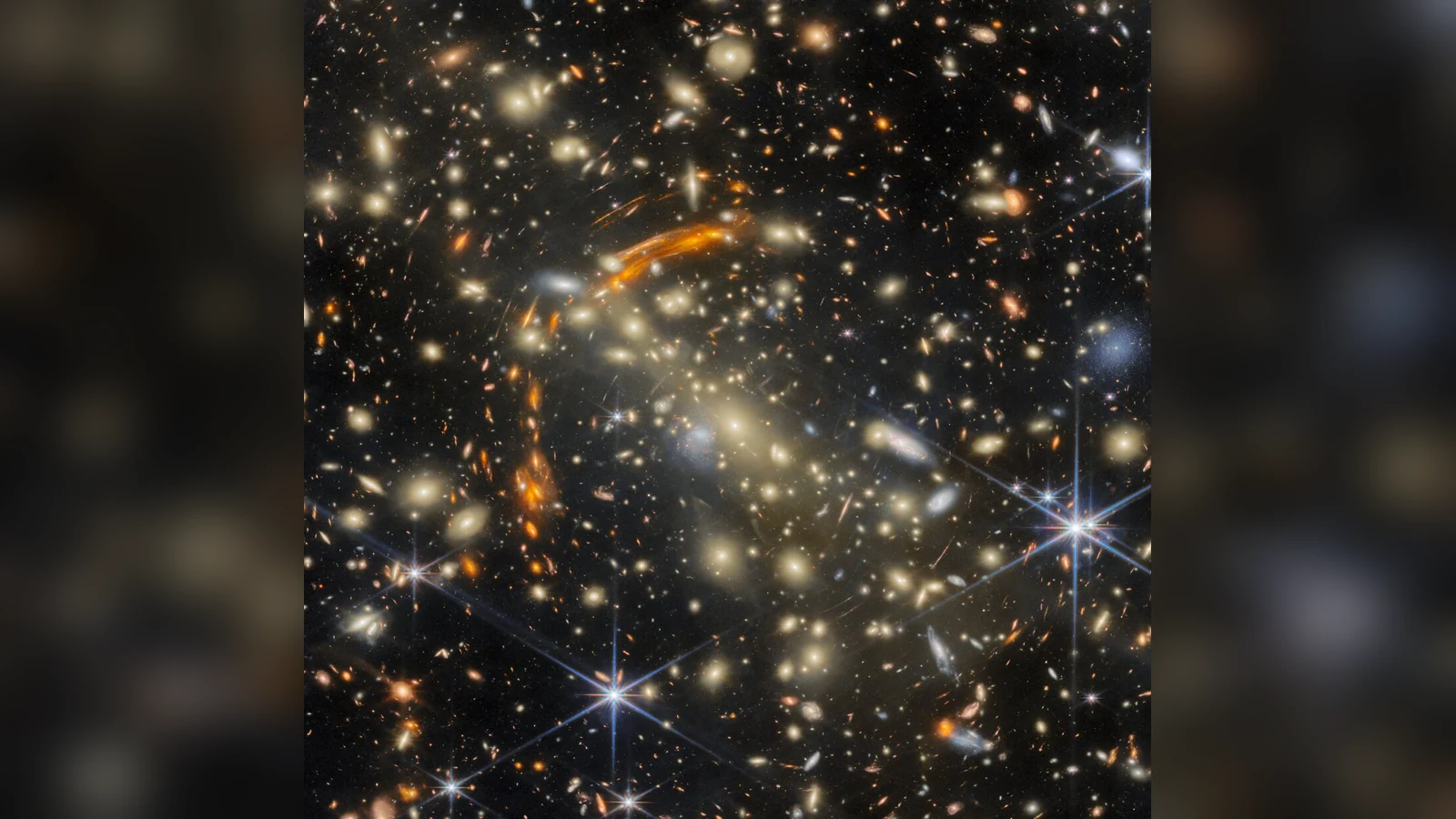
The James Webb Space Telescope has turned its gaze back to the deep Universe, capturing galaxy cluster MACS J0454.1-0300 in an image where gravity warps, magnifies and multiplies distant galaxies.
The new image was released as ESA/Webb’s Picture of the Month on September 29, 2026. Light from the cluster itself has travelled for so long that we see it as it was when the Universe was about 8 billion years old, while several orange galaxies around it lie even farther away.
What makes the image remarkable is not only the density of galaxies, but the way the cluster’s mass acts as a natural cosmic lens, allowing Webb to reveal objects that would otherwise be too faint and distant to observe.
Two rare multiple-image configurations in one cluster
Gravitational lensing occurs when a very massive foreground structure, such as a galaxy cluster, curves spacetime and changes the path of light from objects behind it. The result can be elongated arcs, strong magnification or even multiple images of the same galaxy.
What stands out in MACS J0454.1-0300 is that researchers identified two areas where the same distant object appears four or more times. Such configurations are estimated to occur in only 10–20% of galaxy clusters, and ESA/Webb says this is the first time two of them have been seen in the same cluster.
These lensed regions reveal galaxies from very early cosmic epochs: one group as it was about 2 billion years after the Big Bang and another galaxy from just 800 million years after the Big Bang. The galaxy group also appears to be merging, triggering an intense burst of star formation.
Magnification beyond 300 times
Within the distorted regions, astronomers have identified bright “knots” corresponding to areas as small as about 5 light-years across. In some cases, gravitational magnification exceeds a factor of 300, effectively turning the galaxy cluster into a natural telescope in front of the telescope.
That is why gravitational lensing is so valuable for studying the early Universe: it does more than create dramatic distortions. It genuinely boosts the light from extremely distant targets and lets astronomers study scales that would otherwise remain out of reach.
The Hubble comparison shows the power of infrared imaging
The same cluster had already been photographed by Hubble, with that image released in 2014. Comparing the two views is striking: the Webb image reveals hundreds of galaxies that are not apparent in the earlier image.
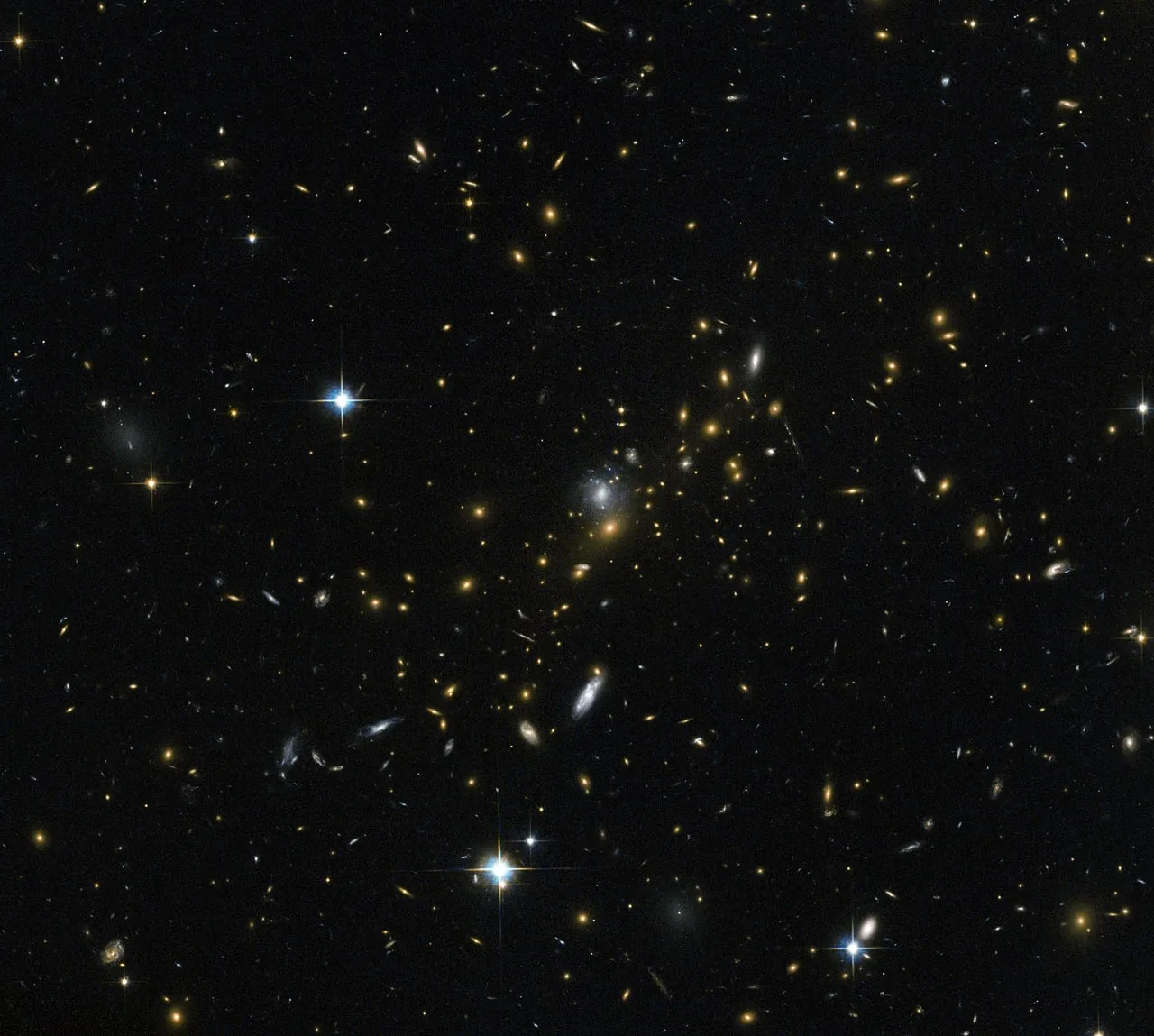
Those galaxies did not appear in the meantime. Webb is far more sensitive to redder, infrared light, which is especially important for objects whose light has shifted to longer wavelengths as it travels through the expanding Universe.
The data behind the new image come from two Webb observing programmes, #5058 and #6882. One uses strong gravitational lenses to search for individual stars in the Universe’s first billion years, while the other studies a large sample of galaxy clusters across multiple wavelengths.
What we think
For image makers, the Webb–Hubble comparison is a clear reminder that scientific imaging is not simply about resolution. Wavelength choice and instrument sensitivity can radically change what becomes visible in the same part of the sky.
Gravitational lensing also offers a striking example of a natural phenomenon becoming part of the imaging system itself, adding magnification that no telescope could create on its own.
Frequently asked questions
What is gravitational lensing?
It is the effect in which the mass of a foreground object, such as a galaxy cluster, bends the path of light from a more distant object. The background source can therefore appear distorted, magnified or duplicated.
Why can the same galaxy appear more than once?
When the alignment between the source, the gravitational lens and the observer is right, light can follow different paths to the telescope, producing multiple images of the same object.
How far back in time are we seeing MACS J0454.1-0300?
The cluster’s light has travelled for so long that we see it as it was when the Universe was about 8 billion years old.
Why does Webb reveal more galaxies than Hubble?
Webb is much more sensitive to infrared and redder light, where many extremely distant galaxies are easier to detect. That is why the new image reveals hundreds of galaxies that are not apparent in the 2014 Hubble view.