

Summary
- James Webb captured planetary nebula NGC 2392 about 5,000 light-years from Earth
- The observations were made with NIRCam and MIRI in near- and mid-infrared light
- The white dwarf at the center ionizes the gas and destroys part of the surrounding dust
- Dense dust clumps survive and shield material located behind them
- Hubble observed the same nebula in visible light around 2000
- NGC 2392 is expected to disperse in approximately 10,000 years
James Webb has revealed planetary nebula NGC 2392 in unprecedented infrared detail, about 5,000 light-years away, where a white dwarf continues to shape and destroy the material surrounding it.
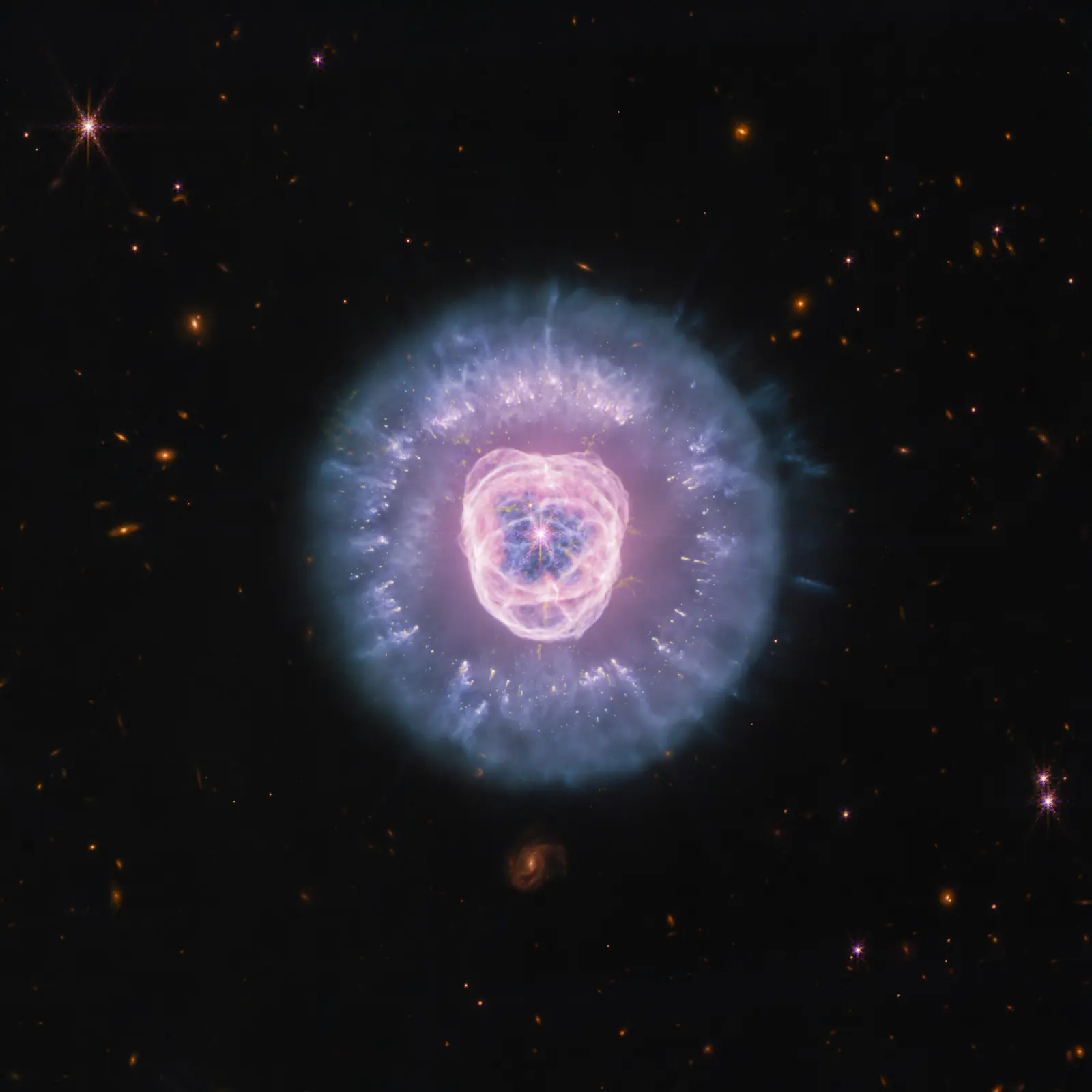
NASA and ESA released new images of NGC 2392, referred to in the announcement as the Lion Nebula, on August 10, 2026, using observations from the James Webb Space Telescope’s NIRCam and MIRI instruments. The observations were obtained on November 19, 2025, combining near- and mid-infrared wavelengths to reveal compact dust clumps, ionized gas and complex structures around the central stellar remnant.
The image is more than an impressive cosmic portrait. NGC 2392 is a snapshot of the final stages in the life of a relatively low-mass star, allowing astronomers to examine how radiation and outflows from a hot white dwarf alter the gas and dust expelled by the same star thousands of years earlier.
A “lion” 5,000 light-years away
NGC 2392 lies in the constellation Gemini, approximately 5,000 light-years from Earth. According to NASA’s data, the region covered by the new image spans about 1.8 arcminutes, corresponding to roughly 2.6 light-years. The object is also catalogued as Caldwell 39.
Its distinctive morphology resembles the head of a male lion: the bright central star appears like a “nose,” the inner rings and cavities form the “face,” while a broader dust shell creates the impression of a mane. This is, of course, a visual analogy rather than an intentionally lion-shaped physical structure.
What NIRCam and MIRI see differently
Webb observed the nebula with NIRCam, which operates in the near-infrared, and MIRI, which observes longer mid-infrared wavelengths. The new composite image uses data from both instruments, while NASA has also released a separate MIRI view.
This is particularly important for studying dust. Infrared observations allow Webb to highlight structures that do not appear in the same way in visible light, including compact dust clumps and diffuse regions of ionized gas. The MIRI image shows that some dust is being destroyed by radiation from the central star, while other filaments and denser concentrations continue to survive.
The engine sits at the center
The key to the entire structure of NGC 2392 is the extremely hot remnant of the original star: a white dwarf.
When a relatively low-mass star reaches the final stages of its life and can no longer sustain nuclear reactions in its core as before, it gradually sheds its outer layers. The expelled gas and dust form what astronomers call a planetary nebula, while the extremely hot core remains at the center and evolves into a white dwarf. Despite their name, planetary nebulae have nothing to do with planets.
In the case of NGC 2392, NASA and ESA describe the original star as oxygen-rich. The intense radiation from its remnant ionizes the surrounding gas and produces an expanding bubble corresponding visually to the lion’s “face.”
The mane is not uniform
One of the most interesting features of the new observation is found in the outer “mane.”
ESA explains that this is the interior of a dust shell illuminated by the central white dwarf. Structures resembling small tufts or comet tails are dense dust clumps. Because they are compact enough to resist the intense radiation for longer, they act as shields for material behind them.
NASA’s data also show concentrations of molecular hydrogen. The image therefore does not simply reveal where material exists, but presents a region where different components are undergoing different stages of destruction, heating and dispersal.
A nebula changing as we observe it
The shape Webb sees today took several thousand years to develop, but it is not permanent. The bubble of ionized gas continues to expand, material keeps moving away from the stellar core and radiation continues to erode the dust.
Astronomers estimate that in approximately 10,000 years the nebula will have largely dispersed. On a human timescale this is an enormous period, but in the lifetime of a star it represents an exceptionally brief transitional phase.
Comparing Webb with Hubble
NGC 2392 is not being observed by a space telescope for the first time. Hubble imaged it around 2000 in visible light and had already revealed distinctive structures resembling giant comets pointing radially away from the central star.
The new image does not replace the older observation but complements it. Hubble delivered an extremely detailed visible-light view, while Webb now allows the same region to be studied in near- and mid-infrared wavelengths, where dust and ionized gas appear differently. This comparison across wavelengths is precisely what makes the combination of the two observatories scientifically valuable.
PTTL has also covered other recent Webb observations of planetary nebulae, including the Helix Nebula, where the infrared telescope similarly revealed detailed structures in the gas and dust surrounding a dying star.
Technical details of the new image
The new data come from observing program 9548, led by principal investigator M. Garcia Marin, and were recorded on November 19, 2025. The image uses observations from NIRCam and MIRI with the F115W, F187N, F212N, F335M and F1000W filters. The released image was processed by Alyssa Pagan of the Space Telescope Science Institute.
The image was released on August 10, 2026, with credits to NASA, ESA, CSA and STScI.
What we think
The real value of the new NGC 2392 image goes beyond the striking resemblance to a lion. Simultaneous access to near- and mid-infrared wavelengths gives astronomers a better way to separate what is happening to dust and ionized gas as the white dwarf transforms its surroundings. Combined with Hubble’s earlier visible-light view, NGC 2392 becomes an especially clear example of how different the same stellar scene can appear when observed at different wavelengths.
Frequently asked questions
What is NGC 2392?
It is a planetary nebula in the constellation Gemini, about 5,000 light-years from Earth, formed from the outer layers of a star during the final stages of its life.
Why is it called the Lion Nebula?
In the new NASA and ESA release, NGC 2392 is referred to as the Lion Nebula because its morphology resembles a lion’s head, with an inner formation resembling a face and an outer ring resembling a mane.
What does James Webb see differently from Hubble?
Hubble observed the object in visible light, while Webb uses near- and mid-infrared observations with NIRCam and MIRI, revealing dust, compact clumps and ionized gas in different ways.
What is at the center of the nebula?
At the center is the extremely hot stellar core left behind after the star shed its outer layers: a white dwarf. Its radiation continues to ionize and alter the surrounding gas and dust.
How long will NGC 2392 remain visible?
Astronomers estimate that the nebula will disperse in approximately 10,000 years as its gas and dust continue to move away from the center.