

Summary
- NASA released a new James Webb image of the galaxy Centaurus A
- The galaxy lies about 11 million light-years from Earth
- Webb revealed dust structures, millions of stars, and an active core
- Centaurus A still carries evidence of a collision with another galaxy about two billion years ago
- The image shows an unusual S-shaped structure that remains under study
The James Webb Space Telescope has revealed new details in Centaurus A, a nearby active galaxy that still carries the marks of a massive cosmic collision.
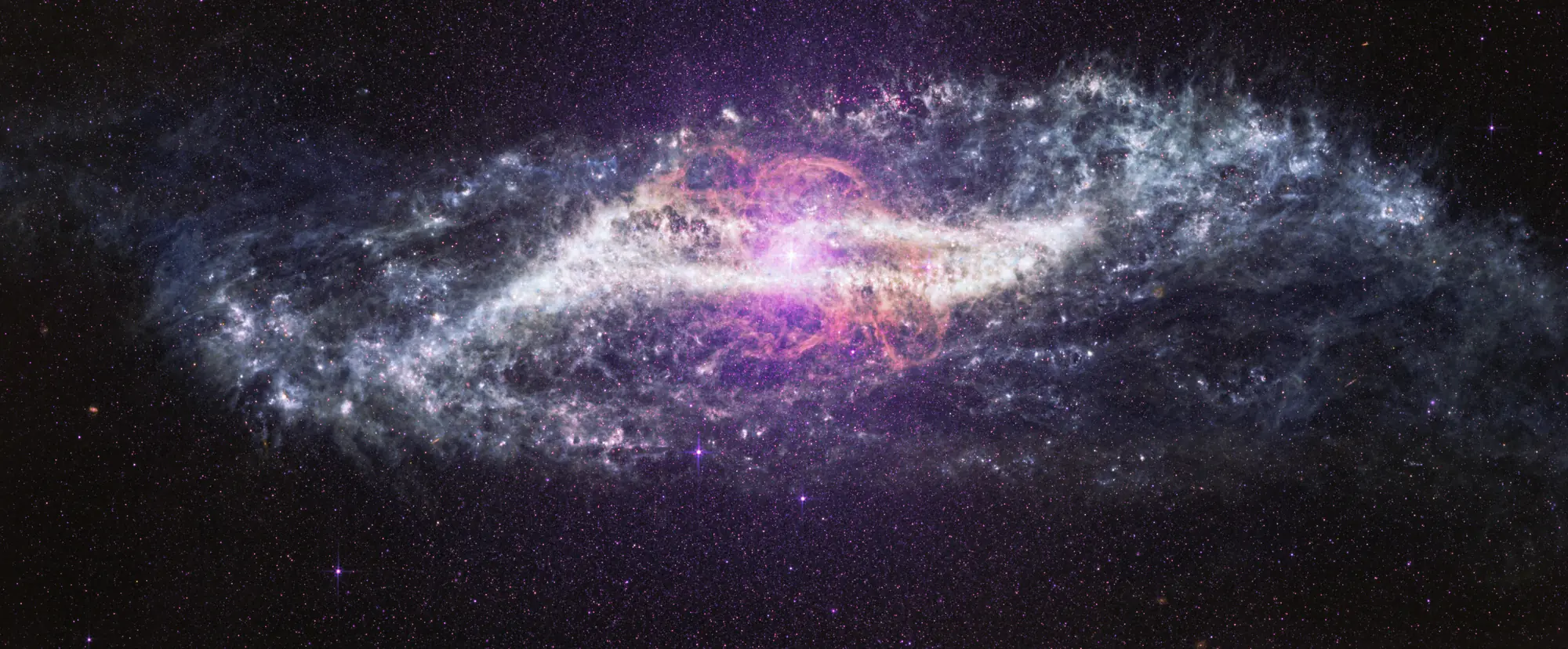
NASA released new images of the galaxy Centaurus A, also known as NGC 5128, to mark the fourth anniversary of the James Webb Space Telescope’s science operations. The images show the galaxy in near- and mid-infrared wavelengths, revealing dust structures, millions of stars, and activity around its central supermassive black hole.
The observation matters because Centaurus A is relatively nearby, about 11 million light-years from Earth, and serves as one of the best natural laboratories for studying the relationship between galaxies, their collisions, star formation, and black hole activity.
A nearby but highly active galaxy
Centaurus A is not an ordinary nearby galaxy. At its center lies a supermassive black hole that feeds on surrounding material and launches powerful energy jets, influencing the structure and evolution of the galaxy.
At the same time, the galaxy’s shape is still marked by a major collision with another galaxy about two billion years ago. The traces of that merger remain visible in its warped structure, dust lanes, and regions where new stars continue to form.
What Webb saw that was hidden before
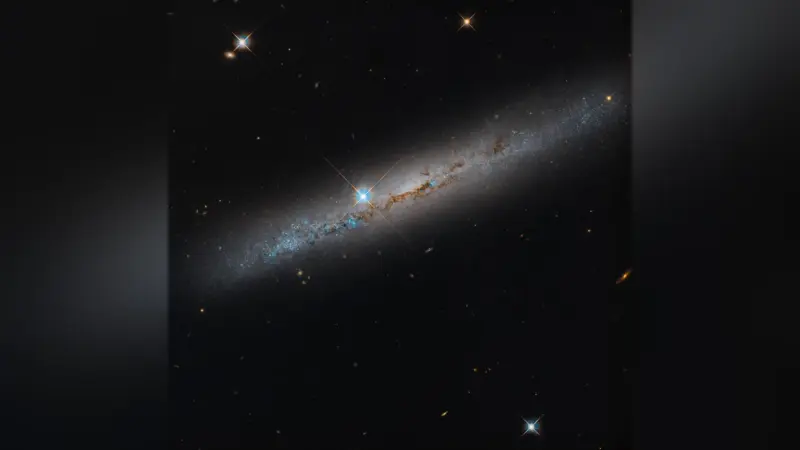
Hubble had observed Centaurus A in visible light, but thick dust blocked much of the central region. The retired Spitzer telescope had provided larger-scale infrared images, but without the same ability to resolve individual stars.
Webb combines high sensitivity and resolution in the near- and mid-infrared. This allows it to pierce the dust lanes and reveal a dense field of countless stars, as well as structures that show how active the galaxy’s interior remains.
The strange S-shaped structure
In the image from MIRI, Webb’s mid-infrared instrument, an unusual structure resembling the letter S stands out. NASA says this feature raises questions about its origin and whether it is connected to the black hole’s activity, the galactic collision, or the formation of new stars.
The same field also shows a warped dust lane shaped like a parallelogram crossing the galaxy’s center. The bright red points in the infrared image correspond to dust-rich stars or star-forming regions.
Galactic archaeology through millions of stars
Webb’s high resolution allows astronomers to study Centaurus A star by star, even in regions that were previously hidden behind dust.
This level of detail turns the observation into a form of galactic archaeology. The stars can help scientists reconstruct the galaxy’s timeline: when its older stellar populations formed, when activity slowed, and when the collision triggered new bursts of star formation.
The black hole and the motion of gas
Webb does not only capture images. Through spectroscopy, scientists can also measure the movement of gas inside the galaxy.
Early evidence from the observations shows fast ionized gas moving outward, likely under the influence of the central black hole. Warm molecular hydrogen has also been detected in a warped rotating disk near the center.
This supports the picture of a galaxy where the black hole can act in two ways: compressing gas and encouraging star formation, while also pushing material away and limiting the birth of new stars.
What we think
The new image of Centaurus A is a case where Webb offers not just an impressive picture, but a tool for understanding galaxy evolution. The key interest lies in how the details of dust, stars, and gas connect with one another, giving a rare nearby view of how an ancient collision and an active black hole can shape an entire galaxy.
Frequently Asked Questions
What is Centaurus A?
Centaurus A, or NGC 5128, is a nearby active galaxy located about 11 million light-years from Earth.
Why is Webb’s new image important?
Because it reveals regions hidden by dust and allows scientists to study stars, dust structures, and gas in much greater detail.
What does the S-shaped structure show?
Its origin has not yet been fully explained. Scientists are examining possible links to black hole activity, star formation, and the remains of the galactic collision.
Which Webb instruments were used?
The images are based on near- and mid-infrared observations using NIRCam and MIRI.
What role does the black hole play at the galaxy’s center?
The supermassive black hole feeds on material, launches jets, and influences gas and star formation across the galaxy.