

Summary
- IC 348 lies about 1,000 light-years away in the constellation Perseus
- The NIRCam image measures 30,866 by 38,204 pixels and exceeds 1.17 billion pixels
- Webb revealed brown dwarfs with masses as low as twice that of Jupiter
- The same observation highlights protostars and Herbig-Haro objects
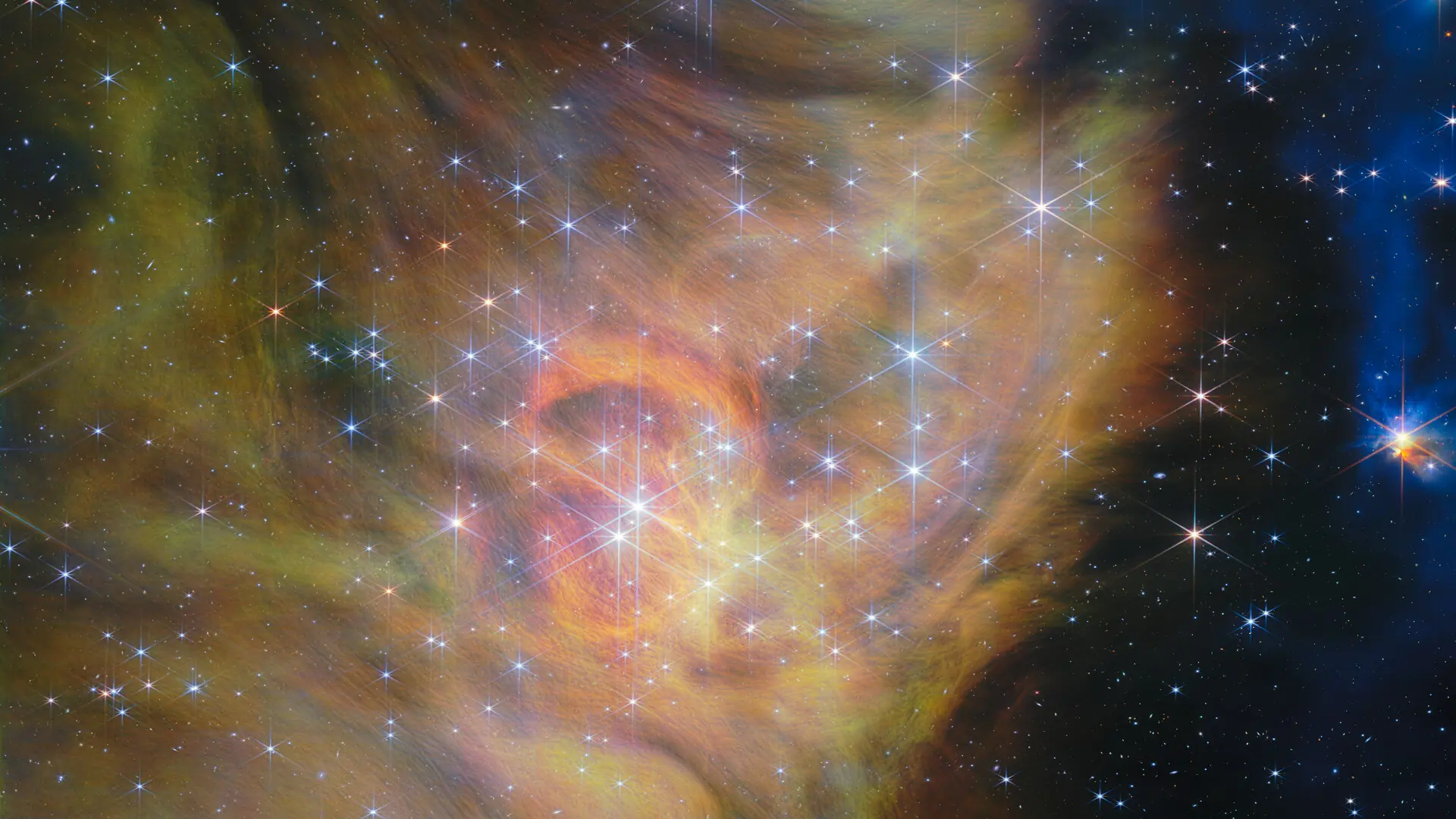
James Webb captured IC 348 in a 30,866-by-38,204-pixel image, revealing brown dwarfs with masses as low as twice that of Jupiter.
The star-forming region lies about 1,000 light-years away in the constellation Perseus. The new infrared view is one of the largest Webb images released to the public to date, combining a spectacular field with data on the lowest-mass objects that the star-formation process can produce.
NIRCam observed the region on 30 August 2024 through the F162M, F182M, F360M and F444W filters. Researchers selected candidate brown dwarfs from their colours and brightness, then followed up with NIRSpec spectroscopy in 2025 to study their masses.
An image with more than 1.17 billion pixels
The full image measures 30,866 by 38,204 pixels, or 1,179,204,664 pixels — about 1.18 gigapixels. ESA/Webb offers a 6.6 GB fullsize original, while NASA also provides full-resolution TIFF, PNG and JPEG files. The field of view is about 16.09 by 19.92 arcminutes.
That resolution has practical scientific value: the same frame resolves dense fields of young stars, clouds of gas and dust, protostars with outflows, and distant background galaxies. The colours are created by mapping four NIRCam infrared filters into visible hues.
Brown dwarfs only twice Jupiter’s mass
The smallest normal stars weigh about 8% of the Sun’s mass. Below that limit lie brown dwarfs: objects that form through molecular-cloud collapse like stars, but whose cores never become hot enough to sustain ordinary hydrogen fusion into helium.
In 2022 observations, the same research team found brown dwarfs in IC 348 with masses as low as three to four times Jupiter’s. The deeper observations have now revealed objects only twice Jupiter’s mass, about 0.19% of the Sun’s mass. They are the least massive brown dwarfs known and are smaller than current models predict such objects should be able to form.
A disk around a planetary-mass object
One of the lightest newly found brown dwarfs shows signs of a disk of material around it. That leaves open the possibility that small planets could form around an object that is itself comparable to a planet in mass.
The brown-dwarf spectra also contain a feature the research team attributes to an unidentified hydrocarbon. This signature has appeared only in the atmospheres of the lowest-mass brown dwarfs and may indicate that these extreme objects occupy a spectral class of their own.
Protostars, HH 797 and HH 211
A collection of protostars stands out in the upper-right region of the image. As newborn stars eject powerful jets of material, the jets collide with surrounding gas and dust and create luminous structures known as Herbig-Haro objects.
HH 797, the long narrow feature running almost horizontally, turns out to contain two protostars with nearly parallel outflows. Just to its right, HH 211 has a propeller-like appearance, with narrow jets and broader outflows.
What we think
The most interesting aspect is the connection between the scale of the image and the scientific information contained within it. The 1.18 gigapixels are not simply an impressive file-size statistic: they allow very faint brown dwarfs, structures around protostars and distant background objects to be studied across an exceptionally crowded field.
Frequently asked questions
How large is the IC 348 image?
The full image measures 30,866 by 38,204 pixels, or about 1.18 billion pixels. ESA/Webb provides a 6.6 GB fullsize original.
How far away is IC 348?
The IC 348 star-forming region lies about 1,000 light-years from Earth in the constellation Perseus.
What is a brown dwarf?
It is an object that forms in a star-like way but does not gain enough mass to sustain ordinary hydrogen fusion in its core.
How small are the newly found brown dwarfs?
The lightest objects found are about twice Jupiter’s mass, or roughly 0.19% of the Sun’s mass. They are the least massive brown dwarfs known.
Which Webb instruments were used?
NIRCam was used for imaging and candidate selection in 2024, followed by NIRSpec spectroscopy in 2025 to study the objects’ masses.