Summary
- Hubble and Webb captured three views of the Cat’s Head Nebula in Carina.
- The region lies approximately 7,500 light-years from Earth.
- Visible and infrared light highlight different stars and structures of gas and dust.
- The glowing “eye” may indicate a young star embedded in the cloud.
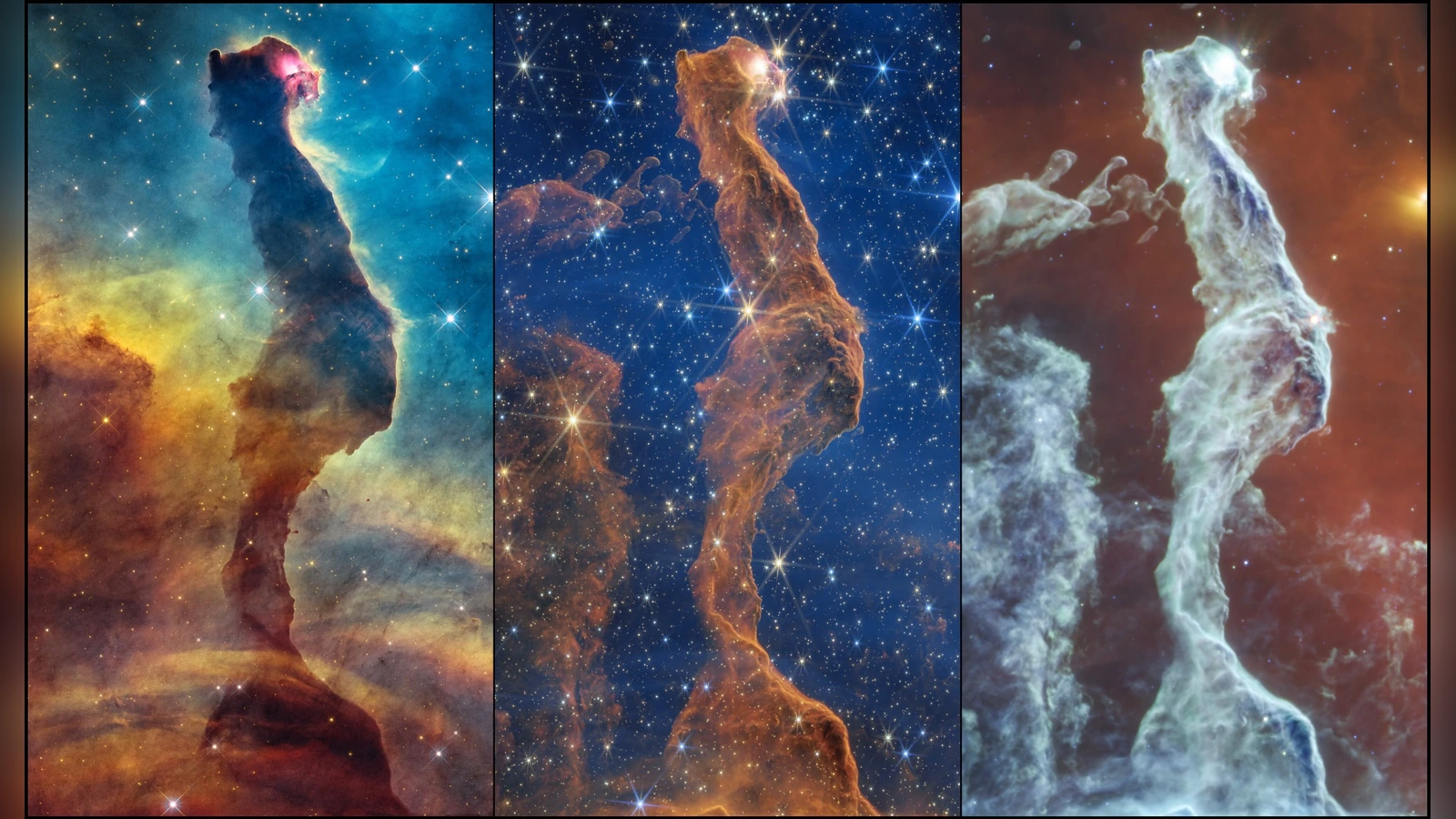
Hubble and James Webb have captured three complementary views of a nebula resembling a cat sitting with its back towards us, showing how differently the same scene can appear when the observing wavelength changes.
Released on 29 October 2026, the images show the Cat’s Head Nebula, a region within the vast Carina Nebula approximately 7,500 light-years from Earth. The dark pillar of gas and dust resembles a seated cat turning its head to the right, revealing a glowing “eye”.
The official zoom video travels from the wider star field into this particular region.
How the cosmic silhouette takes shape
The shape was probably sculpted by intense ultraviolet radiation and winds from massive stars in Carina. As surrounding gas and dust are removed, denser material resists erosion for longer, temporarily preserving the distinctive outline.
This is a star-forming region that continues to change. Its present appearance is temporary: the birth and evolution of stars will reshape and eventually disperse its material.
Hubble: Dust blocks the light
In the left-hand image, Hubble’s Wide Field Camera 3 records the pillar in visible light as an almost opaque, dark brown structure. The bright red spot marking the “eye” may indicate a young star still partially embedded in dust.
The yellowish bright rim on the right is consistent with gas illuminated and ionised by nearby massive stars. Ultraviolet radiation heats the gas and may drive photoevaporation, allowing material to escape from the cloud.
Hubble’s filters record emission from oxygen, hydrogen and sulphur, together with starlight scattered by dust. Differences in gas excitation, absorption and illumination contribute to the changing colours of the background.
The pan video explores details in the different views.
Webb: Stars, warm dust and fine filaments
In the middle panel, NIRCam observes in near-infrared light. The pillar becomes more transparent, revealing a much denser field of stars and details of its surface. Some stars remain shrouded in dust, while faint background galaxies are also visible.
On the right, MIRI shows mid-infrared emission from warm dust and carbon-based molecules. Fine filaments and small concentrations of material are particularly noticeable to the left of the pillar. Local differences in conditions and composition change the brightness and colour of the resulting visualisation.
To the right of the pillar, a bright yellow source in the MIRI image is probably an infant star embedded in dust. A narrow filament appears to cross it, but the image alone does not establish a physical connection between them.
The instruments’ different responses were also evident in the Pillars of Creation, where combining NIRCam and MIRI brought together information about stars and dust. Here, Hubble’s visible-light observation adds a third, complementary reading.
The transition video makes it possible to compare the three views of the same region.
What we think
The resemblance to a cat makes us stop and look. But the comparison deserves a little more attention: where one frame shows a dark mass, another reveals stars, while a third gives greater prominence to delicate dust structures. For those of us working with images, this is a particularly clear demonstration of how the available light affects the information we record.
We like seeing the three views side by side. We can follow the same outline and identify the differences ourselves, without automatically treating the picture with more visible stars as the single “better” image. Each instrument highlights different features. A clear caption explaining which instrument and wavelength range we are looking at makes that comparison much more useful.