Summary
- Lensevision experiments with synchronising a fan and a camera.
- Marks on the blades reveal motion hidden between frames.
- The explanation connects the stroboscopic effect with frame rate and exposure time.
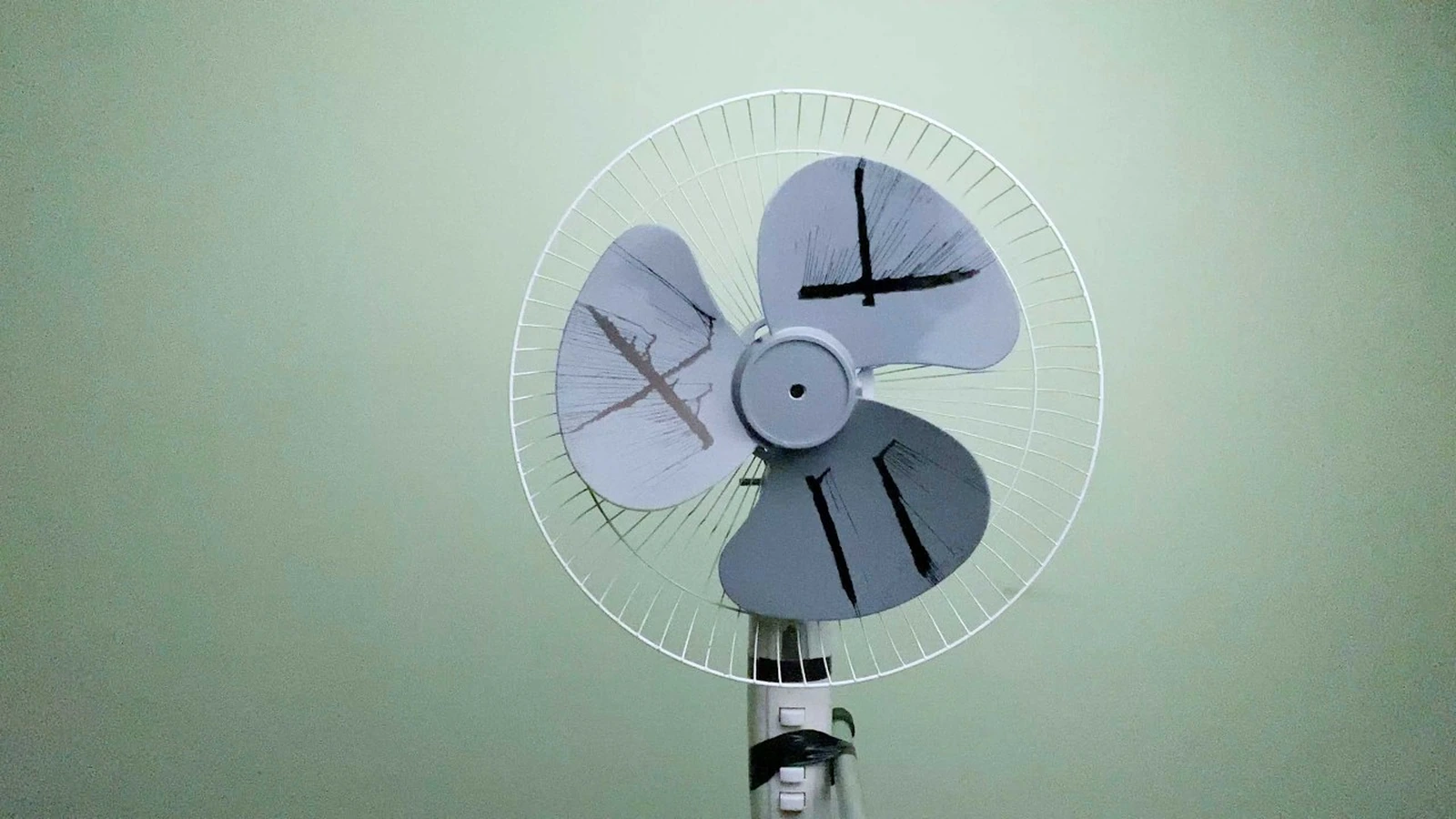
Pavel Mamontov, known as Lensevision, matches a fan’s rotation to camera capture so that its blades appear stationary while they keep spinning.
Different marks on the blades reveal the interesting part: an apparently fixed image can conceal movement between consecutive frames.
The marks reveal the rotation
Mamontov marks the three blades and adjusts the motor speed with a potentiometer. At first, the fan’s outline appears fixed while the marks change positions. Further adjustment makes the marks appear stationary too, with apparent reverse rotation also occurring along the way.
Why the image appears frozen
The explanation lies in the stroboscopic effect and temporal sampling: video gives us successive images with intervals between them. If the same arrangement reappears in every image, playback does not reveal how much rotation happened in between.
Consider three identical, evenly spaced blades recorded at 30 fps. At 10 revolutions per second, or 600 rpm, the fan turns one third of a revolution between frames. Each blade takes the previous blade’s position. The outline repeats, but a unique mark moves to the next position.
For every individual mark to return to its own position, this idealised example requires a full revolution per frame: 30 revolutions per second, or 1,800 rpm. This is a calculation of the synchronisation condition, rather than a published measurement of the fan’s speed in this experiment. Small departures from such a condition can produce a slight displacement between frames, read as slow movement in either direction.
What shutter speed changes
Frame rate determines how frequently images are recorded. Exposure time determines how much movement accumulates within each image. A shorter exposure reduces motion blur, helping the blades appear more distinct. The experiment’s exact shutter speed is not disclosed.
This differs from rolling shutter distortion, where different parts of the image are captured at different times and a moving object can appear to change shape. Apparent stillness concerns the relationship between repetitive movement and successive frames. Both effects can occur together.
What we think
The different marks are the smartest part of this experiment. They make us notice which blade we are looking at, rather than accepting that a stationary outline means a stationary object. Such a simple addition makes a camera behaviour that can otherwise seem paradoxical much easier to understand.
When filming wheels, propellers or other repetitive movements, it is useful to inspect the recording itself as well as the sharpness of an individual frame. A crisp image can give a misleading impression of speed or direction. Choosing a frame rate affects how we communicate movement; deciding how much blur to retain within each frame is a separate creative decision.