Summary
- NASA featured a wide-angle composite by Julien Looten on October 13, 2026.
- The Desert Staircase sculpture appears to continue into the Milky Way.
- Zodiacal light, atmospheric airglow and the Small Magellanic Cloud are also visible.
- The composite dates from July 2025 and remains copyrighted by the photographer.
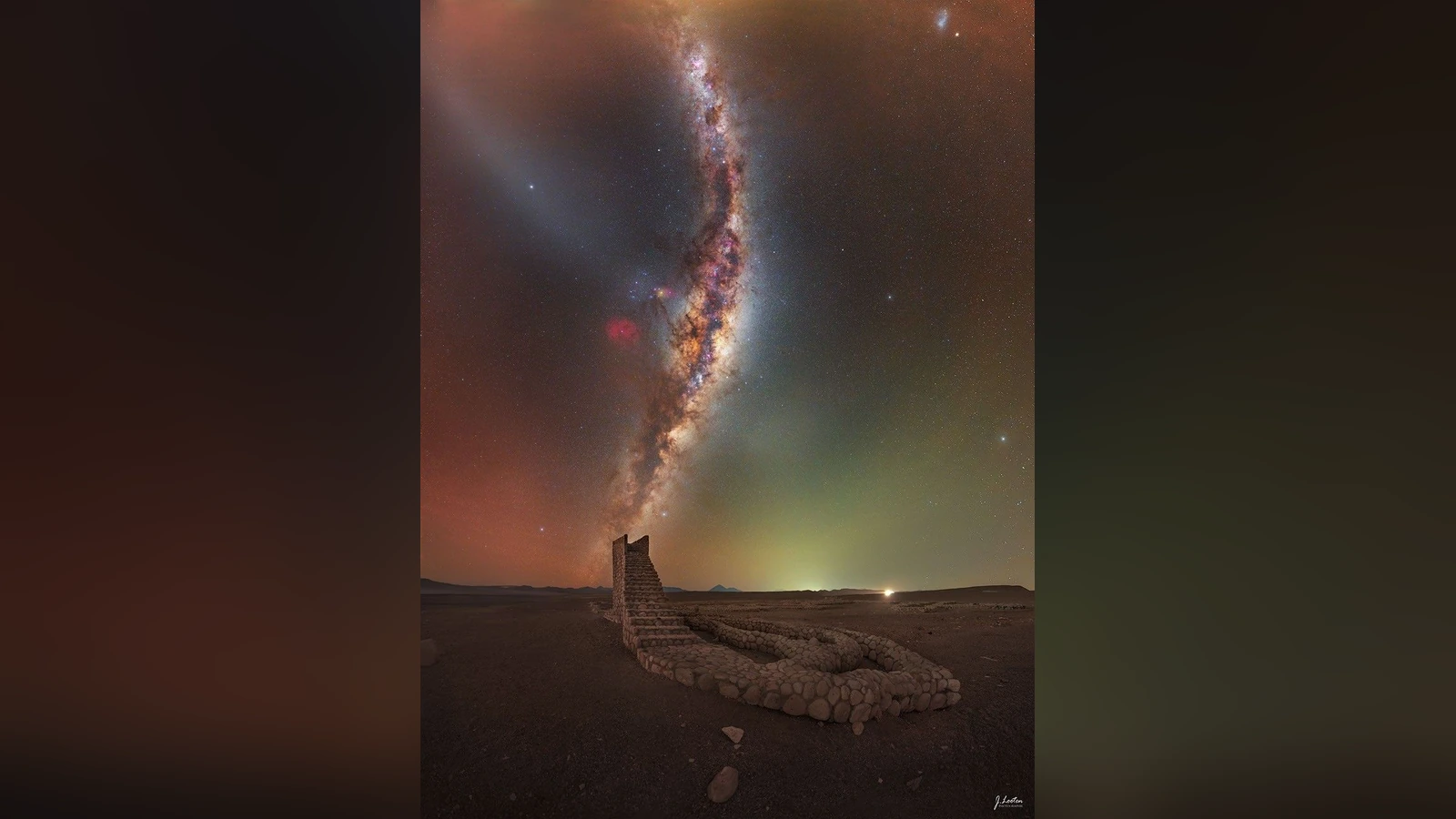
A stone staircase in Chile’s Atacama Desert appears to lead straight into the Milky Way, in a photograph where camera placement makes all the difference.
On October 13, 2026, NASA selected Desert Stairway to Heaven by Julien Looten for its Astronomy Picture of the Day. The wide-angle composite was captured in Chile in July 2025; the APOD date marks its publication, not the original photography.
Your eye follows the stone path across the desert, climbs the final steps and then continues almost seamlessly into the Milky Way’s bright, near-vertical band. The actual staircase ends with the sculpture. The journey beyond it exists only within the composition.
A sculpture and a carefully timed alignment
The foreground contains the real Desert Staircase sculpture in the open Atacama landscape. NASA says the picture was timed so the structure’s uppermost point stood directly in front of the nearly vertical Milky Way. Stone and stars meet through perspective and timing, not because the physical staircase extends into the sky.
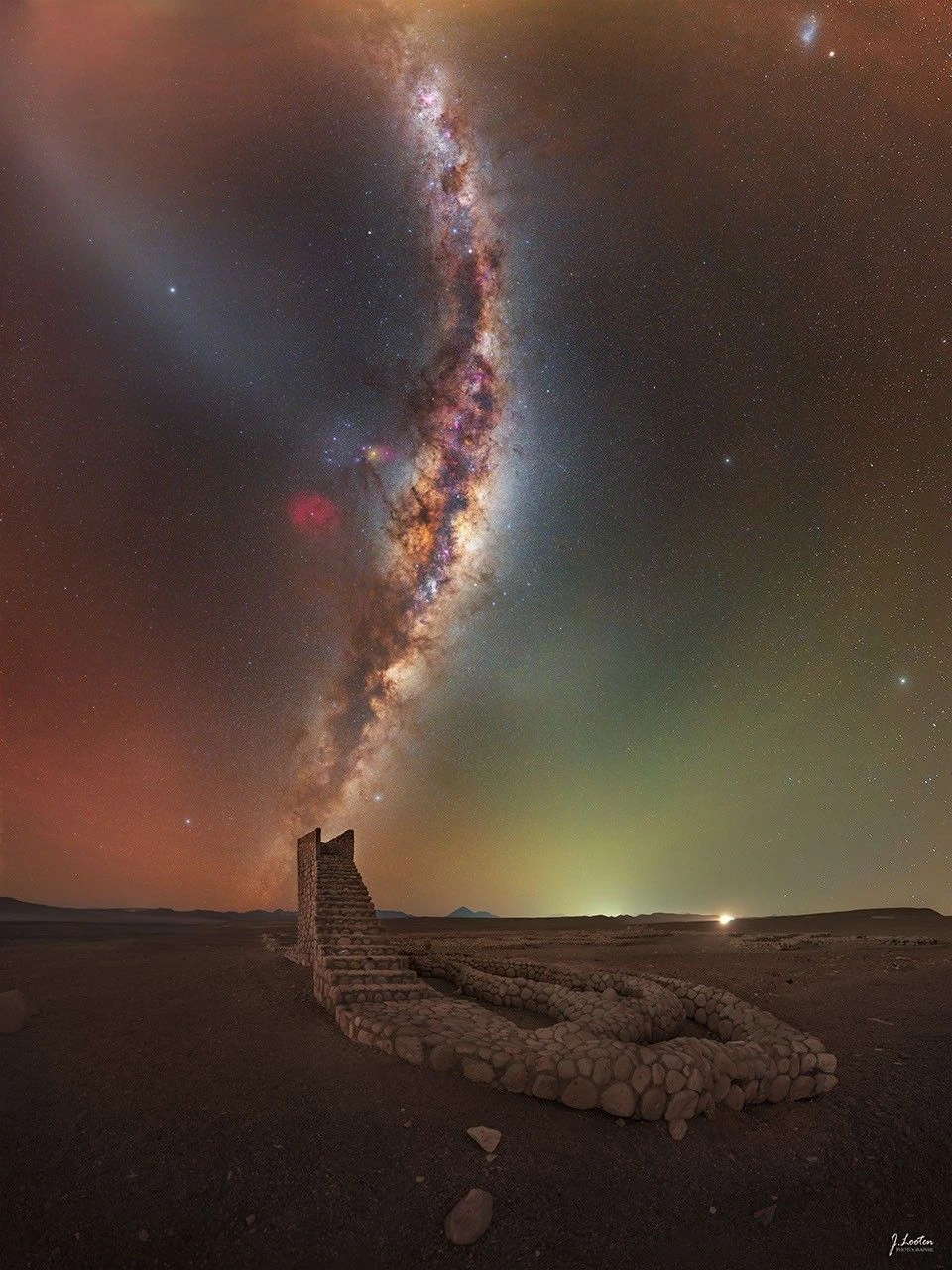
That simple relationship holds the photograph together. A human-scale structure gives viewers a place to begin, while the Galaxy supplies the visual continuation. Without the sculpture, the scene would be an impressive night sky; without the sky, an installation in the desert. Together, they form a clear visual direction.
Look beyond the Milky Way
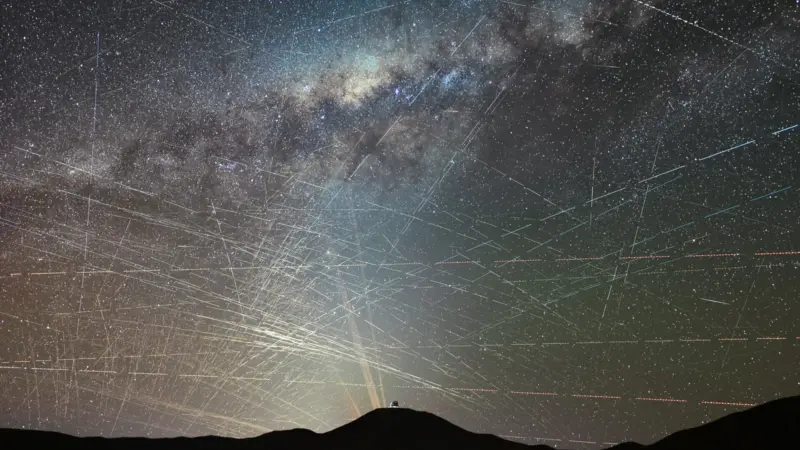
The luminous band is our own Milky Way, its starlight crossed by dark lanes of interstellar dust. Toward the upper left, NASA identifies zodiacal light, the faint glow of sunlight scattered by dust particles in the Solar System. The star Spica is also visible within that band of light.
Closer to the horizon, the green and red tones are not part of the Galaxy. They come from airglow, light naturally emitted in Earth’s upper atmosphere. Near the upper-right corner is the Small Magellanic Cloud, a nearby dwarf galaxy visible from southern skies.
A closer look at the horizon reveals sections of the Andes, Licancabur volcano and the distant lights of San Pedro de Atacama. They are small against the sky, but they place the photograph in a recognizable, specific landscape.
A composite, without a published exposure breakdown
NASA describes the work as a wide-angle composite. Its APOD description does not specify an exposure count, camera equipment or detailed processing workflow. It would therefore be misleading to call this a single untouched RAW frame—or to claim that the Milky Way was inserted into an unrelated landscape.
Looten has made other photographs in Chile. His “Sodium Galaxy” image from the Very Large Telescope at Paranal was included in the Milky Way Photographer of the Year 2026 selection. That is a separate photograph from another location in the Atacama, and it offers additional context for his interest in the region’s night skies.
It matters to distinguish the real location and planned alignment from the processing used to create the finished composite. We can appreciate the visual idea without attributing undocumented capture methods to NASA or the photographer.
What we think
The strongest decision in this image is not how many stars the photographer managed to record. It is where the staircase ends. Looten takes the top of a small sculpture and makes an enormous galactic structure look like its next step. Viewers can grasp the idea immediately, long before they know anything about astrophotography.
We also like the fact that the sky rewards a second look. Zodiacal light, atmospheric airglow and the Small Magellanic Cloud all have their own physical explanations. There is genuine astronomical depth here, but none of it distracts from the initial play on perspective.
One distinction matters for publication: NASA featuring someone’s photograph does not place it in the public domain. Copyright remains with Julien Looten, and republication requires appropriate permission or another valid right to use the image.
Frequently asked questions
Is the staircase a real structure?
Yes. It is the Desert Staircase sculpture in Chile’s Atacama Desert. Its apparent connection to the Milky Way comes from the carefully selected perspective.
Do we know how many exposures were used?
Not from this APOD description. NASA identifies the work as a wide-angle composite but does not provide a full technical breakdown.
Was the picture taken on October 13, 2026?
No. The composite was captured in July 2025 and featured by NASA’s APOD on October 13, 2026.