Summary
- ESA and IAU CPS have agreed to work together on satellite interference affecting astronomy.
- A one-hour composite from the Atacama Desert shows numerous bright trails.
- Proposed measures include darker spacecraft surfaces and reduced unwanted radio emissions.
- The agreement does not yet impose binding limits.
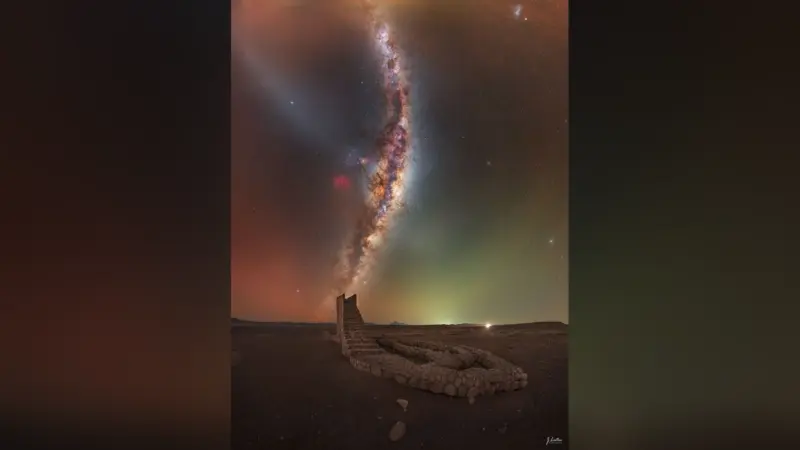
Just one hour of exposures above Chile’s Atacama Desert reveals how difficult it is becoming to photograph the night sky without a satellite passing through the frame.
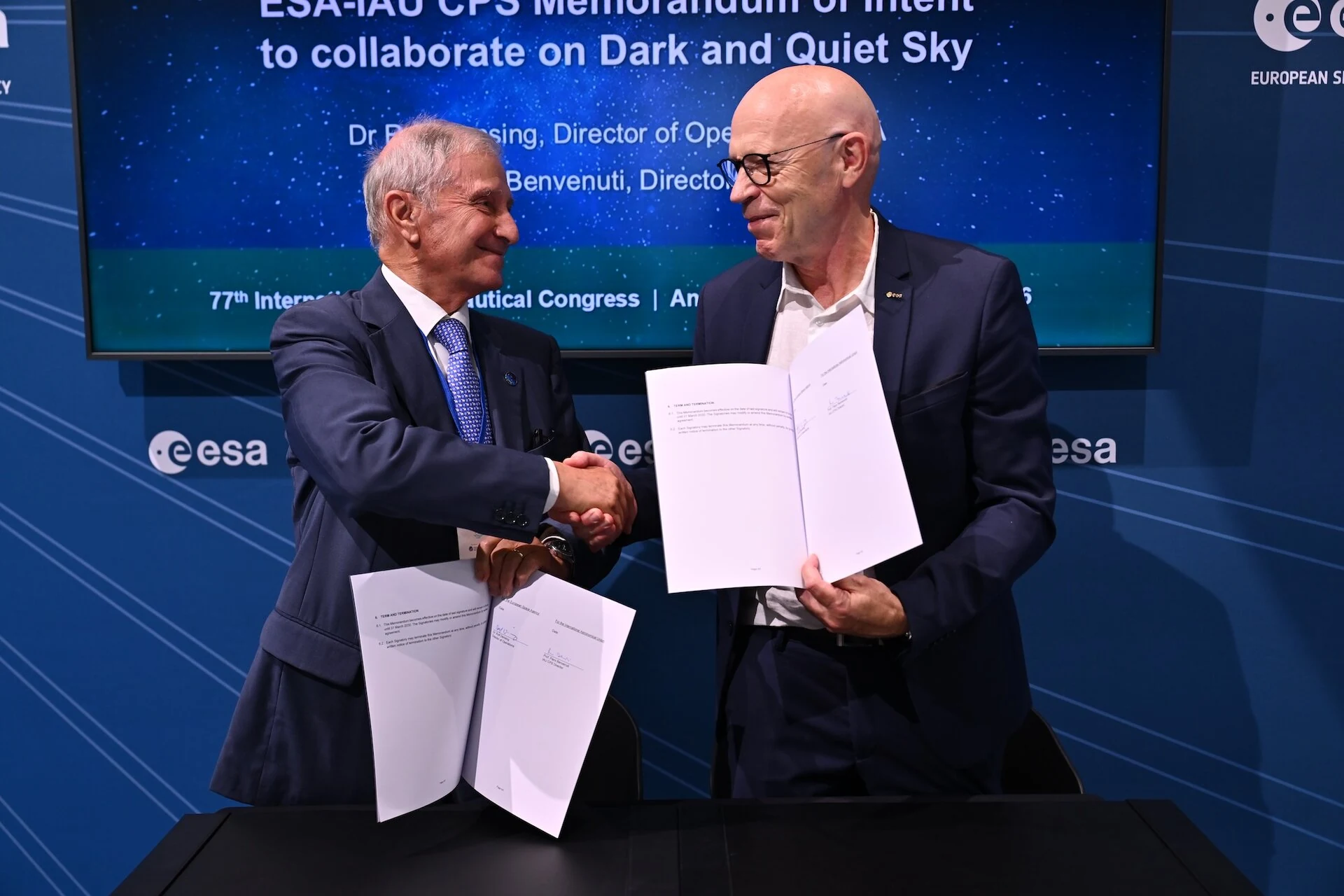
The European Space Agency (ESA) and the International Astronomical Union’s Centre for the Protection of the Dark and Quiet Sky (IAU CPS) have agreed to work together to reduce satellite-constellation interference with astronomy. ESA published its announcement on 8 October 2026, following the signing at the International Astronautical Congress.
What the Atacama image actually shows
Captured on 15 October 2025, about two hours after sunset, the image combines frames from a time-lapse covering just one hour. Most of the luminous streaks come from satellites; a few are aircraft trails, identifiable by their intermittent coloured lights.
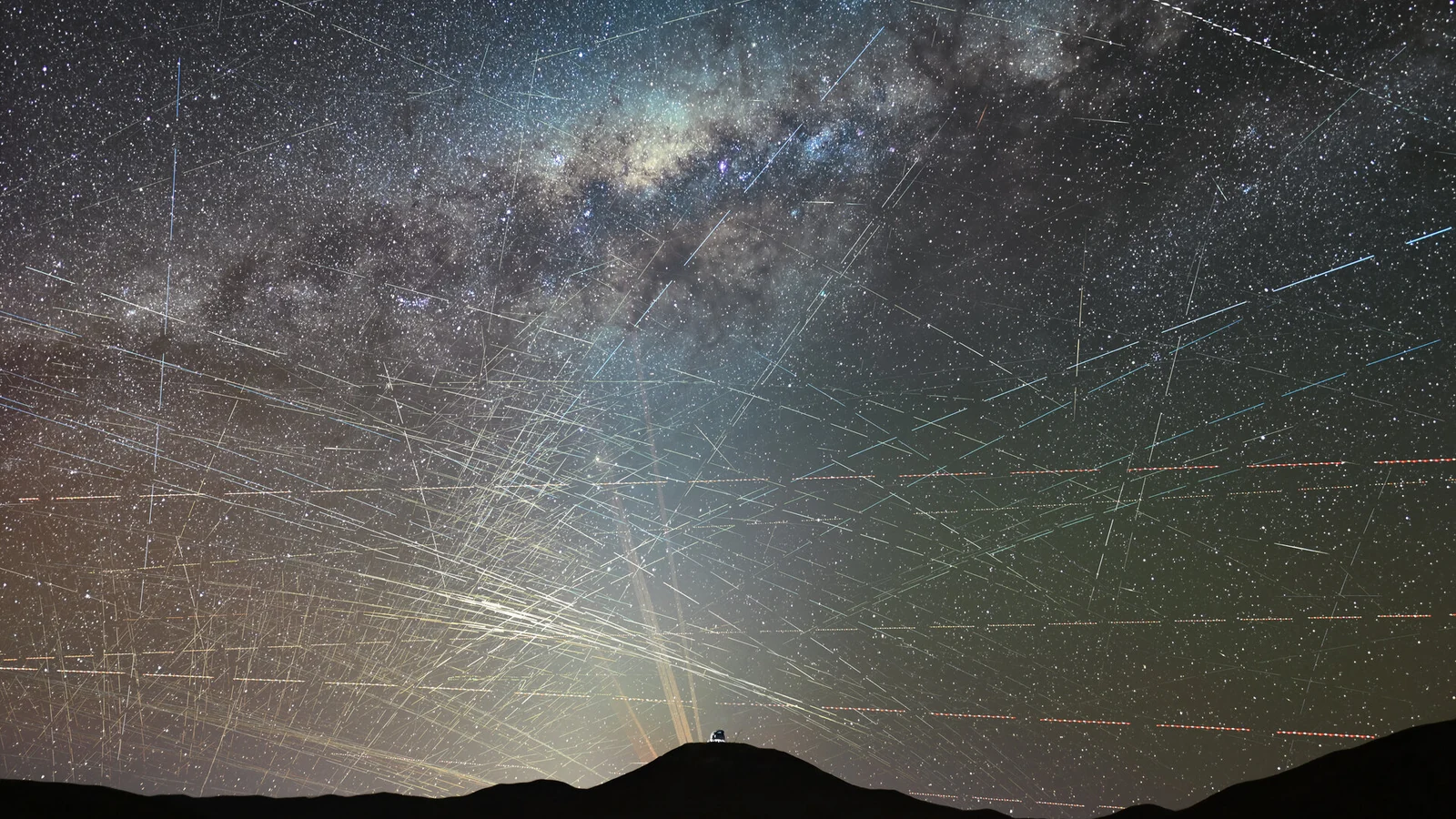
The foreground contains the dome of the Extremely Large Telescope (ELT), under construction on Cerro Armazones. Beyond it are the laser beams of the Very Large Telescope (VLT) at Paranal, 22 kilometres away. These observatory sites were chosen partly for their exceptionally dark skies. Darkness on the ground, however, is no longer enough to guarantee uninterrupted exposures.
Why satellites interfere with photography
Low-Earth-orbit satellites reflect sunlight, leaving lines when they pass through a long exposure. The problem reaches beyond major observatories: landscape astrophotography, panoramas and time-lapses can require frame rejection or additional editing. Removing a streak does not necessarily recover the image information hidden beneath it.
This concern has already prompted discussions about limits on satellite numbers and brightness. Meanwhile, proposals for vastly larger orbital fleets underline why spacecraft design matters before yet more objects enter the sky.
There is also a separate, invisible source of interference. Unintended radio emissions from satellite electronics can disturb sensitive radio telescopes. That is why the goal is both a “dark” sky and a “quiet” one; reducing optical reflections alone will not solve radio-frequency interference.
What ESA and the IAU CPS agreed
The organisations signed a Memorandum of Intent to collaborate. ESA will supply engineering expertise and links to the space industry, while the IAU CPS brings together astronomers, research institutions, observatories and other groups studying how satellite constellations affect astronomy.
Their proposed work includes less reflective spacecraft surfaces, electronics that minimise unwanted radio emissions, and modelling tools that predict satellite visibility from Earth. They also plan dialogue with satellite operators and the development and promotion of industry best practices.
This is not yet a binding satellite-brightness limit, a new launch regulation, or a technology already installed across the orbital fleet. It establishes a framework for developing solutions; it does not erase satellite trails visible today.
What we think
For anyone who stays out late to capture the Milky Way or a clean time-lapse, the Atacama photograph makes the problem remarkably tangible. Even at one of the world’s finest observing sites, having a dark landscape no longer means the sky above is unaffected.
It is encouraging that ESA is focusing on spacecraft design itself. Reducing unwanted reflections and emissions at their source is more sensible than continually expecting photographers and scientists to repair the consequences. Editing can rescue some images, but the cost of interference should not automatically fall on the people trying to document the sky.
The partnership will be meaningful when it produces measurable design changes, widespread adoption by operators and transparent evidence of effectiveness. Today it represents a concrete commitment to cooperation, not a promise that tomorrow night’s photographs will be free of streaks.
Frequently asked questions
Are all the streaks in the picture satellites?
No. The original image description says most are satellites, but a few are aircraft trails with intermittent coloured lights.
Does the agreement ban bright satellites?
No. It is a collaboration to develop engineering solutions and good practices, not a new binding brightness cap or blanket prohibition.