

Summary
- A new ESO study examines the impact of large satellite constellations on astronomy
- The organisation proposes a limit of 100,000 faint satellites around Earth
- Current proposals could add more than 1.7 million new satellites
- Simulations show field-of-view losses of up to 28% for the VLT
- Reflect Orbital’s mirror satellites could significantly brighten the night sky
A new European Southern Observatory study proposes that no more than 100,000 satellites should orbit Earth, under strict brightness conditions.
The European Southern Observatory, ESO, has published a study indicating that current proposals for more than 1.7 million new satellites in orbit could have serious consequences for ground-based astronomy.
The warning matters because the rapid growth of satellite constellations does not only affect the appearance of the night sky, but also the ability of large telescopes to observe faint galaxies, exoplanets and potentially hazardous asteroids.
The 100,000-satellite limit
According to the study, the total number of existing and future satellites should be limited to around 100,000, provided that these satellites are faint enough not to be visible to the naked eye from a dark site.
Olivier Hainaut, an ESO astronomer and author of the study, stresses that this number is not an absolute technical threshold. He explains that even 100,000 satellites would cause losses comparable to other technical losses, such as equipment failures, while he would personally prefer a much lower number.
The critical factor is brightness. If some satellites are brighter than the naked-eye visibility threshold, then the acceptable total number should be significantly lower.
Why the astronomy community is concerned
Since 2019, the number of satellites in orbit has risen rapidly and now exceeds 14,000, with much of the increase linked to SpaceX’s Starlink telecommunications constellations.
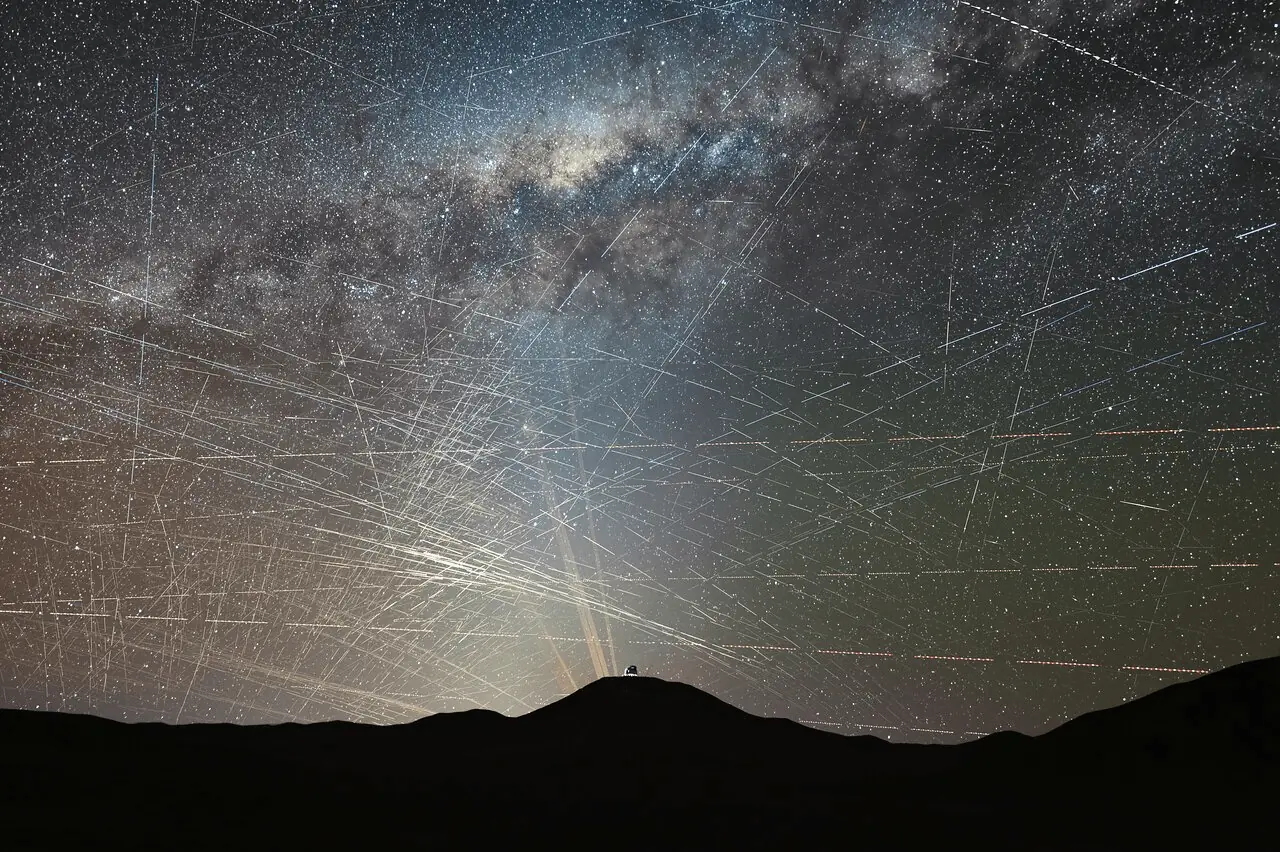
Satellites are illuminated by the Sun and appear in telescope images as bright streaks. When they pass through the field of view, they can cover or destroy the information behind them.
The problem is not limited to the trails satellites leave in images. The overall diffuse light from large constellations can increase the brightness of the sky, reducing the ability to observe very faint celestial objects.
What the simulations show
The study simulated the positions, motion and brightness of current and planned satellite constellations. For SpaceX’s proposed megaconstellation, the results show that images taken two hours into the night with ESO’s Very Large Telescope at Paranal Observatory in Chile could contain dozens of satellite trails.
In this scenario, field-of-view losses could reach up to 28%, even if the satellites are faint enough not to be visible to the naked eye. If they are only slightly brighter, cameras like that of the Vera C. Rubin Observatory could see a large share of their images rendered unusable for several hours each night.
Reflect Orbital’s mirror satellites
Particular concern also surrounds the proposal by Reflect Orbital, a US startup that aims to deploy large satellites with reflective mirrors in order to provide sunlight after sunset.
The company plans a test satellite and, according to ESO, aims to reach up to 50,000 satellites by 2035. The study states that a single such satellite could spoil an observation with a Rubin Observatory-type camera, while a fully deployed fleet could result in every image being lost when the satellites are illuminated by the Sun.
ESO also notes that a full constellation of 50,000 such satellites could make the sky overall up to three or four times brighter.
The issue now moves to regulators
SpaceX and Reflect Orbital have filed requests with the US Federal Communications Commission, FCC, for permission to launch their proposed constellations.
ESO, in collaboration with the UK’s Royal Astronomical Society and the International Astronomical Union, used the new study as the basis for its response to the FCC.
The organisation’s position is that the issue represents an existential threat to optical astronomy if clear limits and strict satellite brightness mitigation measures are not adopted.
What we think
Satellite constellations have real value for communications and technology services, but the sky is not an unlimited space without consequences. ESO’s study shows that the debate cannot focus only on whether there is physical room in orbit, but must also include the protection of astronomy, dark skies and scientific observation.
Frequently Asked Questions
How many satellites currently orbit Earth?
According to ESO, there are currently more than 14,000 satellites in orbit around Earth.
What limit does the new study propose?
The study proposes a limit of around 100,000 satellites, provided that they are faint and not visible to the naked eye from a dark site.
Why do satellites interfere with telescopes?
Satellites reflect sunlight and can appear as bright streaks in images, covering celestial objects and reducing data quality.
Which companies are mentioned in the study?
The study refers to major proposals such as those by SpaceX and Reflect Orbital, while also mentioning other planned constellations.
What happens if the satellites are brighter?
If satellites are visible to the naked eye or brighter than the proposed threshold, the total number that astronomy can tolerate would need to be much lower.