

Summary
- Royal Museums Greenwich has revealed a selection of images from the ZWO Astronomy Photographer of the Year 2026 shortlist
- Almost 4,000 images were submitted by 769 different entrants
- The photographs cover the Moon, the Sun, aurorae, comets, galaxies, nebulae, meteors, Mars and the Milky Way
- The selection includes images from the USA, France, Switzerland, New Zealand, Norway, Iceland, Chile, China and Namibia
- The full shortlist, winners and runners-up will be announced on 17 September
Royal Museums Greenwich has revealed a selection of images from the shortlist of the ZWO Astronomy Photographer of the Year 2026.
Almost 4,000 images from 769 different entrants were submitted to the 2026 international astrophotography competition, with the first selection including shots of the Moon, the Sun, auroras, comets, galaxies, nebulae, meteors, planets and our Milky Way.
The announcement is particularly significant, as the competition is one of the most important reference points for astrophotography, highlighting images that combine technical precision, scientific interest, creative composition and patience.
The First Selection From the Shortlist
Royal Museums Greenwich presented a selection of images that have made it onto the shortlist of the ZWO Astronomy Photographer of the Year 2026, offering a first look at the standard of this year’s competition.
The photographs cover a wide range of subjects, from urban landscapes with the Moon and solar phenomena to deep-sky objects, galaxies, nebulae, auroras and experimental long-exposure techniques.
Among the images are the rising Buck Moon over Seattle, the path of the Full Moon over Paris, Comet C/2025 A6 Lemmon over the Swiss Alps, the Helix Nebula from Chile and a mosaic of the core of our Milky Way from Namibia.
Moon, Sun and Celestial Phenomena
The Moon has a strong presence in this year’s selection, sometimes as the main subject and sometimes as a compositional element in landscapes featuring cities, mountains and famous landmarks.
In AJ Smadi’s image, the orange Buck Moon rises above Seattle, illuminating the city at twilight. Martin Giraud uses careful planning to capture the Full Moon aligned with the Eiffel Tower and Sacré-Cœur, while Fredric Walder records the setting Full Moon over the Golden Gate Bridge.
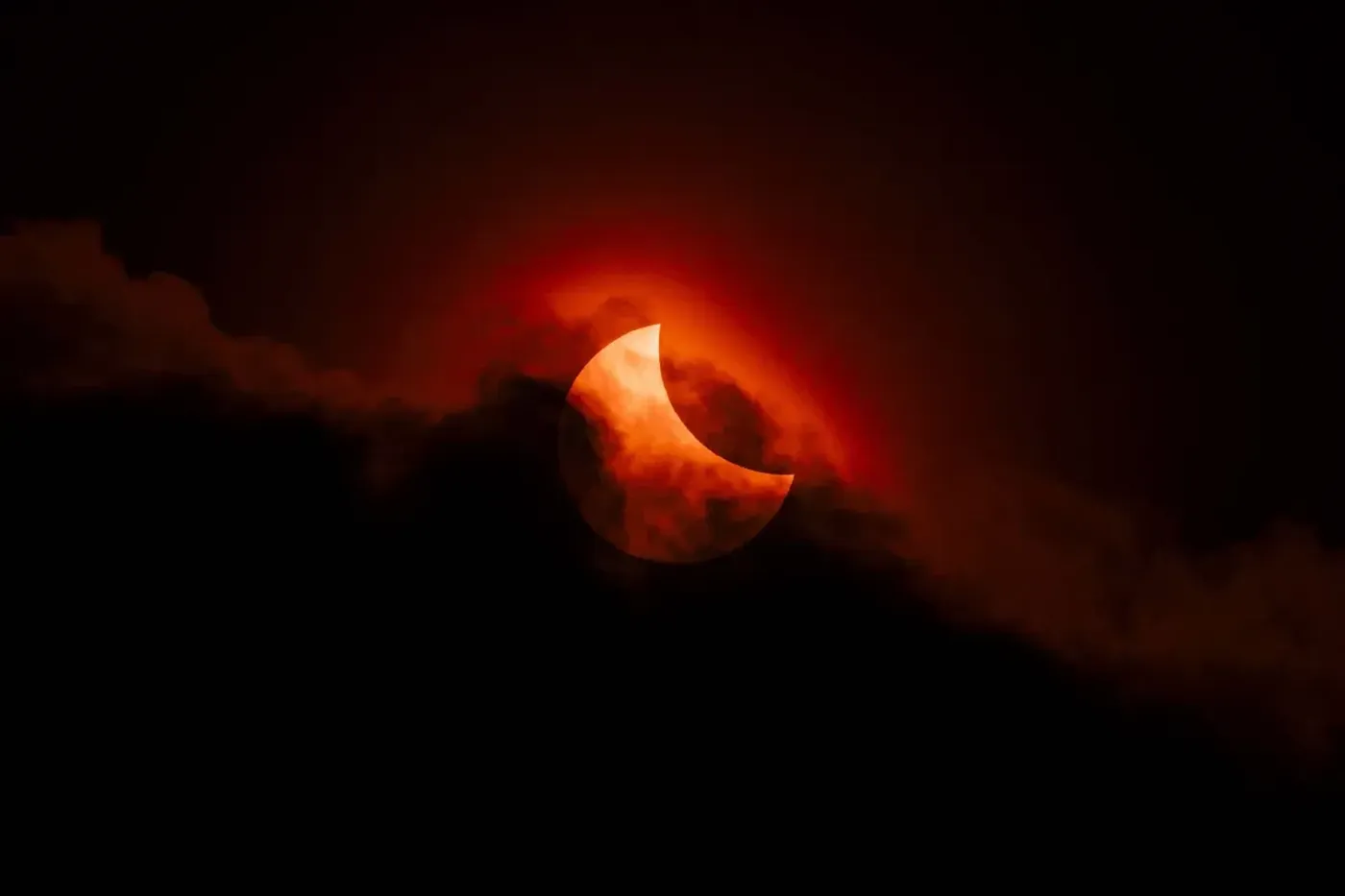
The Sun is presented through different approaches. James McBeath photographs the 2025 partial solar eclipse through clouds, Mario Cogo captures the solar limb with plasma and inverted tones, while 14-year-old Lin Yuchen enters the youth category with a high-resolution H-alpha image of the Sun’s chromosphere.
Auroras, Landscapes and the Night Sky
The aurora images stand out for their intensity and colour variety. From Norway to Iceland and Utah, photographers captured skies filled with green, red and purple hues.
Julien Cadena photographed an exceptionally intense aurora over the peaks of Norway, Yifan Cao combined the phenomenon with Goðafoss waterfall in Iceland, while Samuel Morse captured the aurora over Causey Reservoir in a single exposure.
The nightscape images also include Evan McKay’s shot at Cathedral Cove in New Zealand, Uroš Fink’s image at Velika Planina in Slovenia and João Yordanov Serralheiro’s photograph of star trails over the Scallop sculpture on Aldeburgh Beach.
Deep Sky and Planets
The selection also includes demanding deep-sky images, revealing the structure of galaxies, nebulae and star-forming regions.
The image of Andromeda by Chuhong Yu and Zuoming Wang shows M31 in optical and near-infrared wavelengths, highlighting regions of ionised gas, dust and new star formation.
Humbert Cédric presents the Helix Nebula, one of the closest and most impressive planetary nebulae, while Yijing Zhu and Xinghan Yang photograph the galaxies M81 and M82, two neighbouring systems that interact gravitationally.
In the planets category, Tom Williams presents a composite image of Mars after opposition, showing the rapid decrease in the planet’s apparent size as it moves away from Earth.
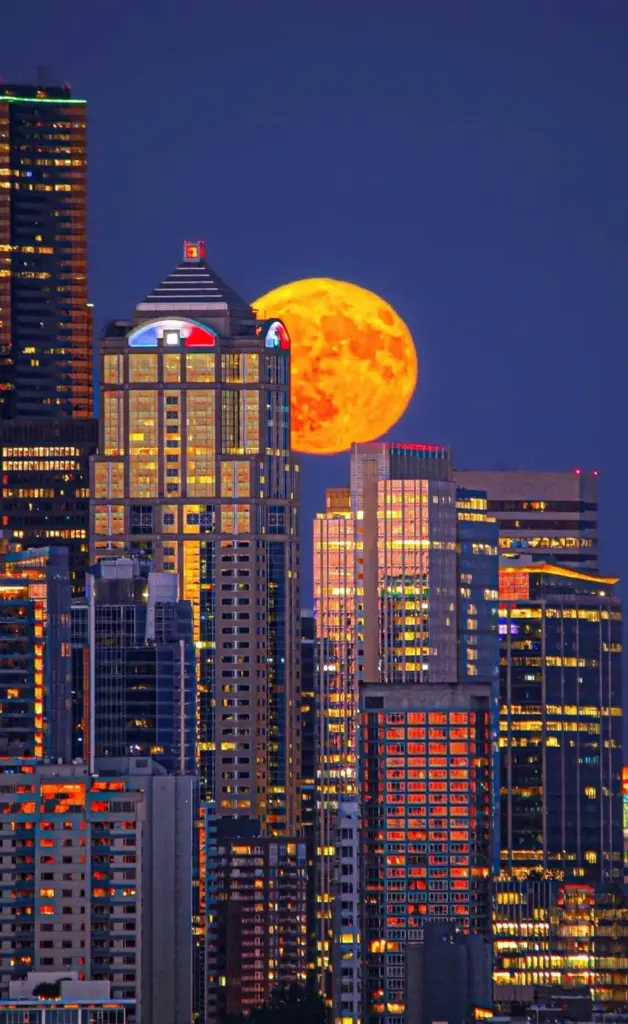
Golden Moonrise Over Seattle, by AJ Smadi. Seattle, Washington, USA. The image shows the city of Seattle illuminated at twilight during a summer sunset. Above the city, the orange Buck Moon is rising. The colour of the Moon, as reflected on the Seattle horizon, casts a golden light across the entire city. Its deep glow adds intensity to the image and creates contrast between the elegant lines of the complex architecture and the raw, rugged relief of the landscape.
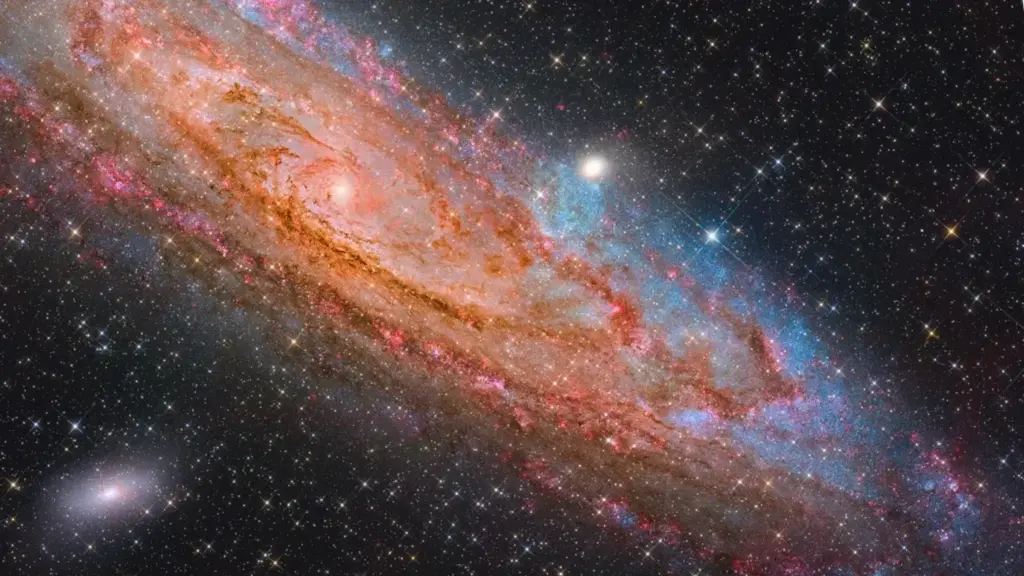
The Crimson Vortex and Sapphire Blossoms of Andromeda, by Chuhong Yu and Zuoming Wang. Zhuanghe City, Liaoning Province, China. This deep-field image of the Andromeda Galaxy, M31, captures its dual nature: a crimson vortex of ionised gas and dust spiralling towards the supermassive black hole at its centre, and sapphire “blossoms”, bright blue stellar nurseries blooming along its spiral arms. The image was captured in both optical and near-infrared wavelengths and reveals the galaxy’s dynamic balance through the strong contrast between red and blue, with matter falling towards the core while new stars light up in the arms. The creators said they were impressed that they managed to distinguish the galaxy’s faint stars, as well as the vortex near the core.
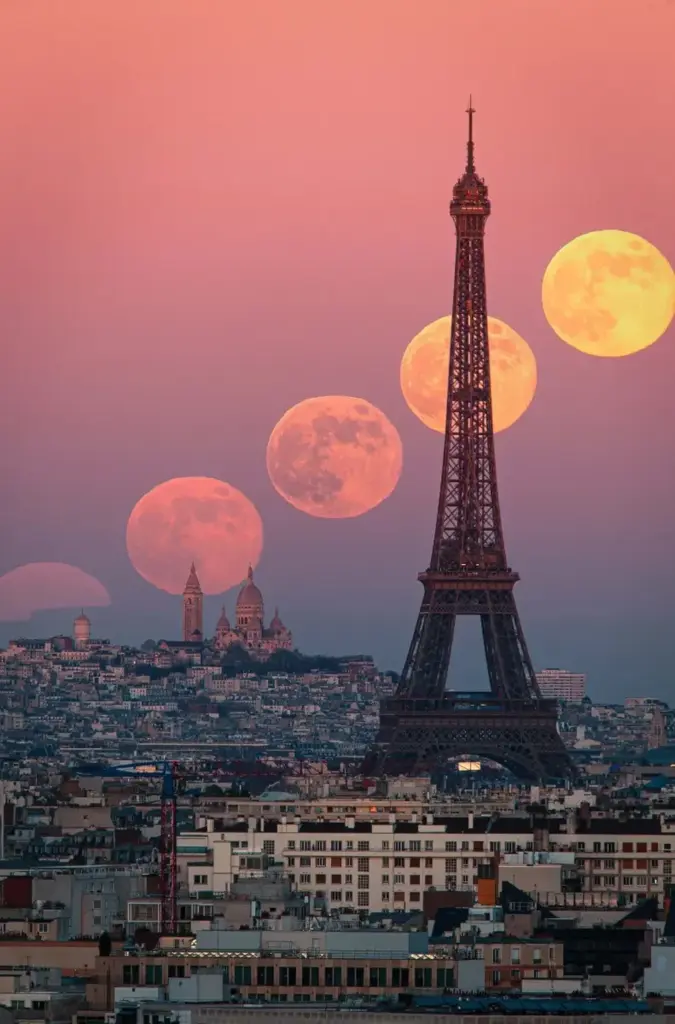
Supermoon Path Over Paris at Sunset, by Martin Giraud. Meudon, Île-de-France, France. A few days before New Year’s Day, the photographer noticed in his planning app that the first Full Moon of 2026 would rise in perfect alignment with a spot he had identified years earlier. The Eiffel Tower was 6.3 kilometres from his position and the Basilica of Sacré-Cœur was 11.1 kilometres away. This explains why the Moon appears so large in the frame. At this distance, it is quite rare for all the necessary conditions for the shot to come together. The location had to provide perfect alignment between the photographer, the buildings and the rising Moon. A difference of only a few metres would have ruined the composition.
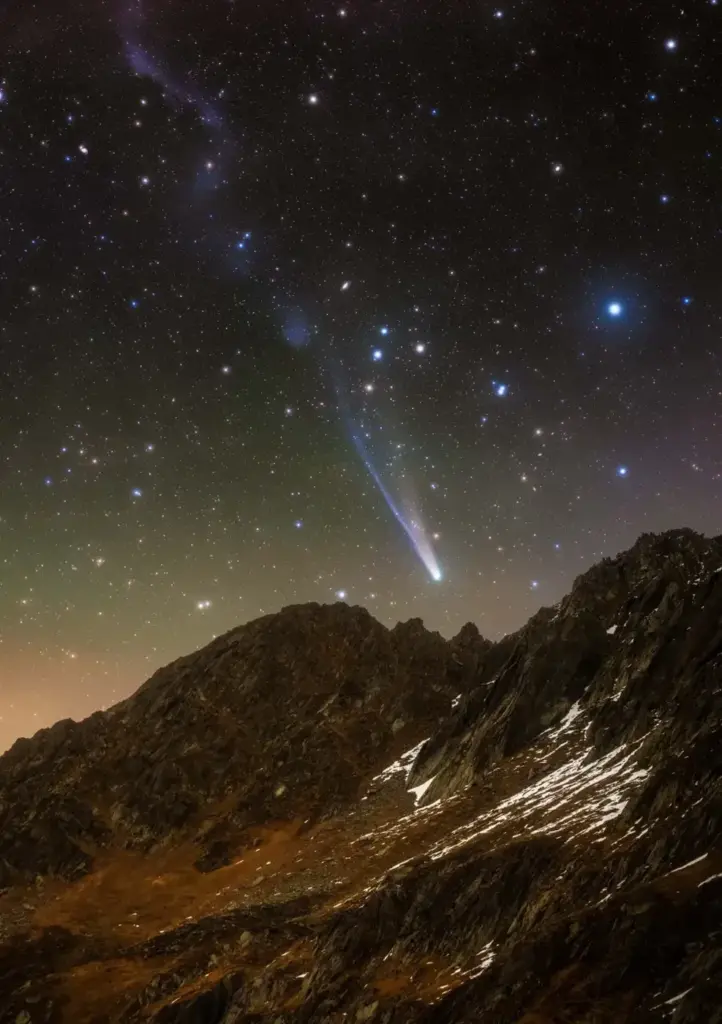
Comet C/2025 A6 (Lemmon) Over the Swiss Alps, by Jakob Sahner. Tujetsch, Graubünden, Switzerland. The photograph shows Comet C/2025 A6 Lemmon in the early morning hours. The four-hour hike to the location was worth it, even though the photographer had not previously planned how he would photograph the comet. He drove deep into the Swiss Alps to make use of the last clear night before the new lunar cycle. The landscape was impressive and provided an ideal foreground for the comet.
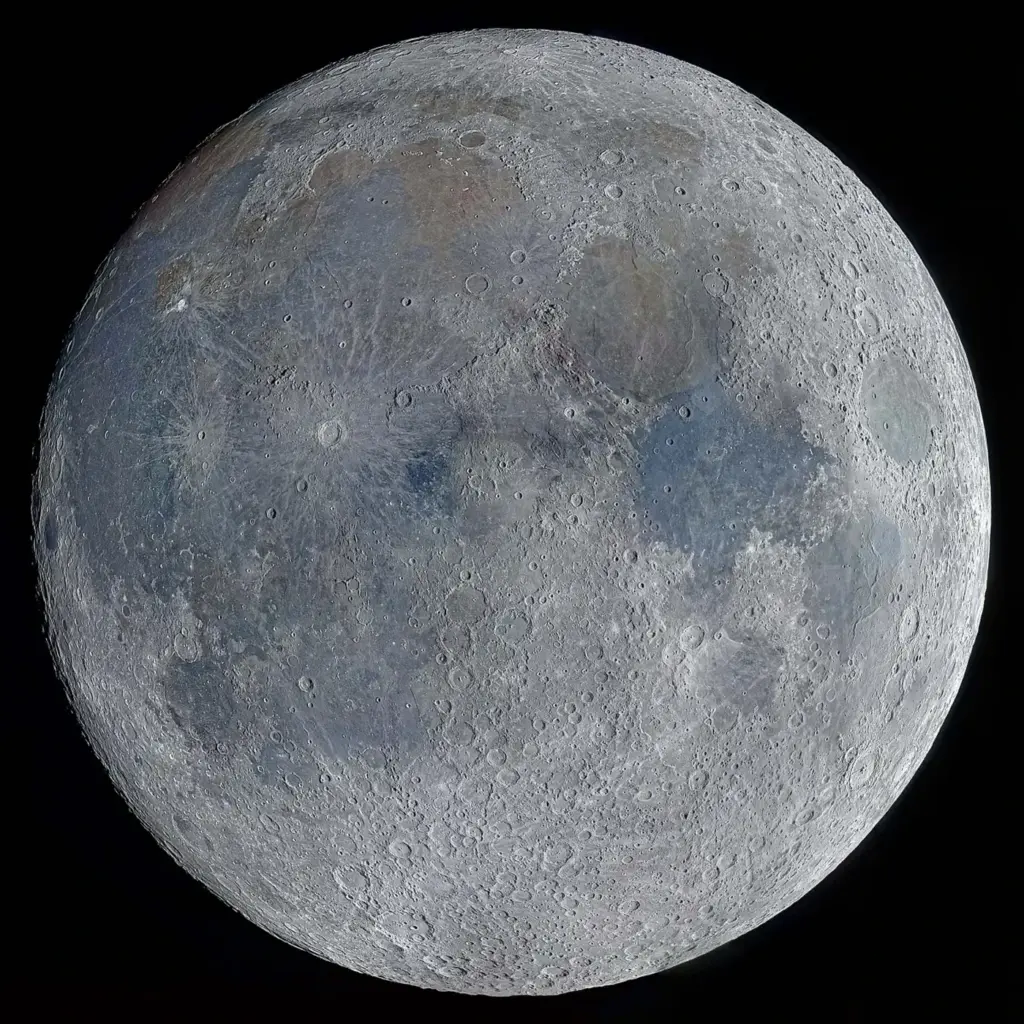
Shadow Moon, by Richard Addis. Wallasey, Merseyside, England. The photographer had always wanted to create a composite image using photographs from every lunar phase, from New Moon to Full Moon. In April 2025, he finally had the opportunity. Two weeks of clear skies, something extremely rare in the United Kingdom, allowed him to collect enough data to complete this labour of love. The image shows shadow detail across the entire lunar surface, something that cannot be seen during the Full Moon, when the surface is directly illuminated. It truly highlights the lunar landscape and creates a beautiful study.
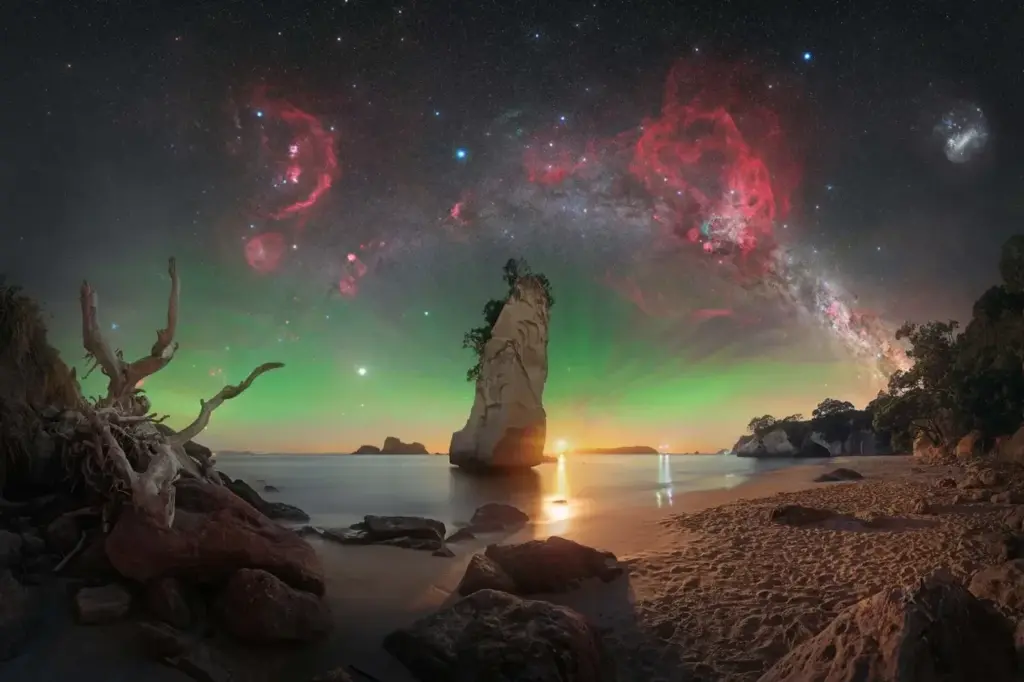
Te Hoho Rock Moonrise, by Evan McKay. Cathedral Cove, Waikato, North Island, Aotearoa New Zealand. On that particular night, the photographer had only a small window of time to capture the sky before the Moon began to rise, so he decided to make the most of it. He polar-aligned his mount during twilight and then began photographing the sky panorama from that location. The Moon started rising shortly after he completed the sky, so he then captured the foreground. The moonlight gave him the best result in both layers and beautifully illuminated the foreground. To enhance the sky, he photographed a separate panorama with a dual narrowband filter and blended it in to bring out the nebulae.
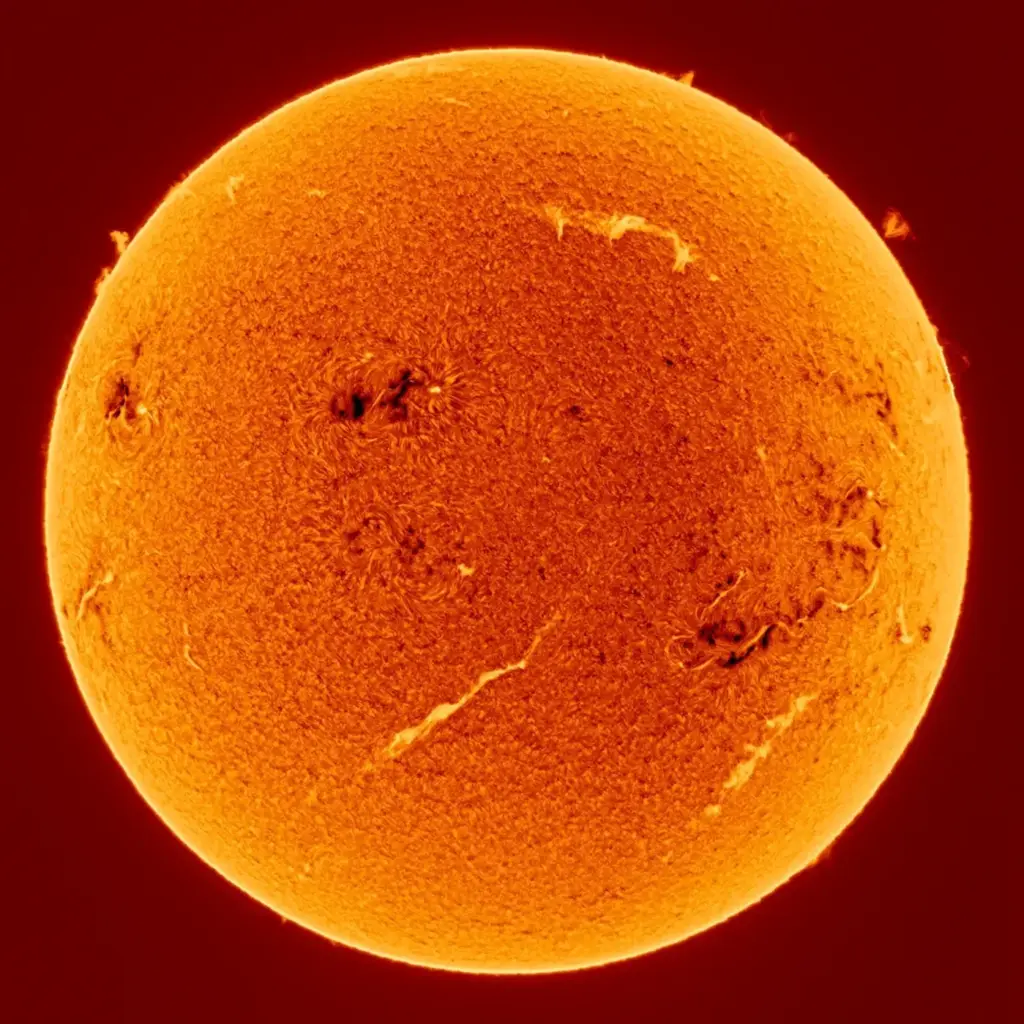
Dancing Flames, by 14-year-old Lin Yuchen. Xiamen, Fujian Province, China. Selected in the youth category of the ZWO Astronomy Photographer of the Year. This high-resolution H-alpha image of the Sun’s chromosphere was captured from the photographer’s home under decent seeing conditions. It reveals intricate surface details, such as sunspots, solar flares, filaments and prominences along the solar limb.
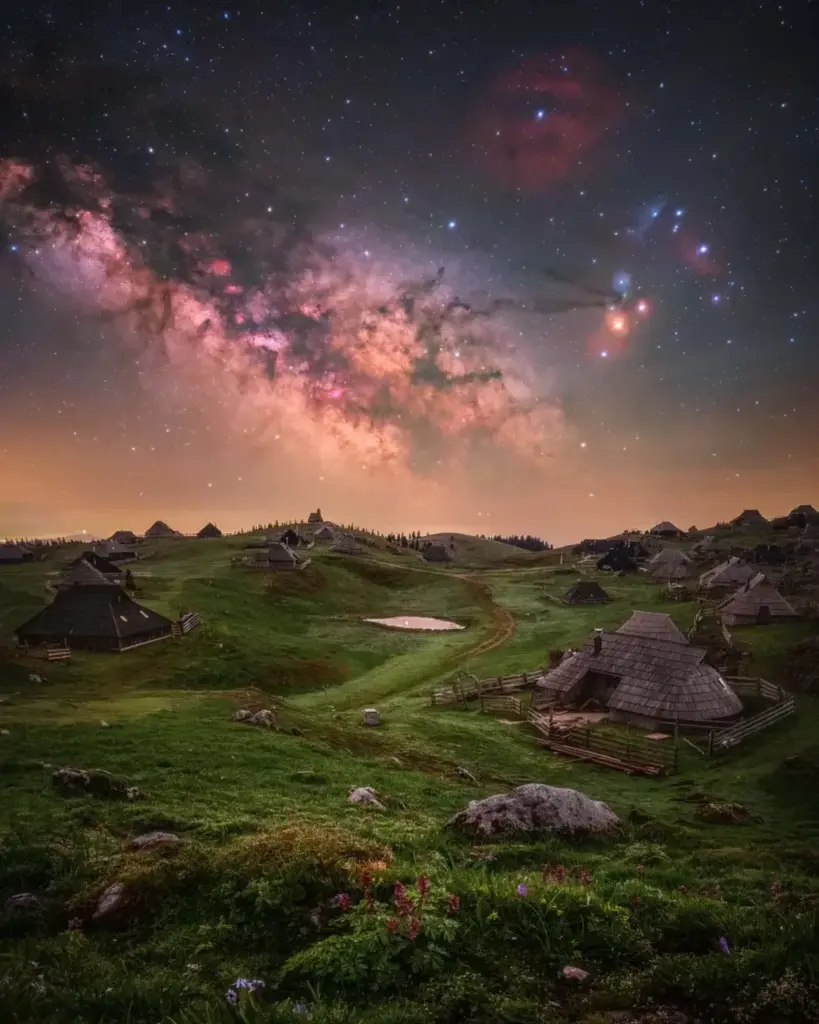
Fairyland, by Uroš Fink. Velika Planina, Kamnik-Savinja Alps, Slovenia. Velika Planina is one of the most beautiful places in Slovenia, a paradise for photographers, where they never run out of compositions. In the foreground of the image is a settlement with the wooden huts that are characteristic of the area, while in the background the core of our Milky Way rises in all its beauty.
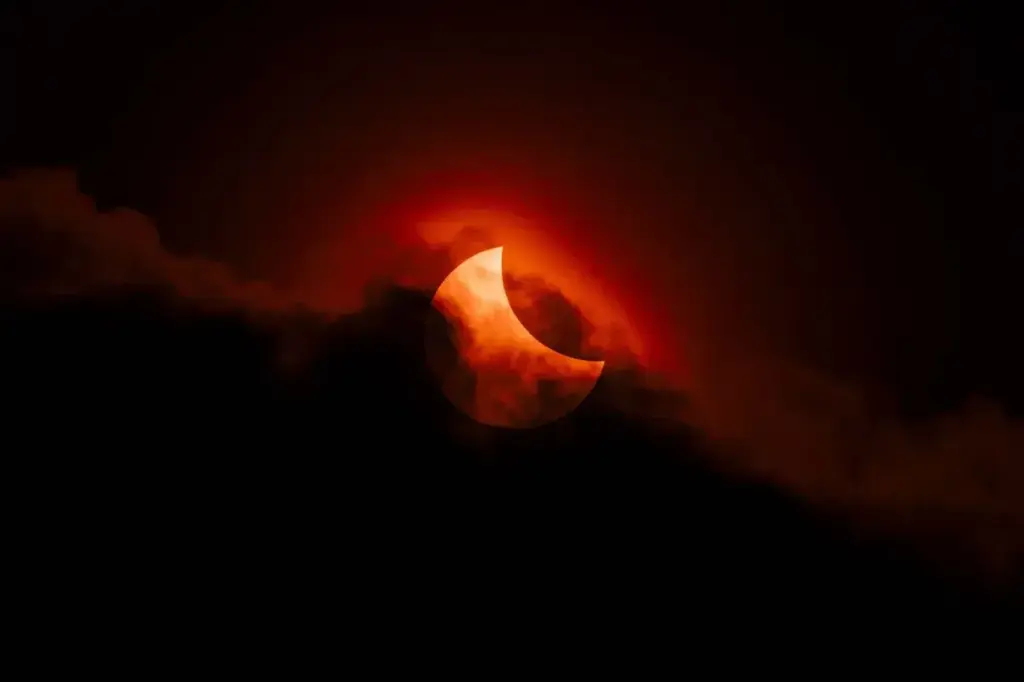
Moody Partial Solar Eclipse, by James McBeath. The 2025 partial solar eclipse was photographed through fast-moving clouds on a beautiful spring morning. The photographer spent several hours in a local park watching the eclipse with his camera, showing many passers-by what he was doing and giving them a good view of the eclipse. He ended up with hundreds of shots, but this one, with the clouds perfectly framing the Sun, immediately caught his attention. He said he was very pleased with most of the photographs he took that day, but this one is by far the most dreamlike.
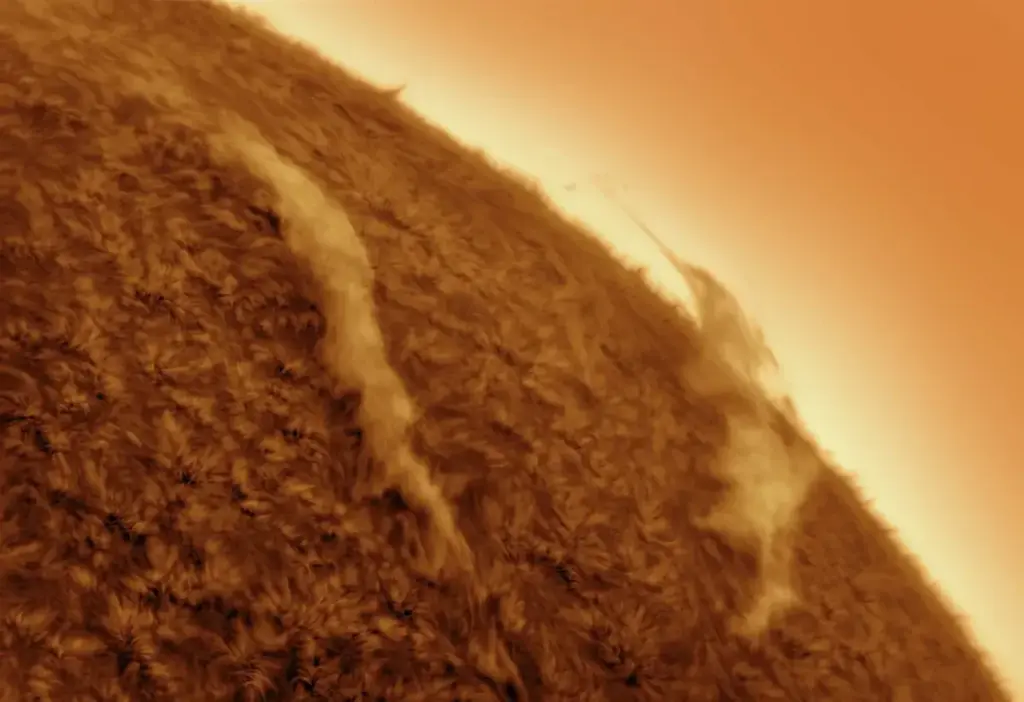
Suspended Plasma, by Mario Cogo. Monticello Conte Otto, Vicenza, Italy. The solar limb, presented with inverted tones and enhanced colour, reveals a “filaprom”, a filament-prominence formation rising like an arch of fire shaped by invisible magnetic forces. Nearby, a filament winds across the bright surface, cutting through the incandescent plasma. The tonal inversion enhances contrast and creates a strong sense of three-dimensionality, revealing the dynamic nature of our star.
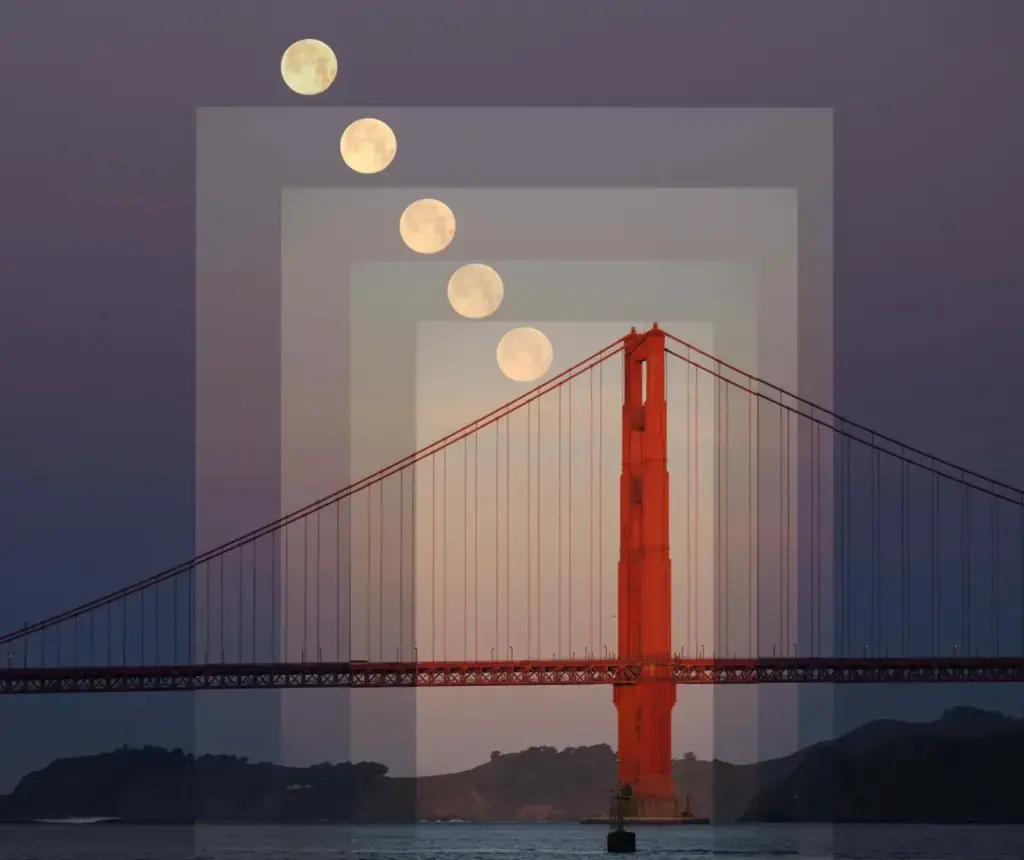
Fifteen Minutes of Moonset and Sunrise Over the Golden Gate, by Fredric Walder. San Francisco, California, USA. This composite image shows five separate shots of the setting Full Moon, captured as the sky changed from deep blue, where the pink glow known as the Belt of Venus was visible, to the full illumination of golden hour. The photographer tried to show the evolution of both the colour and brightness of the sky, while keeping the lunar disc at roughly the same brightness in each section.
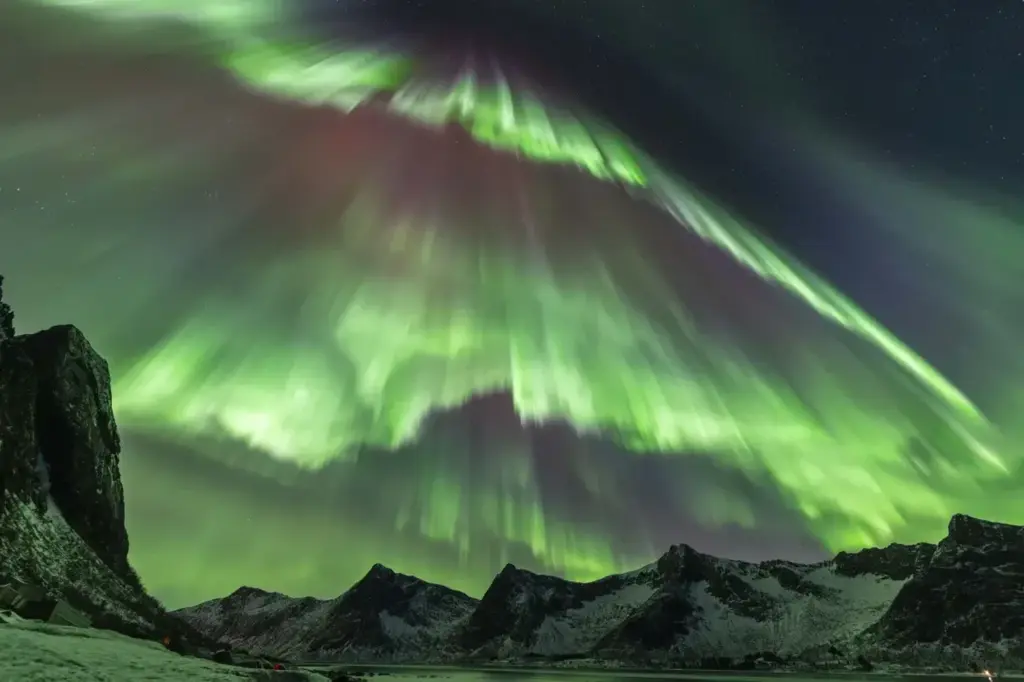
An Auroral Deluge, by Julien Cadena. Lyngen, Troms, Norway. The photographer had set up his camera facing the iconic “Devil’s Teeth” peaks on the island of Senja in Norway. He hoped the Northern Lights would rise directly above the jagged peaks, but instead they flared in the opposite direction. Their intensity and speed were breathtaking. The real challenge in the shot was avoiding overexposure from the extremely bright aurora. As a result, the foreground was underexposed, although this was easily balanced in post-processing.
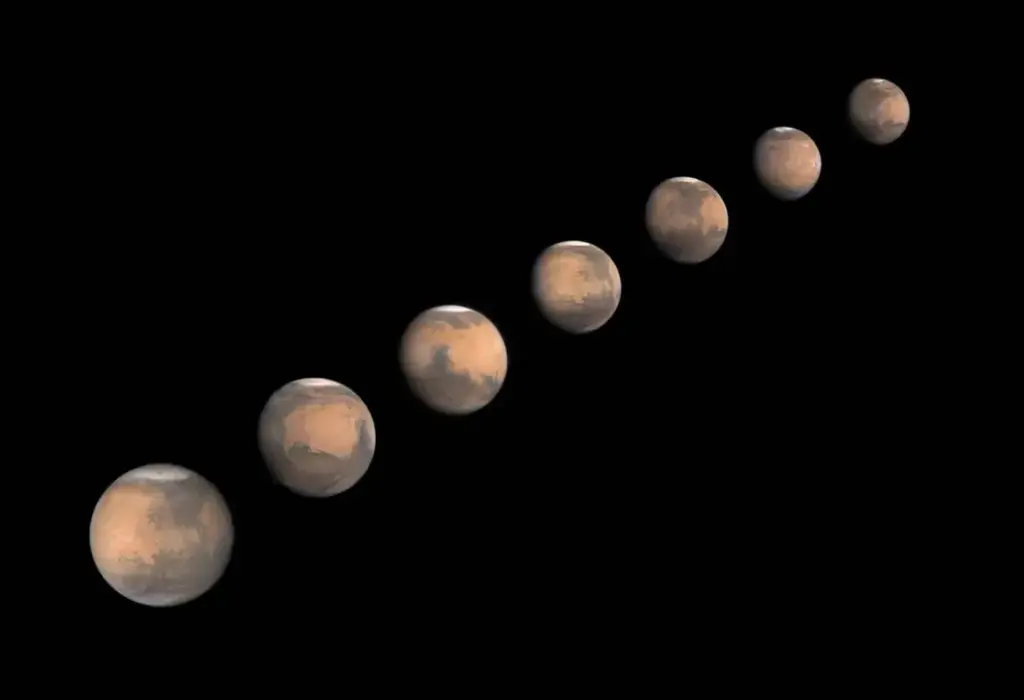
Mars in 2025, by Tom Williams. Trowbridge, Wiltshire, England. This composite image shows several views of Mars after it reached opposition, the point at which Earth lies directly between Mars and the Sun. All images were captured at the same scale, highlighting how quickly the planet’s apparent size decreases as it moves away from Earth. Seasonal changes are also visible, with the polar ice cap shrinking as the planet’s northern hemisphere enters local spring and summer. Notably, the four largest volcanoes on Mars are clearly visible as dark “spots” in the middle image, with Olympus Mons, the largest known volcano in the Solar System, appearing at the upper left.
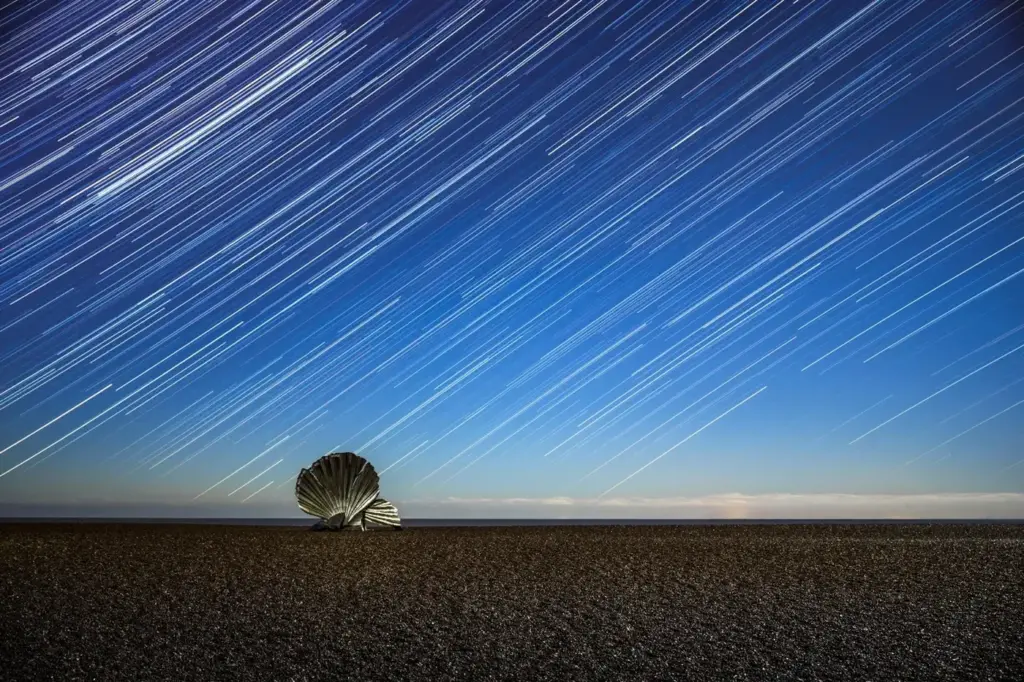
I Hear the Stars, by João Yordanov Serralheiro. Aldeburgh Beach, Suffolk, England. This image of star trails over the Scallop sculpture on Aldeburgh Beach was a long time coming, as the photographer waited for the right night and the right conditions. It represents the quiet and peaceful feeling of sitting by the sea, listening to the waves come and go as time passes, something captured here by the movement of the stars.
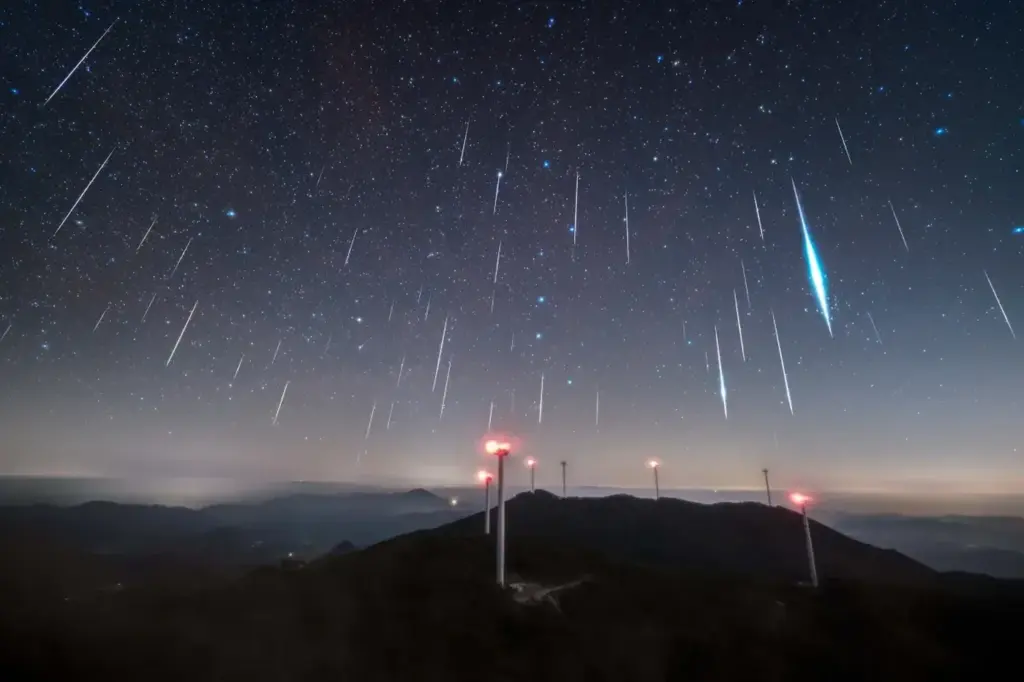
Meteor Shower Over the Big Dipper, by ZhiPu Wang. Sanming, Fujian Province, China. The Geminid meteor shower was reliable again in 2025, with many bright meteors. After its radiant, the point from which the meteors appear to originate, rose on the night of 14 December, the sky filled with shooting stars. At midnight on the 15th, the photographer pointed his camera towards the rising Plough, also known as the Big Dipper, in the constellation Ursa Major. He initially planned to photograph only the Plough, using a soft-focus filter to enhance the star points, but during the shoot he noticed a large number of meteors in the field of view, so he adjusted his settings to capture them. Within three hours, he had recorded dozens of meteors.
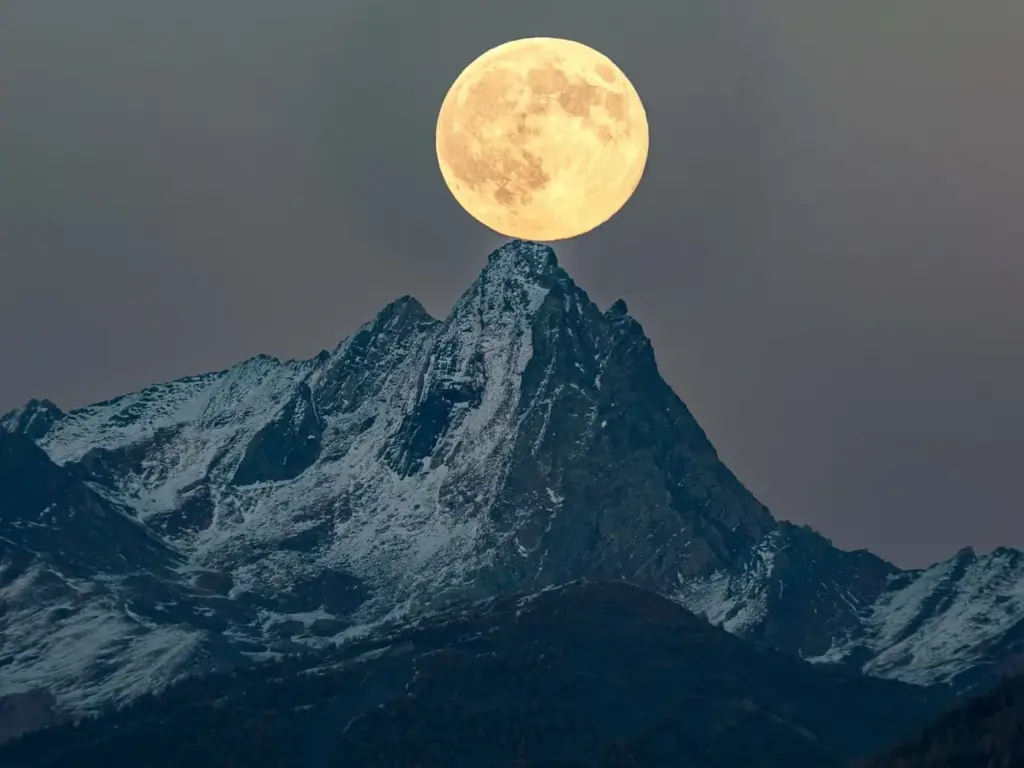
Watched by the Moon, by Jean-François Gely. Arvieux, Provence-Alpes-Côte d’Azur, France. Once a month, the Moon rises exactly as the Sun sets. This creates fantastic natural scenes. The photographer loves finding the perfect spot from which to photograph it together with an iconic peak such as Bric Bouchet, as seen here.
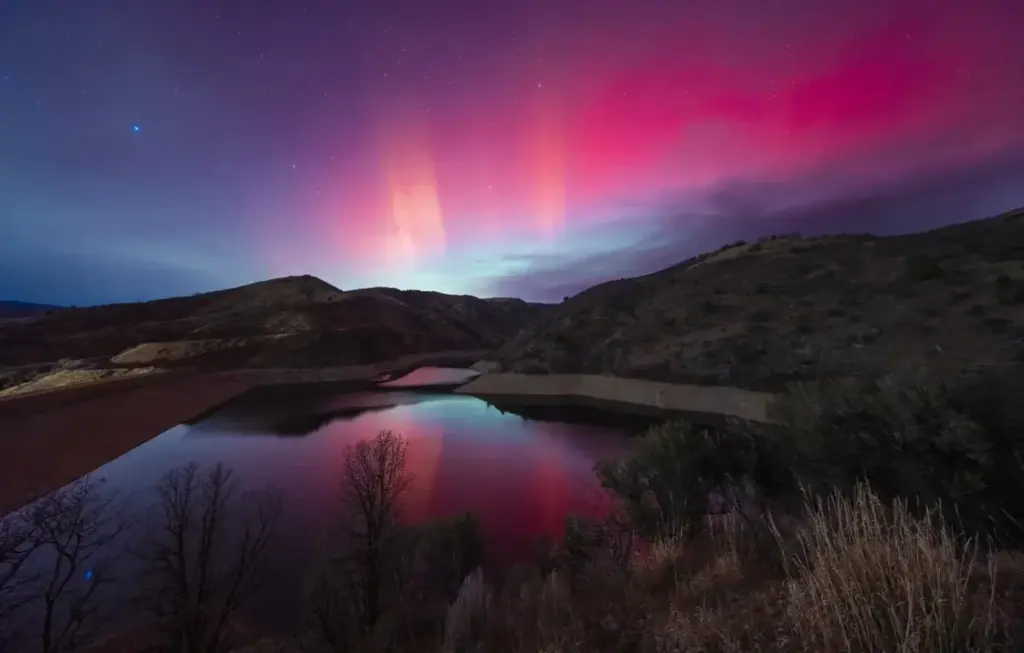
Aurora Over Causey Reservoir, by Samuel Morse. Weber County, Utah, USA. The photographer managed to capture this aurora near Causey Reservoir together with a friend. They had to deal with clouds and heavy traffic, with many people trying to see the same aurora, but eventually they managed to find it. This is a simple single exposure, with no compositing or other alterations, although the photographer shifted the colour balance slightly towards blue to bring out the vibrancy and create colours complementary to the red of the sky.
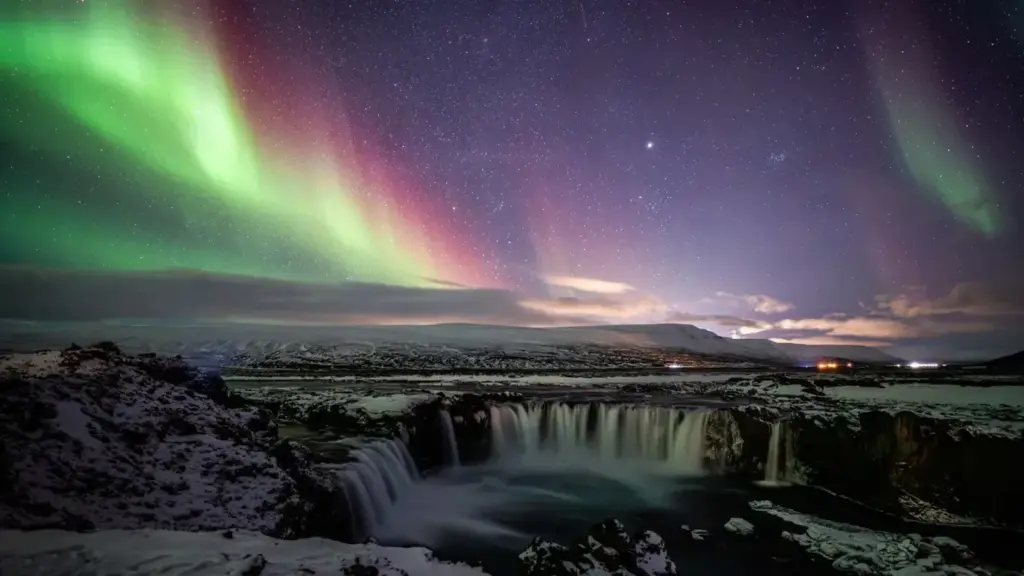
Colourful Aurora and Waterfall, by Yifan Cao. Goðafoss Waterfall, Þingeyjarsveit, Iceland. The photographer witnessed a major aurora outburst in Iceland, during which the entire sky glowed green, red and purple. Goðafoss waterfall is a famous landscape, closely associated with Norse mythology. The photographer stayed there for two days, checking the forecast every hour, trying to capture this unforgettable moment.
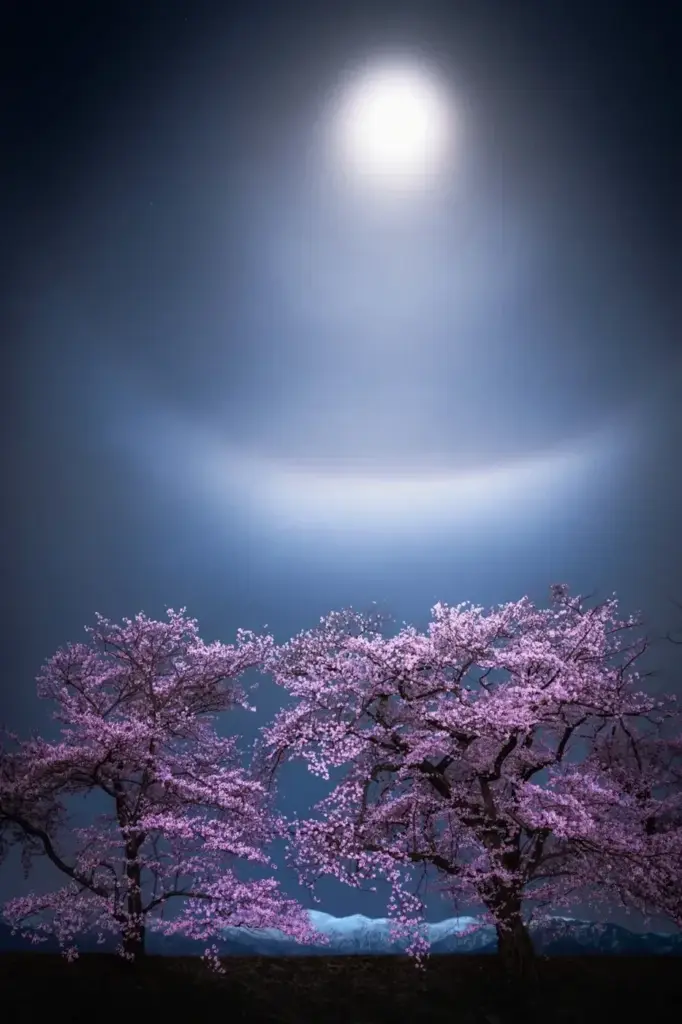
Setsu-getsu-ka, by Takanobu Kurosaki. Asahi, Toyama Prefecture, Japan. “Setsu-getsu-ka” is a traditional Japanese expression meaning “snow, moon and flowers”. The photograph captures this trio at the Funakawa River, framing Mount Asahi, the symbolic peak of Asahi, and the cherry trees beneath a lunar halo and a rare, faint tangent arc, optical phenomena caused by the refraction of moonlight through ice crystals in clouds. The blossoms last only about ten days, making their timing with the snow-covered mountain and these atmospheric optical phenomena a once-in-a-season wonder. To emphasise the fragility of the scene, the photographer captured it as a single exposure rather than a composite.
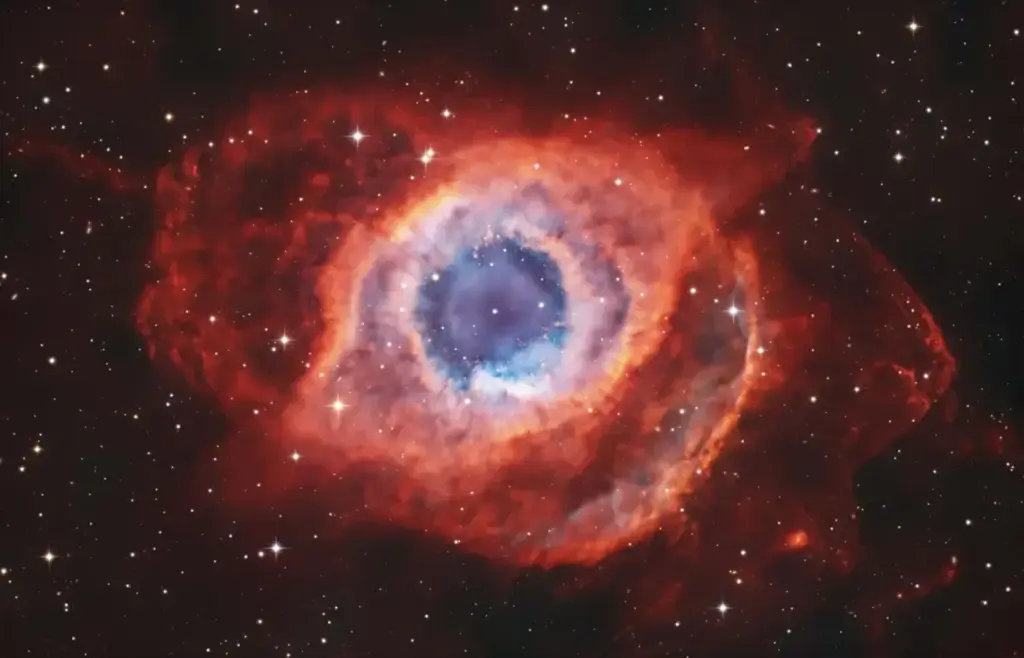
NGC 7293: The Helix Nebula, by Humbert Cédric. Elqui Province, Coquimbo, Chile. NGC 7293, better known as the Helix Nebula, is one of the closest and most spectacular planetary nebulae that can be observed from Earth. It lies about 650 light years away, in the constellation Aquarius. Planetary nebulae are the remnants of dying stars. In the case of the Helix Nebula, around 10,000 to 12,000 years ago, a star similar to our Sun expelled its outer layers into space at the end of its red giant phase. The extremely hot remnant core emits intense ultraviolet radiation, which ionises the surrounding gas, making it glow with spectacular colours.
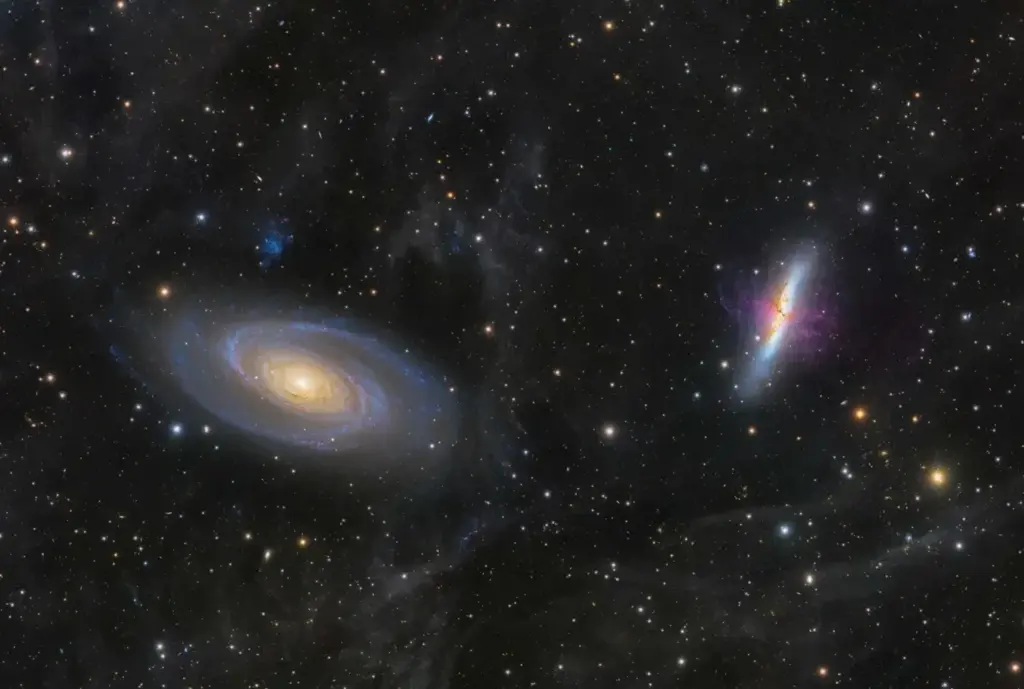
Cosmic Neighbours: Beauty and the Beast, by Yijing Zhu and Xinghan Yang. Ürümqi, Xinjiang Uyghur Autonomous Region, China. The image captures a dramatic cosmic pair: the serene elegance of Bode’s Galaxy, M81, on the left, beside the chaotic violence of the Cigar Galaxy, M82, on the right. They are about 12 million light years from Earth and these two neighbours are locked in a gravitational dance that has deeply shaped their fate. M81 retains its perfect grand-design spiral form, an image of galactic grace. In sharp contrast, M82 is a starburst galaxy, shaken by a close encounter with its larger companion. This gravitational disturbance has triggered a vigorous burst of star formation in its core, ejecting spectacular red filaments of superheated hydrogen gas into space, clearly visible in this deep exposure.
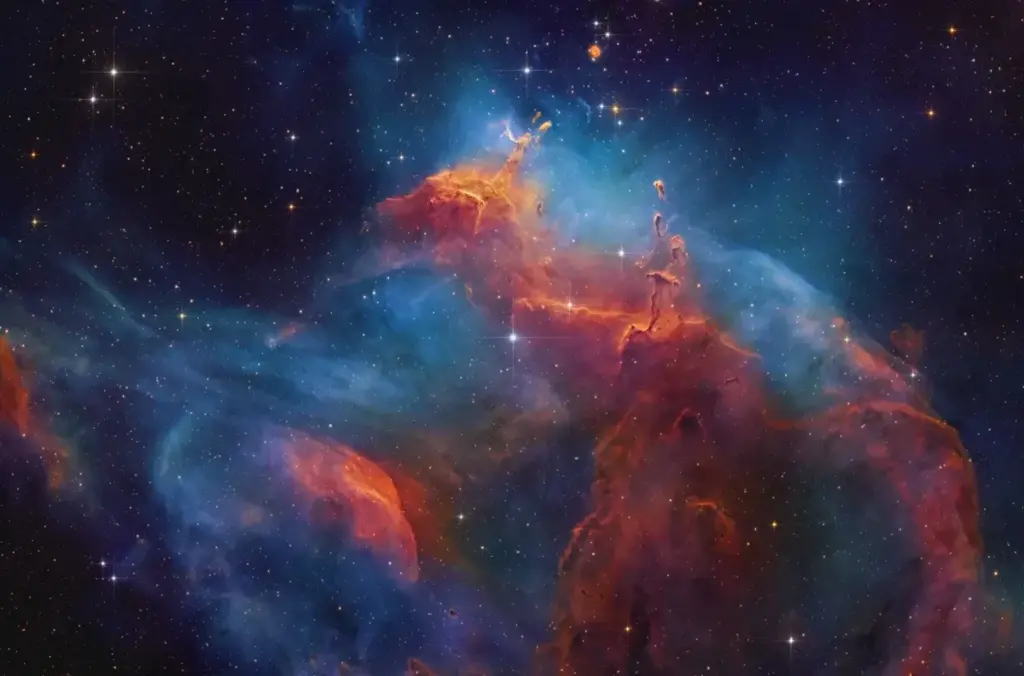
Gum 37: The Southern Tadpoles, or Teapot Nebula, by Ani Shastry. El Sauce Observatory, Río Hurtado, Chile. Gum 37 is an HII complex in the southern sky, where stellar radiation sculpts pillars, edges and curved shock fronts. It is commonly known as the Southern Tadpoles Nebula, but the longer the creator looks at it, the more he feels it resembles a cosmic teapot pouring cobalt-coloured mist into the darkness. Here, ember-red ridges of hydrogen glow like heated ceramic beside regions of denser gas, while cool blue oxygen floods the surrounding cavities, tracing winds and ionisation fronts that open up the nebula layer by layer. Dark seams of dust are visible within the brighter regions, giving depth to the entire scene.
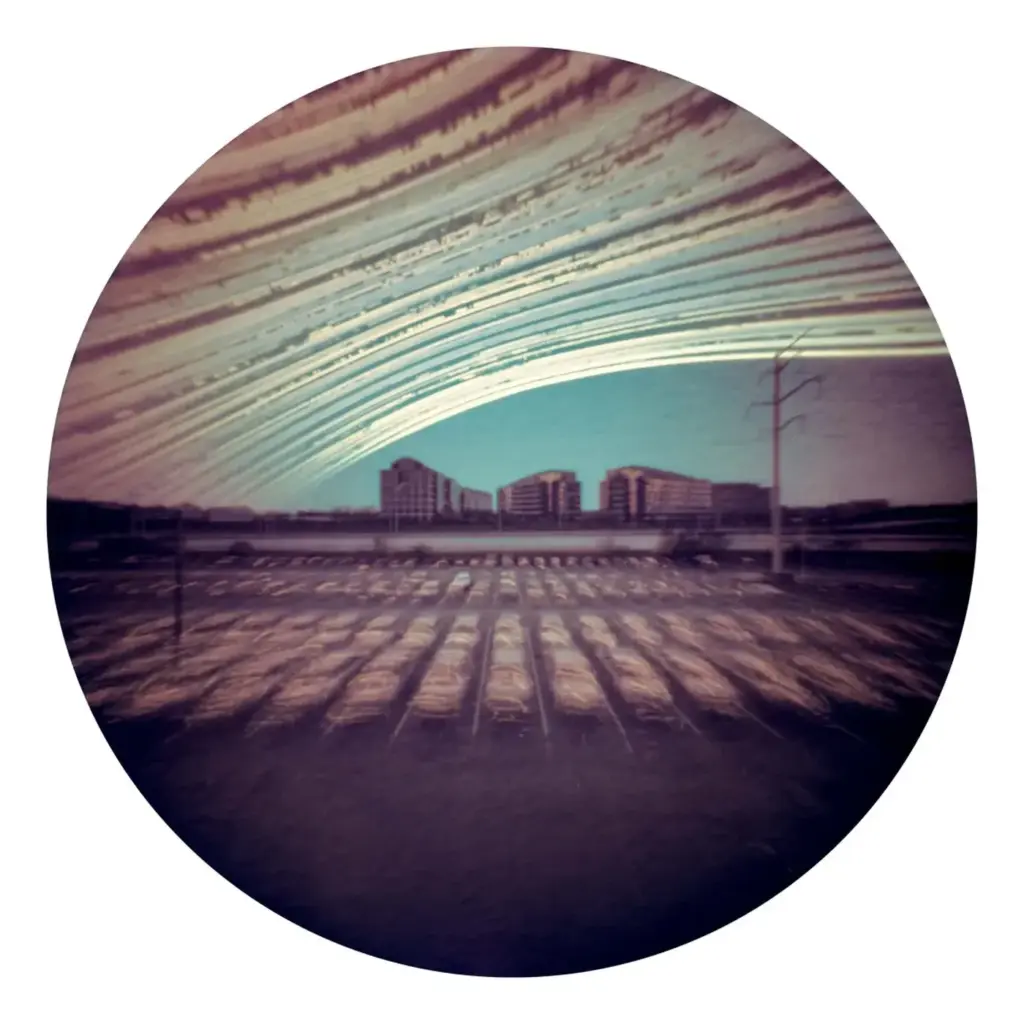
Solargraph 182 Days, by Ksawery Wrobel. Selected in the Annie Maunder Open Category. Solargraphy is a photographic technique that uses a homemade pinhole camera and photosensitive paper to create extremely long exposures. Depending on how long the camera remains in place, the final image records the path of the Sun across the sky from dawn to dusk, as well as its gradual shift from north to south, or the reverse, between the solstices. Each bright line represents one sunny day. If a line is missing, it means the Sun was hidden by clouds. For his solargraph photographs, the creator uses small round aluminium containers, as they are easy to install in urban spaces.
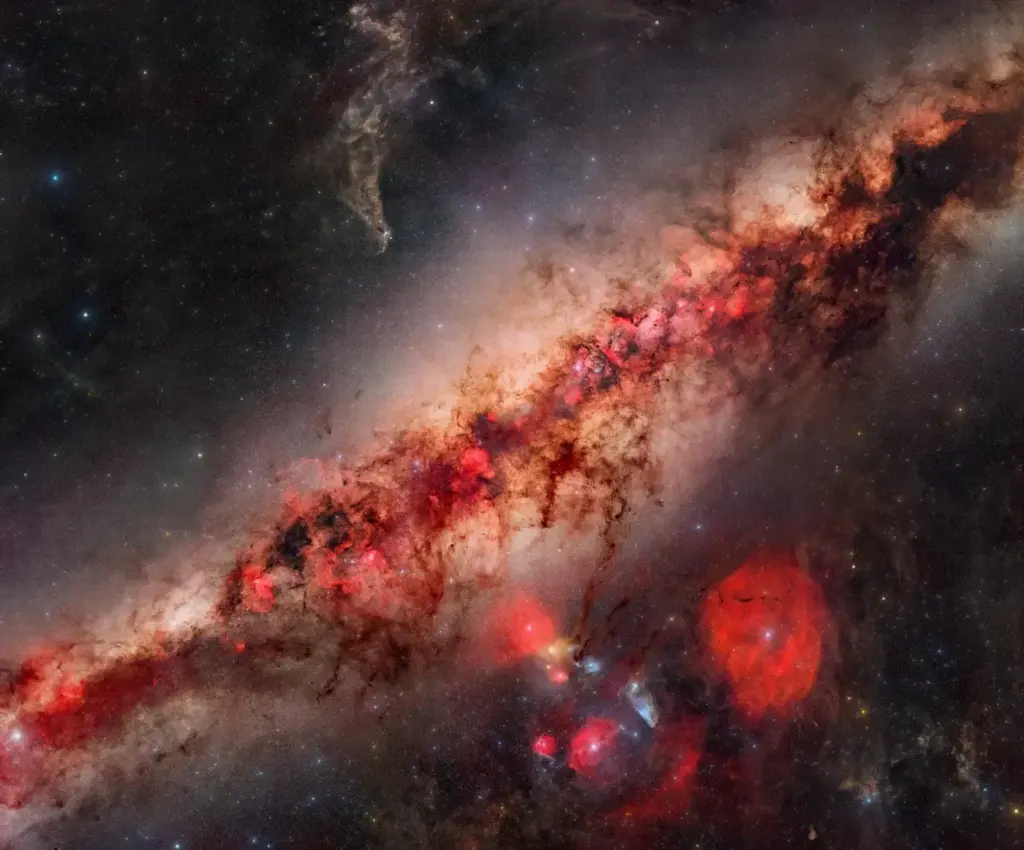
A Deep Look Into the Milky Way’s Core, by Jakob Sahner. Koireb, Windhoek Rural, Namibia. The photographer captured this mosaic with two cameras, one for RGB colour and one for H-alpha, in order to record as much detail and structure as possible. The project nearly collapsed when unexpected Newton’s rings, an optical phenomenon that can appear when filters are used, showed up in many of the panels after stacking. The photographer considered abandoning the entire dataset, but eventually found a way to correct most of it and keep the image intact. In the end, the result became a mosaic of about 750 megapixels. It was hard-earned and required many weeks of refinement, but ultimately the creator had the version he had set out to make. It was an unforgettable adventure.
When the Winners Will Be Announced
The full shortlist, winners and runners-up of this year’s ZWO Astronomy Photographer of the Year will be announced during a special online ceremony on 17 September.
The current exhibition featuring the greatest space photography is hosted at the National Maritime Museum and will remain open until 3 August 2026.
What We Think
The 2026 selection shows just how much astrophotography has evolved. The strongest images do not rely only on an impressive subject, but also on planning, knowledge of the sky, technical precision and the photographer’s ability to connect a celestial phenomenon with a clear visual narrative. It is a shortlist that shows astrophotography can be documentation, science and art at the same time.
Frequently Asked Questions
What is the ZWO Astronomy Photographer of the Year 2026?
It is an international astrophotography competition organised by Royal Museums Greenwich, bringing together images from photographers who capture space, celestial phenomena, the Sun, the Moon, planets, galaxies and the night sky.
How many images were submitted to the competition?
Almost 4,000 images from 769 different entrants were submitted to the 2026 competition.
When will the winners be announced?
The full shortlist, winners and runners-up will be announced during a special online ceremony on 17 September.
What subjects does the selection include?
The selection includes images of the Moon, the Sun, auroras, comets, galaxies, nebulae, meteors, Mars and the core of our Milky Way.
Are there entries from young photographers?
Yes, among the images is Dancing Flames by 14-year-old Lin Yuchen from China, which has been selected in the youth category of the competition.