Summary
- Cindy Sherman debuts her new Fabric Matrons series in London.
- Some photographs feature Chanel textiles and jewellery as she explores ageing and female identity.
- Sherman performs the staged fictional characters herself.
- The exhibition at Hauser & Wirth runs from 13 October to 23 December 2026.
Event Details
Cindy Sherman returns with Fabric Matrons, a new series in which luxury fashion becomes a backdrop for a less comfortable question: what happens to the image of a woman as she grows older, and who decides which version of her the world gets to see?
The exhibition opens on 13 October 2026 at Hauser & Wirth London and runs through 23 December. In these new staged colour photographs, Sherman plays a cast of fictional women, using textiles, wigs, makeup and accessories that sometimes compete with the face itself for our attention.
An airbrushed magazine becomes the starting point
The series began with a suitably ironic discovery: a complimentary magazine from an upscale store in the Hamptons, full of images of a well-known woman of Sherman’s generation whose face had been smoothed almost beyond recognition. Sherman took that polished visual language and turned it into a question about the pressure to appear younger, wealthier and forever flawless.
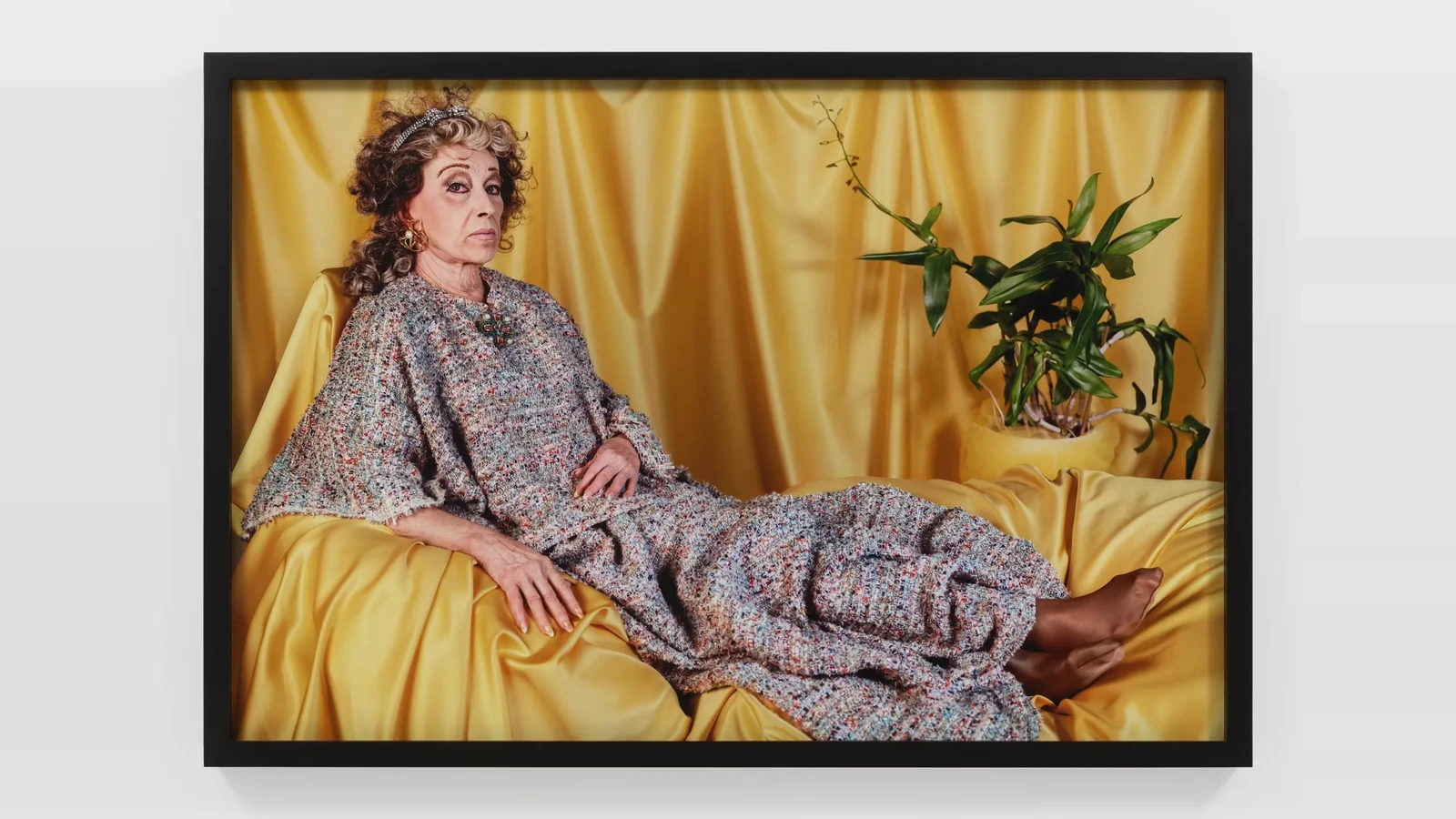
Her central staging device is simple and remarkably flexible: long pieces of fabric function as both clothing and backdrop. Sometimes the subject emerges from the folds; at other moments, she almost disappears into them. The pictures borrow the polish of a costly fashion shoot while making the excess, disguise and construction difficult to ignore.
Chanel enters the frame, but this is not a fashion campaign
At Chanel’s invitation, Sherman incorporated the house’s textiles and jewellery into some of the photographs. Tweeds threaded with gold, sequins and leather sit within deliberately awkward, loosely assembled outfits. A lavish accessory can appear alongside something unexpectedly ordinary, leaving glamour and social status looking less secure than they first seem.
The collaboration has a history. Sherman had used archival Chanel garments and accessories in Ominous Landscapes (2010–2012). In Fabric Matrons, however, the cloth itself has a more forceful role: its colour, folds and texture help decide where the character ends and the set begins.
When a face cannot tell the whole story
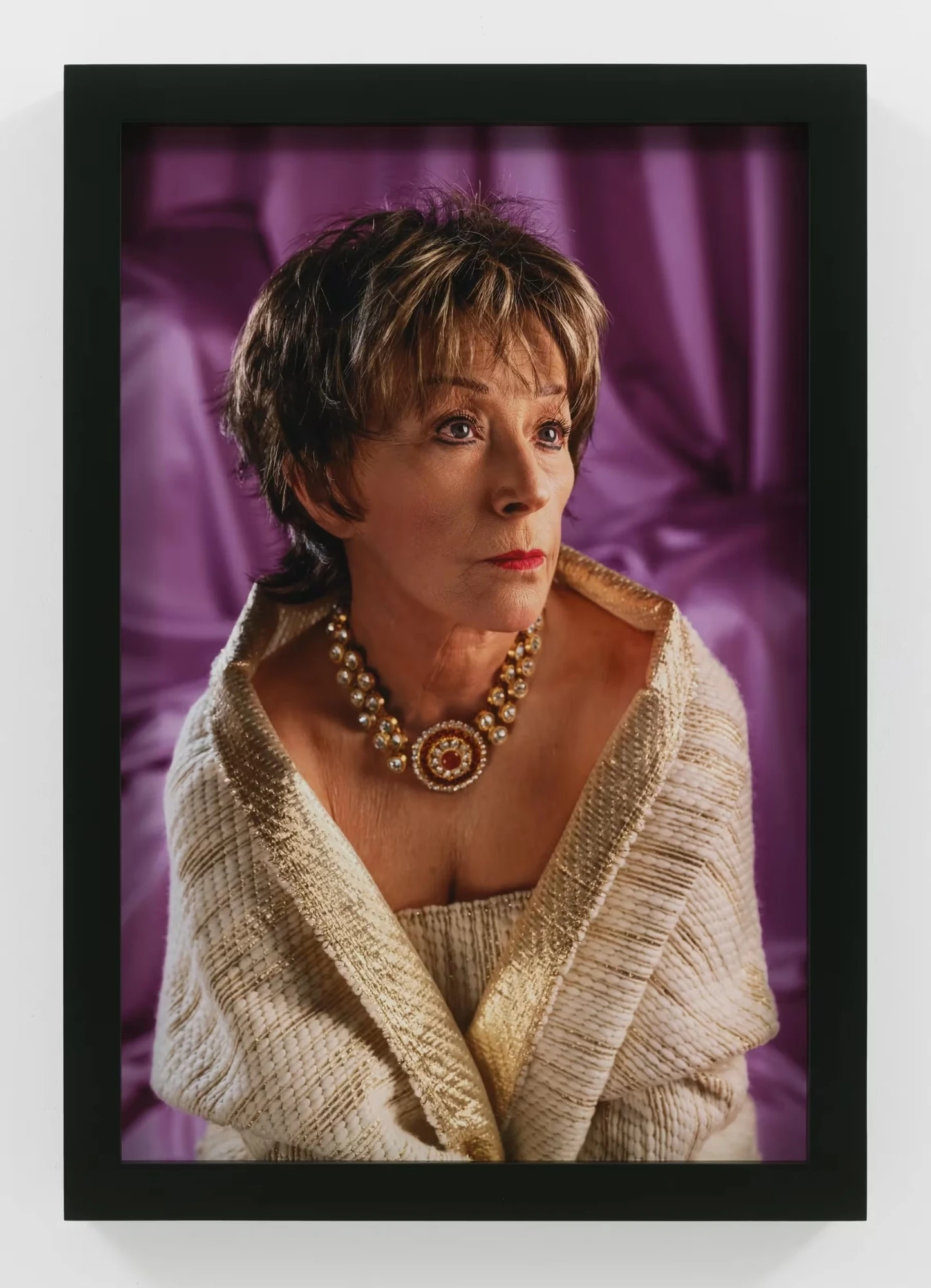
Sherman does not begin by writing biographies for her characters. She experiments with wigs and fabric, finds a pose and expression, then develops each persona through makeup. The improvised process produces an uncanny effect: these women seem to have a lifetime of experience behind them, despite being invented for a single photograph.
Age is present throughout the series, but not in one uniform way. Some faces look almost airbrushed; others reveal or emphasise lines and wrinkles. In some pictures, gloves make hands appear artificially smooth. The pull between wanting to be visible and wanting to escape scrutiny is more revealing than the costly styling alone.
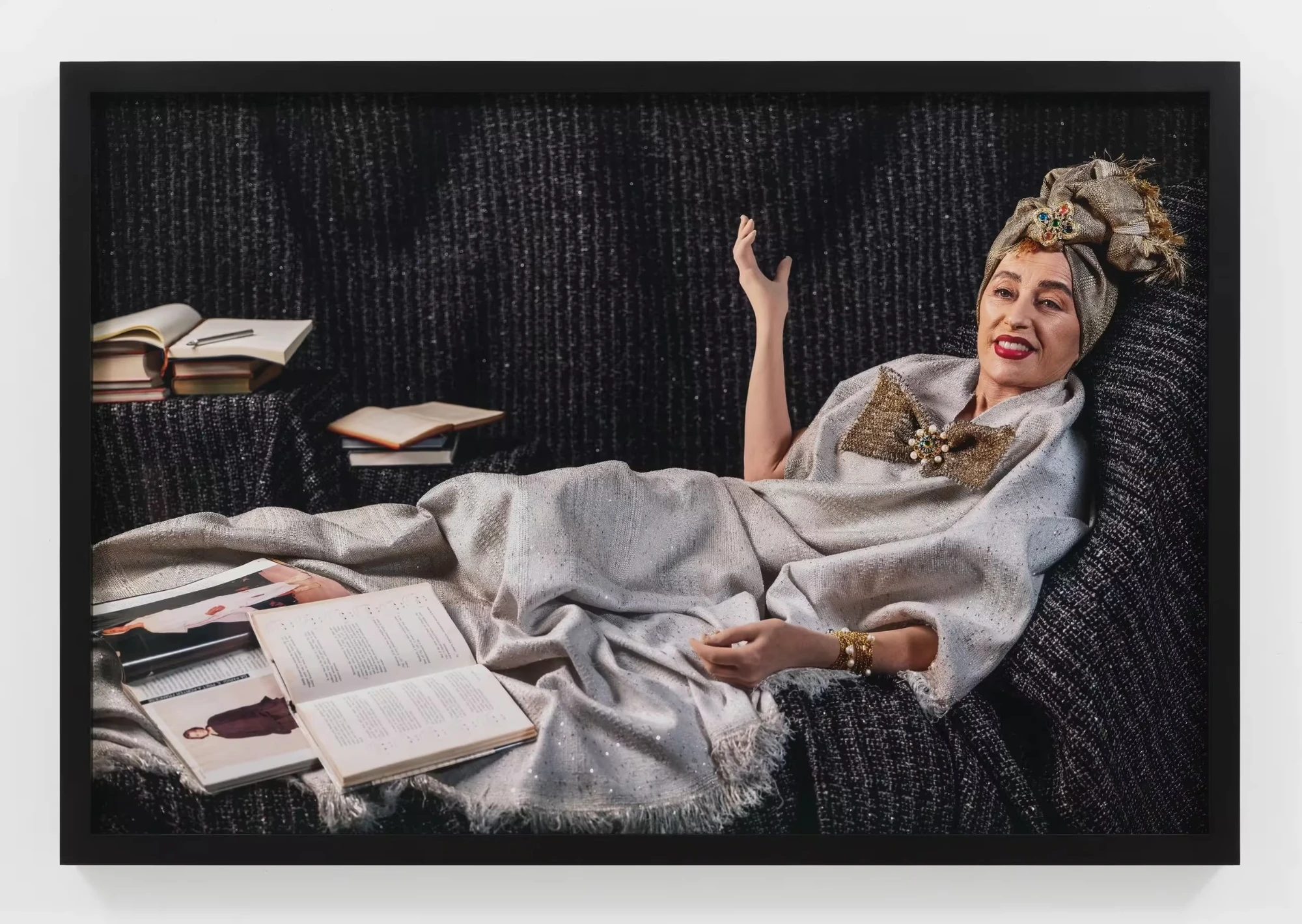
One striking scene puts a glossy magazine and a book about physiognomy — the interpretation of facial features — beside a reclining figure. The magazine invokes familiar beauty ideals, while the book points to wrinkles and facial lines as features worth observing rather than erasing. It is a small visual choice that shifts a seemingly comic portrait towards something more difficult: the way we inspect other people, and ourselves.
That approach connects back to Sherman’s Untitled Film Stills of the late 1970s. She has long placed her own body in front of the camera, not to produce a candid self-portrait but to reveal how convincing a performed identity can be. Her place among the photographers who transformed portraiture rests on precisely that interrogation of the camera’s apparent truth.
Dates and location
Cindy Sherman: Fabric Matrons runs from 13 October to 23 December 2026 at Hauser & Wirth London, 23 Savile Row. The opening reception on 13 October is scheduled for 6–8 pm, with free admission and no advance booking required, according to the organiser. The official exhibition page provides the gallery programme and artwork information.
What we think
Sherman has a remarkable ability to make a highly polished photograph feel unreliable. Here the lavish material is so assertive that you can initially overlook the person wearing it. Look again, and that displacement becomes the subject. The backdrop is no longer a passive setting; it becomes part of the identity a character is trying to project.
For portrait photographers, the series turns a familiar working assumption upside down: that careful lighting and styling help reveal the person in front of the lens. Sherman shows that those same decisions can conceal, fabricate or constrain a subject within social expectations. What matters is not camera specifications, which are not detailed in the exhibition materials, but decisions about framing, set design and performance.
It is especially compelling that she refuses to treat growing older as a visual problem to be fixed with better retouching. Each constructed face makes space for humour, unease, exaggeration and contradiction. You do not have to like the extravagance to recognise the precision of her questions about photography, beauty and whose image society chooses to acknowledge.
Frequently asked questions
Does Cindy Sherman photograph herself in Fabric Matrons?
Yes. As in much of her work, Sherman performs the fictional characters herself. These are staged personas rather than conventional autobiographical self-portraits.
Where and when can I see the exhibition?
From 13 October through 23 December 2026 at Hauser & Wirth London, 23 Savile Row. Consult the gallery’s current schedule for visiting hours and changes.
Are all the outfits in the photographs Chanel?
No. The official exhibition information specifies that Chanel fabrics and jewellery appear in some of the works, not throughout the entire series.