

Summary
- ESA’s CESAR programme presented the first astronomical image from the refurbished 50 cm Cebreros telescope, targeting M27.
- ESA describes the milestone as “First Light”, the first successful observation in the system’s new operating phase.
- The image was created with LRGB exposures and a complete set of calibration frames.
- The telescope is expected to support educational activities during the first half of 2027.
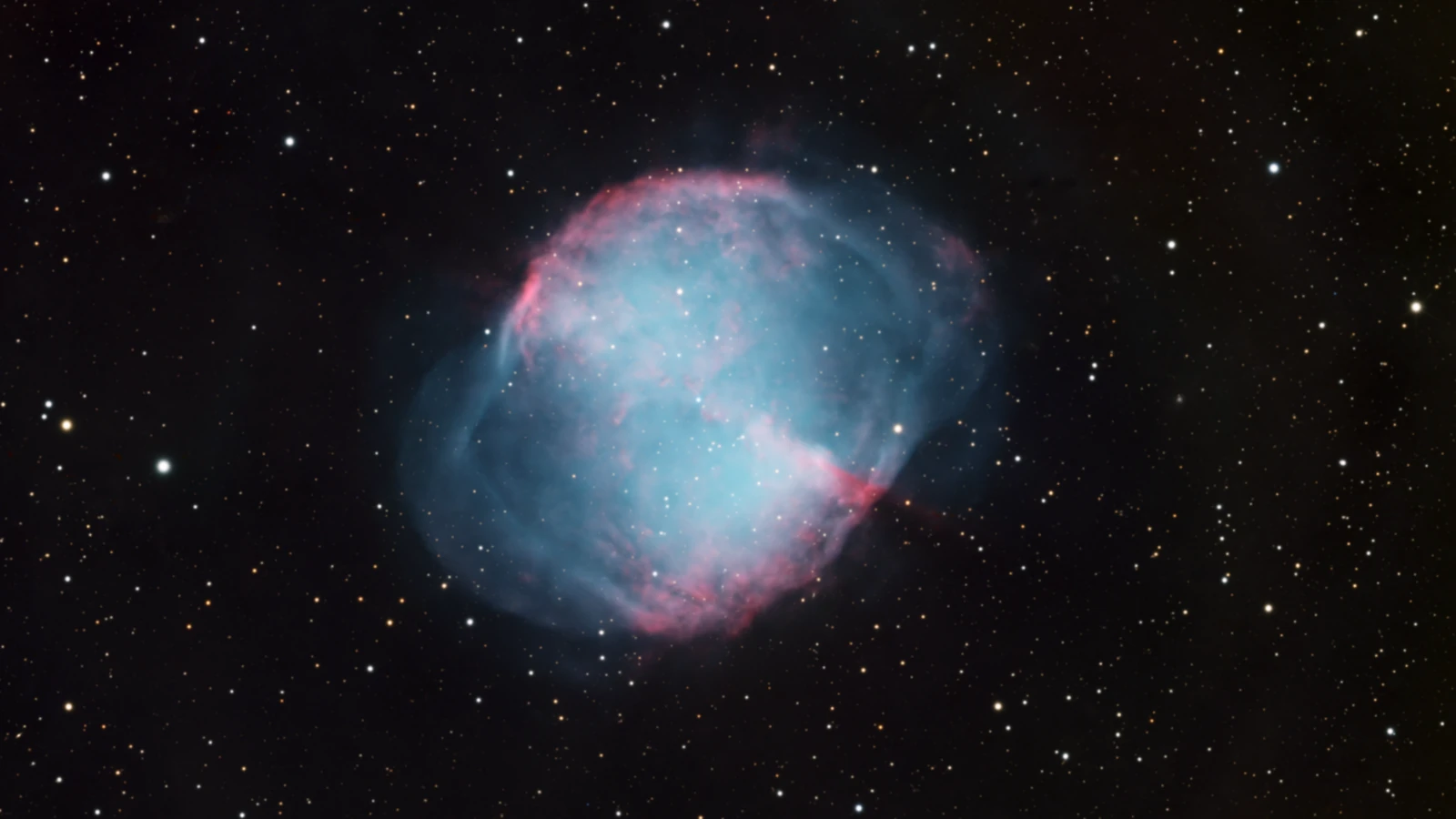
ESA’s CESAR programme has presented the first successful astronomical image from the 50 cm Cebreros telescope after its recent refurbishment and setup, targeting the M27 planetary nebula, also known as the Dumbbell Nebula.
The observations were made on the night of 3–4 September 2026 at ESA’s Cebreros Deep Space Station in Spain, while the official announcement was published on 21 September. CESAR says the refurbishment and setup — the rebuilding, upgrading and reconfiguration of the system — were carried out by TecnoHita Instrumentación.
ESA describes the milestone as “First Light”. In astronomy, the term refers to the first successful observation made when a telescope enters operation or begins a new phase after major technical work. Commissioning is the testing, adjustment and validation period before the system moves into routine scientific or educational use.
There is a useful clarification. CESAR had already reported First Light for a 50 cm Cebreros telescope in 2013. The 2026 announcement presents the CCT after refurbishment and a new setup as the start of a new technical phase, so “First Light” is best understood in that context rather than simply as the first time a 50 cm optical telescope has operated at Cebreros.
Imaging M27 and what LRGB means
M27, the Dumbbell Nebula, was selected for the tests. It is one of the brighter planetary nebulae in the night sky. A planetary nebula is a cloud of gas created when a Sun-like star sheds its outer layers near the end of its life; the historical name does not mean the object is related to planets.
The image was produced using LRGB imaging. L stands for Luminance, which mainly carries brightness and fine detail, while R, G and B are the red, green and blue channels used to build the colour image. The CMOS camera was cooled to -15°C, helping to reduce thermal noise during longer exposures.
The team also captured the full set of supporting frames used in processing. Science frames are the actual exposures of M27. Flat-field frames help correct vignetting, uneven illumination and dust shadows; dark frames record thermal and electronic sensor signal without incoming light; and bias frames measure the camera’s electronic readout offset.
These frames are used for calibration, meaning the correction and normalisation of the raw data. Alignment then matches the individual exposures precisely, while stacking combines multiple frames to strengthen useful signal and reduce noise. The colour channels are finally combined into the finished image.
What seeing means and why it is measured in arcseconds
According to CESAR, the sky was dark and cloud-free, with stable humidity, wind and atmospheric pressure. Some light contamination from the station was present but was not considered critical for the observations.
ESA also reports seeing generally above 3 arcseconds. Seeing describes how turbulence in Earth’s atmosphere affects the sharpness of an astronomical image: the smaller the value, the more finely stars and small details can generally be resolved. An arcsecond is a very small unit of angular measurement commonly used in astronomy to describe this apparent level of detail.
The 50 cm Cebreros telescope
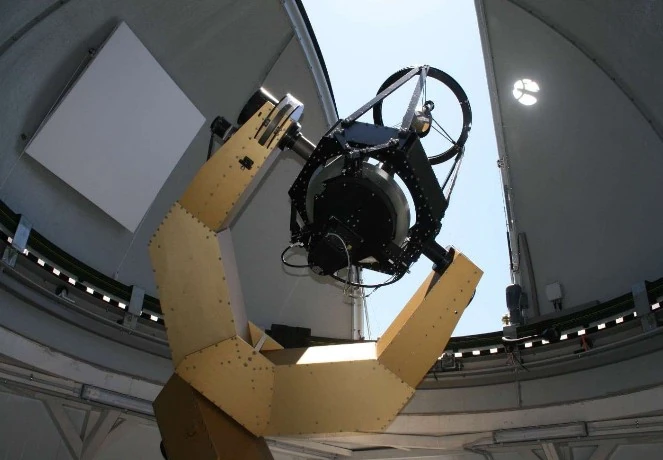
Cebreros is a classical Cassegrain telescope with a 0.5 m primary mirror and a 5 m focal length. In a Cassegrain design, two mirrors fold the light path inside the telescope, allowing a long focal length without requiring an equally long optical tube.
The combination of a 0.5 m aperture and 5 m focal length gives an f/10 optical system. The f-number expresses the relationship between focal length and the diameter of the optical system. The telescope is located at ESA’s Deep Space Tracking Station near Cebreros in Ávila and is housed in a 3.5 m automated dome.
Why commissioning matters for imaging
Commissioning checks much more than whether the telescope can simply produce an image. It verifies that the optics, camera, filters, tracking — the telescope’s ability to follow the apparent motion of the sky accurately — and the processing workflow all operate correctly as one system.
For photographers and image creators, the process makes clear that the final astronomical image is not a single frame. It is the result of many exposures, supporting calibration data and successive stages of correction, alignment, stacking and colour combination.
Next step: access for schools
CESAR says the telescope will become available for educational activities during the first half of 2027. Schools and educational institutions will be able, with expert guidance, to participate in the process from selecting scientific targets and planning observations to executing them and analysing the resulting data.
What we think
The value of the announcement is not limited to the M27 image; it also exposes the workflow behind a scientific astronomical image in a clear way. Returning a 50 cm telescope to active educational use can give students direct insight into how real observational data are planned, captured and processed.
Frequently asked questions
What does “First Light” mean?
It is the first successful observation made when a telescope enters operation or begins a new operating phase after major technical work. In the 2026 announcement, the term is tied to commissioning of the refurbished CCT.
What is commissioning?
It is the testing and adjustment period used to confirm that the telescope, camera, filters, tracking and processing workflow operate correctly as a complete system.
What does LRGB mean?
It combines one Luminance channel with separate red, green and blue channels. L mainly carries fine detail, while RGB supplies the colour information.
What are flat, dark and bias frames?
They are supporting exposures used to correct optical and electronic imperfections before the actual sky images are stacked.
When will the telescope be used for education?
CESAR plans to make it available for educational activities during the first half of 2027.