

Summary
- NASA selected a composite photograph by Dario Giannobile from Sicily for the October 1, 2026 APOD.
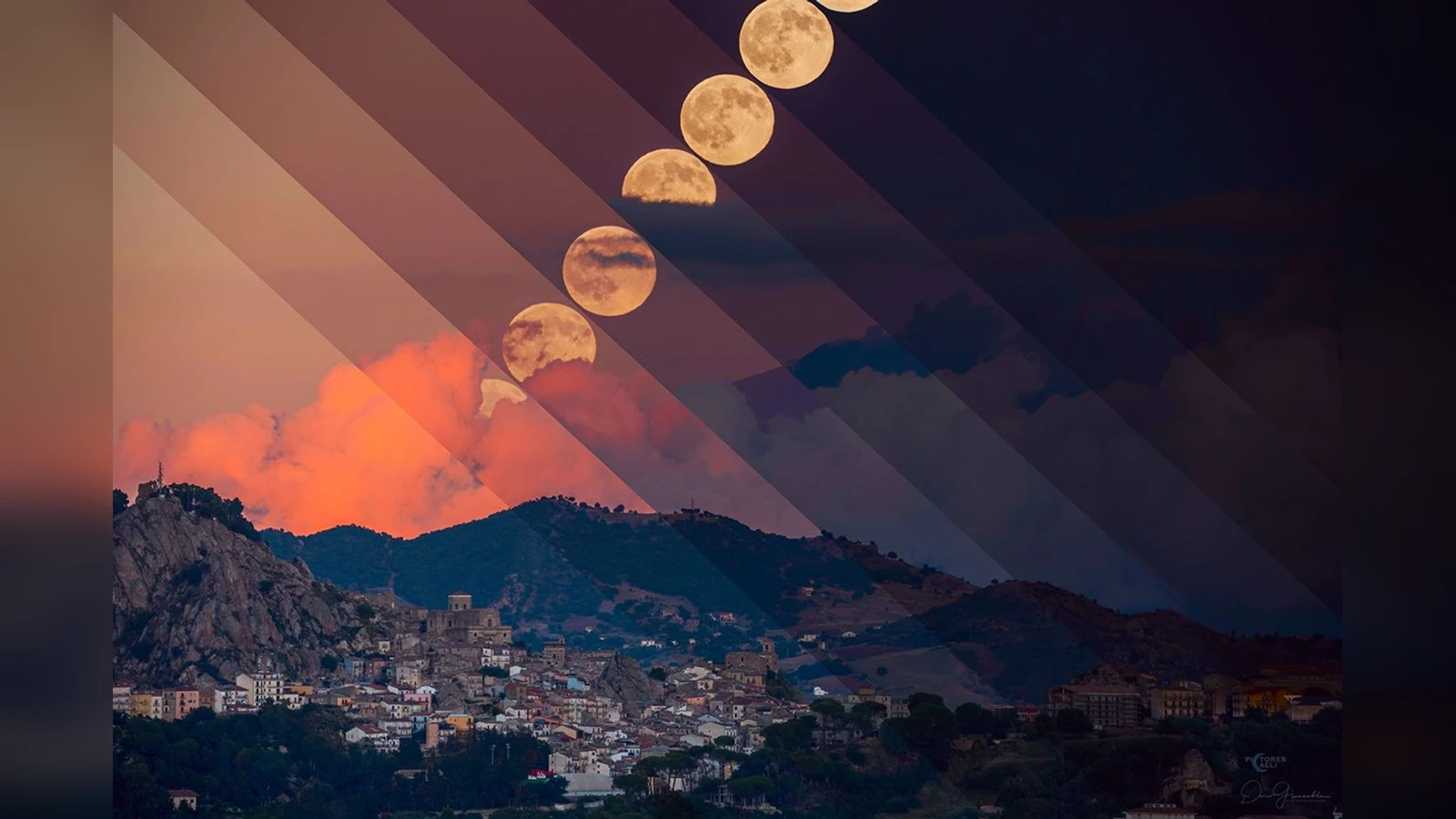
- The image follows the rising Harvest Moon as the sky darkens above Nicosia.
- Antitwilight colors, the Belt of Venus, and ash and gas from Mount Etna appear in the scene.
- NASA states that the image is a composite and does not publish camera, lens or exposure data on the APOD page.
NASA selected a striking composite for the October 1, 2026 Astronomy Picture of the Day, bringing together the full Moon, antitwilight colors and activity from Mount Etna in a single landscape.
The image was created by Dario Giannobile and, according to NASA, was photographed the previous weekend in Sicily, just outside the town of Nicosia. It is a composite showing the Moon rising while the sky gradually darkens.
What the composite shows
The town of Nicosia fills the lower part of the frame while successive positions of the full Moon appear above the horizon. NASA says the lower clouds reflect antitwilight colors, while ash and gas from Mount Etna can be seen higher in the background.
The pink band low in the sky is identified by NASA as the Belt of Venus. The scene therefore combines the Moon’s apparent path, the transition from sunset into night, and the volcanic plume in one visual sequence.
Why a full Moon rises around sunset
NASA explains that during a full Moon, the Moon and the Sun are on opposite sides of the sky. That is why the full Moon rises around the time the Sun sets, allowing a scene like this to include both antitwilight colors and an already visible lunar disk.
APOD refers to this full Moon as the Harvest Moon, a traditional name used in some Northern Hemisphere cultures for the full Moon of this part of the year.
What we think
The strength of the image comes from connecting a celestial event with a recognizable landscape and real atmospheric conditions. For image makers, it is a useful example of how careful composition can turn a sequence of lunar photographs into a complete visual narrative without relying on unpublished technical details.
Frequently asked questions
Is this a single exposure?
No. NASA explicitly describes it as a composite photograph showing the Moon rising as the sky becomes darker.
Where was the photograph taken?
In Sicily, just outside the town of Nicosia, Italy.
What is the pink band in the sky?
NASA identifies it as the Belt of Venus, part of the antitwilight scene.
Who is the photographer?
The image is credited to Dario Giannobile, who is listed by APOD as the photographer and copyright holder.