

Summary
- The deep partial eclipse darkened about 96% of the lunar disc
- In Athens, the deepest visible phase came at 6:50 a.m., just before moonset
- The images reveal Earth’s shadow, atmospheric refraction and major exposure differences
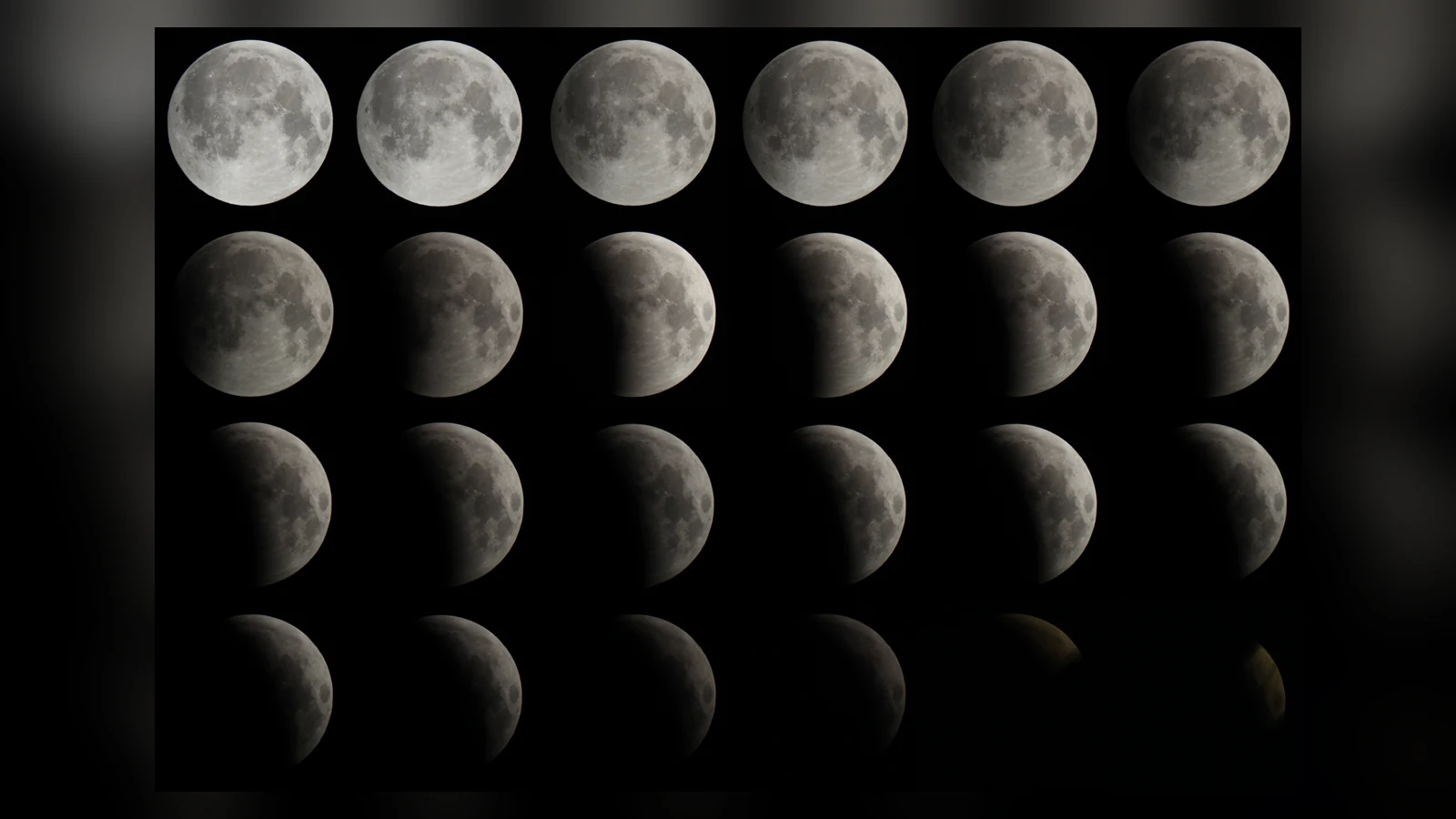
The deep partial lunar eclipse of August 28 produced images that look almost like totality, as Earth’s shadow covered about 96% of the illuminated lunar disc.
In Greece, the event began at 4:23 a.m., the partial phase started at 5:33 a.m., and the deepest moment visible from Athens came at about 6:50 a.m., when the Moon was only 0.4 degrees above the west-southwestern horizon. Moonset followed at 6:54 a.m., before the global maximum at 7:12 a.m. Greek time, so photographs from Greece show a spectacular but not the absolute deepest stage.
That is precisely what makes the pictures interesting: some show the Moon low in atmospheric haze and dawn light, while images from North America record Earth’s shadow higher in a dark sky. The observer’s location changes the background, contrast and apparent orientation of the shadow, but not the physics of the event.
What the photographs from Greece show
Verified professional pictures from Athens show the Moon extremely low on the horizon, seen through denser layers of Earth’s atmosphere. At that altitude, atmospheric extinction reduces brightness and strengthens warm tones, while dawn light compresses the available dynamic range. Photographer Louiza Vradi recorded the eclipse over Athens for Reuters in an image with a clearly documented place and date. It is licensable material and is therefore not republished here without permission.
The sequence visible from Greece also confirms the crucial timing described in our detailed guide to the eclipse times: as the deepest visible phase approached, the Moon was also getting closer to setting. For photographers, that meant the landscape could become a strong part of the composition, but low contrast and atmospheric distortion made clean close-ups more difficult.
Earth’s shadow in a photographic sequence
Space.com’s public Reel shows the Moon close to the deepest phase of the August 28 eclipse, with almost the entire lunar disc immersed in Earth’s umbra and only a thin bright strip left in direct sunlight. The dark area is not night “moving” across the Moon but the umbra, the central and darkest cone of Earth’s shadow. Its curved edge is effectively the projection of the spherical Earth onto the lunar disc.
In the frames closest to maximum eclipse, a small bright area remains outside the umbra. That is the feature that distinguishes a deep partial eclipse from totality: however small it may appear, part of the Moon is still receiving direct sunlight. The enormous brightness difference between this area and the reddish shadowed surface explains why a single exposure often cannot render both correctly.
Why the shadowed Moon turns red
Earth blocks direct sunlight, but its atmosphere refracts and bends a small portion of that light into the shadow. Shorter wavelengths are scattered more strongly, while red and orange light reaches the Moon more efficiently. The part immersed in the umbra therefore does not disappear completely and takes on colours that vary with atmospheric clarity, cloud, dust and the camera settings used.
Getty Images’ official Instagram carousel brings together five views of the eclipse from Washington, Quito, British Columbia, Madrid and Ramsgate. The images move from an architectural composition with the Washington Monument to close views of the lunar disc, showing how foreground, altitude, atmospheric conditions and exposure produce very different photographs of the same event. Credits are included in the original Getty Images post.
What changes from one location to another
The eclipse is the same astronomical event for every observer, but its timing and the Moon’s position in the sky differ. In Athens, the global maximum occurred after moonset. In Canada and much of the United States, by contrast, the deepest phase was visible in a darker sky and at a higher altitude, offering better conditions for telephoto lenses and astrophotography sequences.
USA Today’s public gallery brings together photographs from different locations and different stages of the event. In the images closest to maximum eclipse, the Moon takes on copper and reddish tones while a thin bright strip remains outside the shadow. The post credits Craig Bailey, Nadia Zomorodian, Kacper Pempel and Borja Suarez.
.single-post .entry-content .wp-block-embed-flickr .wp-block-embed__wrapper, .single-post .entry-content .wp-block-embed-flickr a {display:block;width:100%;} .single-post .entry-content .wp-block-embed-flickr img {display:block;width:100%;max-width:100%;height:auto;} .pttl-article .wp-block-embed-flickr .wp-block-embed__wrapper, .pttl-article .wp-block-embed-flickr a {display:block;width:100%;} .pttl-article .wp-block-embed-flickr img {display:block;width:100%!important;max-width:none!important;height:auto!important;}Ten additional photographs from different photographers
The following photographs were published by their creators on Flickr. The selection covers different locations, techniques and phases, so the gallery works as a genuine photographic record of the event rather than a repetition of similar close-ups.

The Moon just after maximum eclipse, with the north polar area remaining outside the umbra while the lower disc lies deeper in the red shadow. The image blends seven bracketed exposures made at Waterton Lakes National Park in Alberta. Photo: Alan Dyer / Amazing Sky Photography via Flickr.

A 180-degree panorama from the Maskinonge wetlands at Waterton Lakes National Park places the eclipsed Moon at left and the Milky Way at right, showing how dark the sky became around maximum eclipse. Photo: Alan Dyer / Amazing Sky Photography via Flickr.

The eclipse above Arizona’s San Francisco Volcanic Field, in a blend that preserves both the lunar disc’s extreme brightness range and the stars behind passing cloud. Photo: Jeremy P. Perez via Flickr.

One of Bruce Ikenberry’s photographs from Overlook Point Park in Tumwater, Washington, records the strong contrast between the bright edge and the larger part of the disc inside the shadow. Photo: Bruce Ikenberry / Wambo Jambo via Flickr.

This image made with the compact Seestar S30 Pro astronomical system shows how even a small automated setup can render the colour and geometry of a deep partial eclipse. Photo: StephenGA via Flickr.

A close view of the deep phase made with a Sony A7 III and 200-600mm lens, in which the red region remains visibly darker than the thin white band outside the umbra. Photo: Paul T. Marsh via Flickr.

An isolated close view of the eclipsed Moon, with the boundary of Earth’s shadow visible across the disc and the red colour becoming stronger toward the more deeply shadowed area. Photo: lsecsvee14 via Flickr.
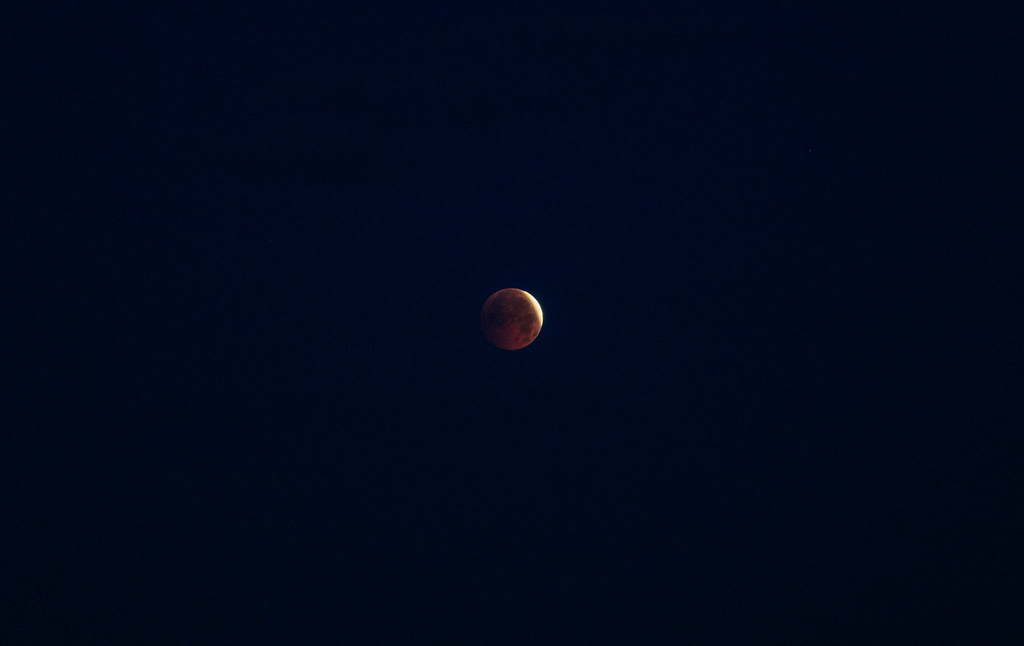
The partial eclipse photographed from Norwich, Norfolk, on August 28, with the atmosphere and cloud adding a different texture around the lunar disc. Photo: Ethan McPherson via Flickr.

A frame from Illinois records another stage as the lunar disc moves out of the umbra, useful for comparing the shadow’s position at a different moment. Photo: weslowik via Flickr.

A frame from a lunar-eclipse sequence made with a Sony A7C and 200-600mm lens, clearly showing the bright band beside the reddish shadowed area. Photo: Timothy Shea via Flickr.
How to read eclipse photographs correctly
Eclipse images are not all directly comparable. A multi-frame composite compresses time into one picture, a close-up may use different exposures for bright and dark areas, and an image made near the horizon looks through a much longer atmospheric path. That is why it matters to check the place, time, creator and whether the result is a single frame or a composite sequence.
For those who tried to photograph it, the practical difficulties were exactly those discussed in our article on photographing the Full Moon and the eclipse: a stable tripod, manual focus, careful highlight control and frequent corrections as brightness changed rapidly.
What we think
The August 28 eclipse was a good example of how differently the same natural event can be rendered. Greek photographs gained atmosphere and environmental context, while images from North America showed the deep shadow more clearly. The collection’s real value is not limited to the striking red colour; it allows us to read the geometry of the eclipse, the shooting conditions and the limits of each photographic record.
Frequently asked questions
Was the August 28, 2026 eclipse total?
No. It was a deep partial eclipse. About 96% of the lunar disc was darkened, but a small portion remained outside Earth’s central shadow.
Why was the global maximum not visible from Athens?
In Athens, the Moon set at 6:54 a.m., while the global maximum occurred at about 7:12 a.m. Greek time. The deepest phase with the Moon still above the horizon was recorded at around 6:50 a.m.
Is the red colour real or the result of editing?
The red hue has a real physical cause because sunlight passes through and is refracted by Earth’s atmosphere. Its intensity, however, is affected by exposure, white balance and the processing applied to each image.
Why do photographs from different countries look different?
The time, Moon altitude, atmospheric clarity, lens, settings and processing all differ. Some pictures are also multi-frame composites rather than a single exposure.