

Summary
- The Full Moon peaks on August 28 at 07:18 local time in Greece
- The clearly visible partial eclipse begins in Athens at 05:33
- At around 06:50 the eclipse reaches its deepest visible phase before moonset
- The Moon sets in Athens at 06:54 and an unobstructed west-southwestern horizon is essential
- Exposure conditions constantly change because the Moon darkens while the sky becomes brighter
- That evening the Full Moon returns over Greece as 126 monuments and museums open free of charge
- A Full Moon and an eclipse on the same day
- What exactly will be visible from Greece
- This is not a total eclipse
- The horizon is the main photographic challenge
- What is actually worth photographing
- How exposure changes during the eclipse
- Can it be photographed with a smartphone?
- That evening the Full Moon returns over 126 monuments
- One Full Moon, two completely different photographs
- What we think
- Frequently asked questions
The Full Moon of Friday, August 28, 2026 coincides with a partial lunar eclipse, creating an unusual photographic scene in Greece shortly before dawn.
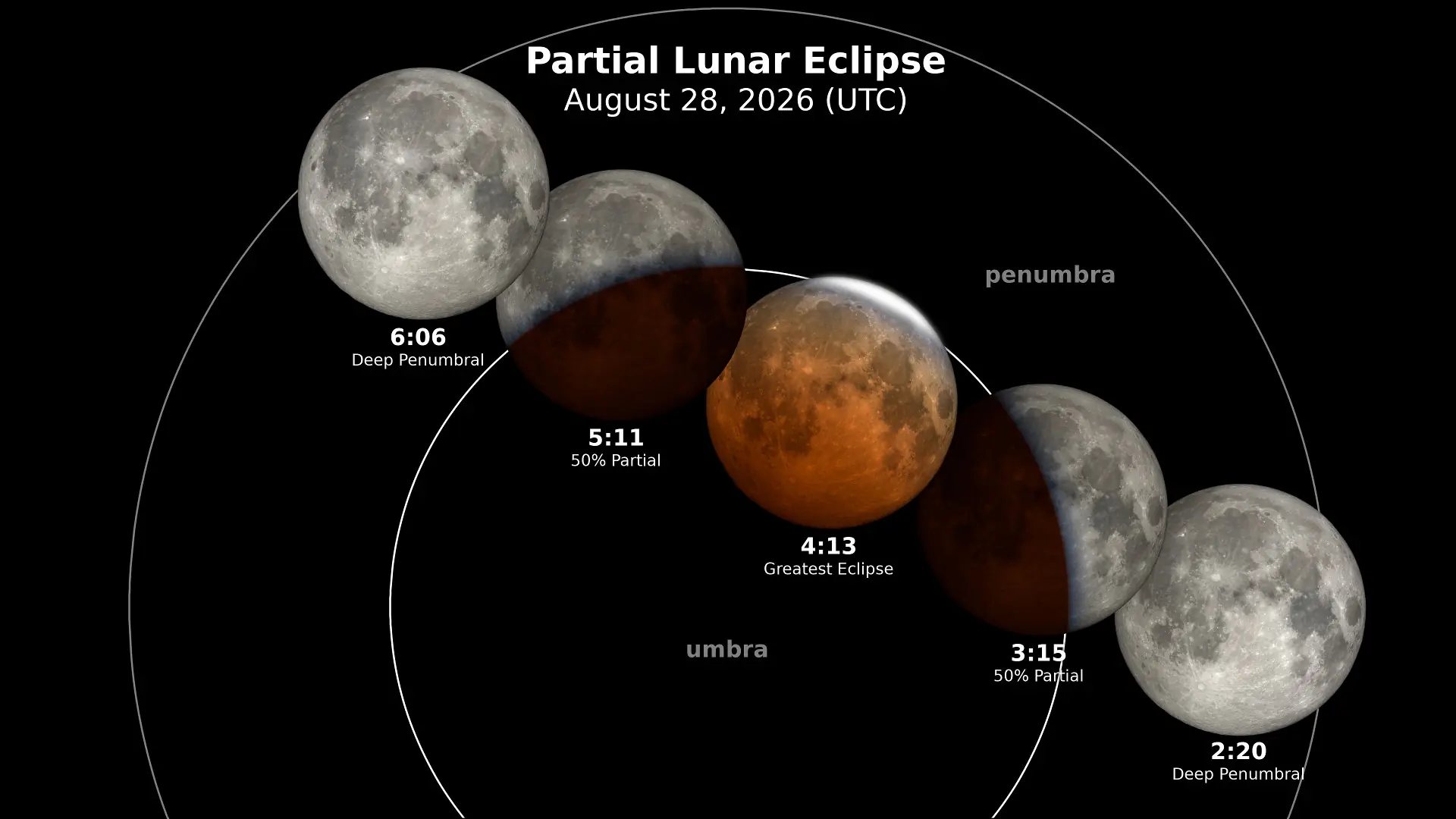
The Moon will begin moving through Earth’s shadow during the early hours of Friday, and from 05:33 the partial eclipse will become clearly visible. In Athens, the phenomenon will continue until moonset at 06:54, while the exact Full Moon occurs at 07:18, when the Moon will already be below the horizon.
For photographers, this is what makes this particular Full Moon special: it is not simply a bright Moon, but a Moon becoming progressively darker while moving extremely low toward the west-southwestern horizon as the sky begins to brighten with dawn.
A Full Moon and an eclipse on the same day
The exact Full Moon occurs at 07:18 local time in Greece on Friday, August 28. In Athens, however, the Moon will have set around 24 minutes earlier, at 06:54.
A few hours earlier, the August 28 partial lunar eclipse is underway, one of four eclipses in 2026 and the year’s second lunar eclipse. NASA lists it as a partial lunar eclipse, visible from regions including Europe and Africa.
This means that the August Full Moon and the eclipse effectively form a single photographic appointment: an almost perfectly full Moon entering Earth’s dark shadow shortly before disappearing below the Greek horizon.
What exactly will be visible from Greece
The first phase begins at 04:23, when the Moon enters the faint outer region of Earth’s shadow. At this stage, the change in brightness is subtle and can be difficult to notice without careful observation.
The most relevant part for observers and photographers begins at 05:33. The Moon then enters Earth’s darker shadow and the visible partial eclipse begins. In Athens, it is still approximately 14 degrees above the horizon, toward the west-southwest.
At 06:50, the eclipse reaches the greatest phase observable from Athens while the entire Moon remains above the horizon. The local eclipse magnitude is then 0.863 and the Moon is only a fraction of a degree above the horizon. Four minutes later, it sets.
Thessaloniki sees an almost identical situation, with the greatest visible phase at 06:50 and moonset at around 06:55. In the eastern parts of Greece the Moon disappears earlier, so the visible eclipse does not progress equally far everywhere.
This is not a total eclipse
The August 28 eclipse is a deep partial eclipse, not a total one.
According to NASA data, the maximum umbral magnitude of the eclipse is approximately 0.93. This means the Moon moves very deeply into Earth’s dark shadow, but the entire lunar disk is never covered and a phase of totality does not begin.
It is also important not to confuse the worldwide maximum with what will be visible from Greece. The true maximum occurs later, when the Moon will already have set from many Greek locations.
The horizon is the main photographic challenge
If there is one piece of advice that matters more than any camera setting, it is location.
During the final and most interesting visible stages, the Moon will be almost on the horizon. A low mountain, buildings, trees or even heavy atmospheric haze can hide it several minutes before the calculated astronomical moonset.
Photographers therefore need a genuinely unobstructed view toward the west-southwest. A coastline facing the correct direction, a safe elevated position or an open horizon may be much more important than owning a longer telephoto lens.
Ideally, the location should be checked the previous day and the composition should be planned with the Moon’s exact path in mind.
For general planning of the Moon’s position, readers can also use PTTL’s detailed Full Moon photography guide. This time, however, the eclipse and the brightening dawn add an extra layer of difficulty.
What is actually worth photographing
The obvious option is a large lunar disk photographed with a telephoto lens. It is not necessarily the most interesting one.
The eclipse progresses while the Moon descends from roughly 14 degrees above the horizon at 05:33 toward the horizon itself. This gives photographers an opportunity to combine it with real landscape elements.
A lighthouse, ridge, building, bell tower, tree or human silhouette can provide scale and geographical identity to the photograph.
With a telephoto lens and enough distance from the foreground subject, perspective compression can make the Moon appear very large relative to the subject without any digital manipulation.
There is also another option: instead of creating a single frame, photograph a sequence of images showing Earth’s shadow moving across the Moon between 05:33 and moonset.
How exposure changes during the eclipse
August 28 presents a photographic challenge that does not exist during an ordinary Full Moon.
The Moon becomes progressively darker as more of it enters Earth’s shadow. At the same time, sunrise approaches and the sky becomes increasingly bright.
Exposure conditions therefore change continuously.
There is no single ISO, aperture and shutter-speed combination that will work from beginning to end.
A practical approach is to use:
- RAW capture to preserve the greatest possible editing latitude
- Manual exposure so that the camera does not unpredictably alter settings as sky brightness changes.
- Frequent checks of the histogram and the brightest parts of the lunar disk.
- A tripod when it is safe and permitted at the chosen location.
- A shutter speed fast enough to retain lunar detail, particularly with longer focal lengths.
- Continuous exposure adjustments as the eclipse develops.
A tripod stabilizes the camera, but it does not stop the Moon’s apparent movement. An excessively slow shutter speed can therefore reduce lunar detail even when the camera itself is completely stable.
Can it be photographed with a smartphone?
Yes, but with different expectations.
A smartphone with a genuine telephoto camera can record the lunar disk better than a model relying entirely on digital zoom. Even so, the stronger smartphone opportunity is likely to be composition rather than surface detail on the Moon.
Its low position allows the Moon to be included in the frame with landscapes, buildings or people. In these situations, a smartphone may produce a much more convincing result than an extreme digital enlargement of the lunar disk.
If RAW capture or a Pro mode is available, it is worth using, along with stable support whenever practical.
That evening the Full Moon returns over 126 monuments
The photographic day does not end when the eclipsed Moon sets.
On Friday evening, the Moon rises again in Athens at around 20:08, still appearing essentially full.
At the same time, Greece’s Ministry of Culture is holding its August Full Moon programme at 126 archaeological sites, historic places, monuments and museums around the country, with free admission. Events are scheduled at 61 locations, while another 65 will remain open to visitors.
This creates a second and completely different experience of the same Full Moon: from the darkened Moon during the pre-dawn eclipse to the bright Moon above the Greek landscape that evening.
Free admission should not, however, automatically be interpreted as permission to use tripods or an organized photographic setup inside every monument. Anyone planning to use more extensive equipment should check the rules of the individual site or choose a public exterior viewpoint for photography.
One Full Moon, two completely different photographs
There is an interesting creative approach for anyone who wants to document the day: two images of almost the same Full Moon within a matter of hours.
The first before dawn, low in the west, with Earth’s shadow crossing the disk.
The second after moonrise in the evening, within the Greek landscape or combined with a distinctive architectural element.
These are not simply two photographs of the Moon. They represent completely different lighting conditions, colors and visual narratives within the same day.
What we think
The August 28 Full Moon is particularly relevant for PTTL because it combines the celestial event itself with a genuine photographic challenge.
The partial eclipse will not reach totality and, from Greece, the Moon will set before the eclipse is over. That is precisely what makes the photographic opportunity different: the photographer has to predict location, horizon and exposure for a Moon that is darkening while simultaneously disappearing into the brightening dawn.
A few hours later, the same nearly full Moon returns to the eastern sky, providing a second opportunity for completely different images.
Frequently asked questions
When is the August 2026 Full Moon?
The exact Full Moon occurs on Friday, August 28 at 07:18 local time in Greece.
When does the partial eclipse begin in Greece?
In Athens and Thessaloniki, the clearly visible partial phase begins at 05:33. The first, much subtler dimming begins earlier at 04:23.
Will we see a total lunar eclipse?
No. NASA classifies the event as a deep partial lunar eclipse with an umbral magnitude of approximately 0.93.
Which direction should we look?
In Athens, when the partial phase begins, the Moon is toward the west-southwest and continues descending toward the horizon until moonset.
What is the best time for photography?
There is no single best moment. The visible partial eclipse begins at 05:33, while at around 06:50 in Athens it reaches the deepest phase observable with the entire Moon still above the horizon. The best composition depends on the height of the local horizon and the chosen foreground.