

Summary
- The Perseids peak on the night of August 12 into August 13, 2026, under a New Moon.
- The 500 Rule estimates exposure time by dividing 500 by focal length, with crop factor taken into account where necessary.
- The newer NPF Rule takes aperture, focal length and pixel pitch into account and is more accurate for modern high-resolution cameras.
- With a 20mm lens, the 500 Rule may suggest 25 seconds, while the NPF Rule can reduce the exposure to roughly 11-14 seconds depending on the sensor.
- A tripod, wide-angle lens, manual focus and continuous exposures remain the key tools for photographing the Perseids.
- When is the best time to photograph the Perseids?
- Why the 2026 Perseids are a special case
- Basic camera settings
- Do not trust autofocus in the dark
- Why a wide-angle lens matters
- The 500 Rule: The formula
- Why the 500 Rule is no longer enough
- The more modern NPF Rule
- Example: 500 Rule versus NPF
- Is there an even more accurate version of NPF?
- What this means specifically for the Perseids
- The secret is continuous shooting
- How to photograph the Perseids with a smartphone
- Be careful with computational Astro modes
- Find genuinely dark skies
- The most common mistakes
- What we think
- Frequently asked questions
The Perseids peak on the night of August 12 into August 13, 2026, under a New Moon, offering excellent photographic conditions, but on modern cameras the familiar 500 Rule is no longer always the best way to calculate exposure time.
NASA says this year’s shower will peak from the evening of August 12 into the early morning hours of August 13, with around 50 to 100 meteors per hour possible when viewing conditions are favorable.
The timing is especially favorable for photographers because the August 12 New Moon dramatically reduces natural light in the night sky. At the same time, anyone looking for truly pinpoint stars should know that the old 500 Rule is only a quick rule of thumb, while the newer NPF Rule also accounts for sensor resolution and aperture.
When is the best time to photograph the Perseids?
Perseids can appear from late evening, but the chances improve as the night progresses and the constellation Perseus climbs higher in the sky. NASA recommends finding a dark location away from light pollution and being patient, as meteors can flash across different areas of the sky.
For photography, there is no need to predict the exact position where a meteor will appear. The more effective approach is to choose a fixed, relatively wide composition and capture continuous frames for an extended period.
Why the 2026 Perseids are a special case
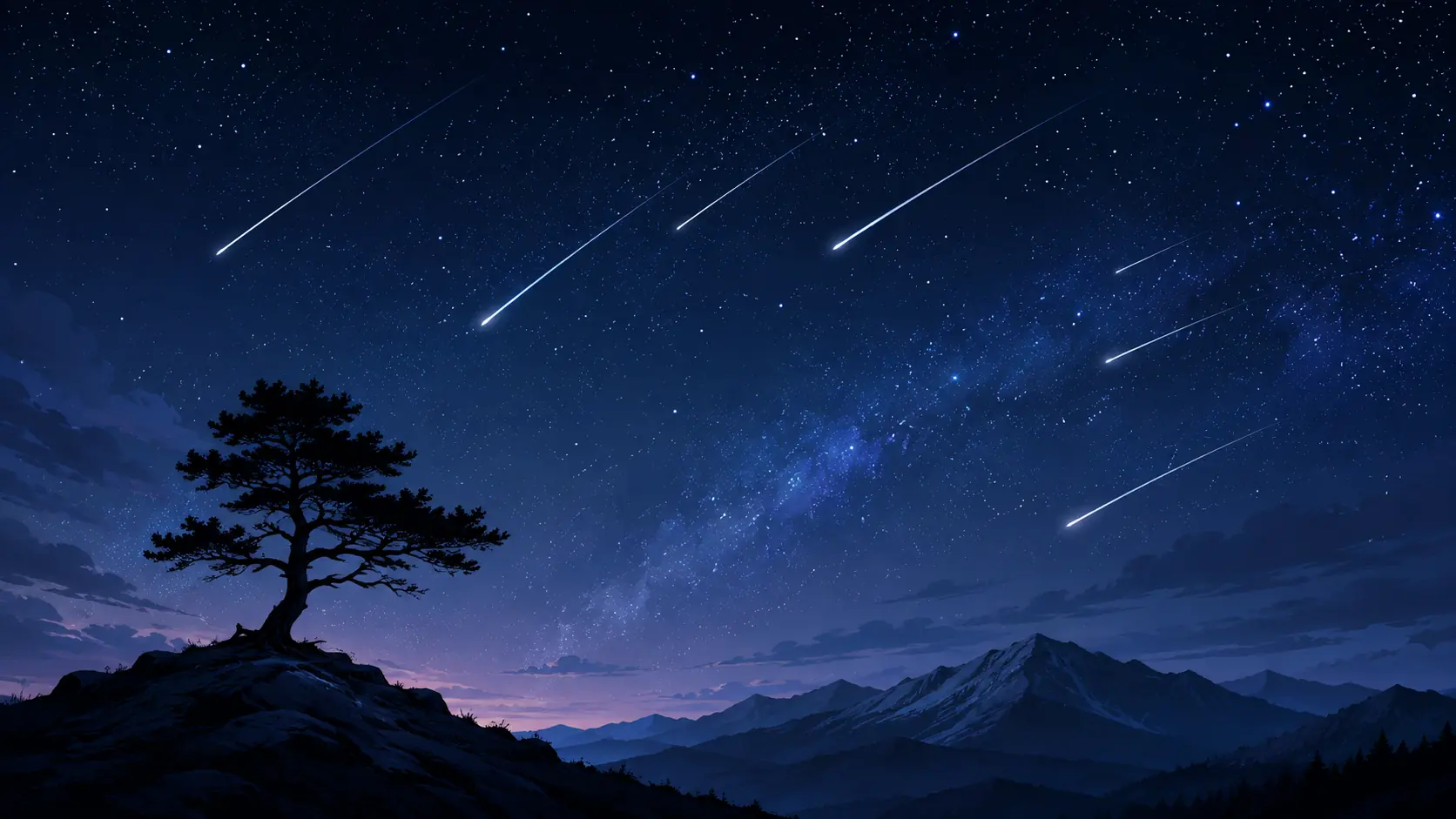
The Perseid meteor shower occurs when Earth passes through debris left behind by Comet Swift-Tuttle. Tiny particles enter the atmosphere and produce the familiar streaks of light, while the shower is also known for especially bright meteors known as fireballs.
In 2026, the peak coincides with a New Moon. In Athens, the New Moon occurs at 8:36 p.m. on August 12, meaning moonlight will not be a significant obstacle during the night.
Basic camera settings
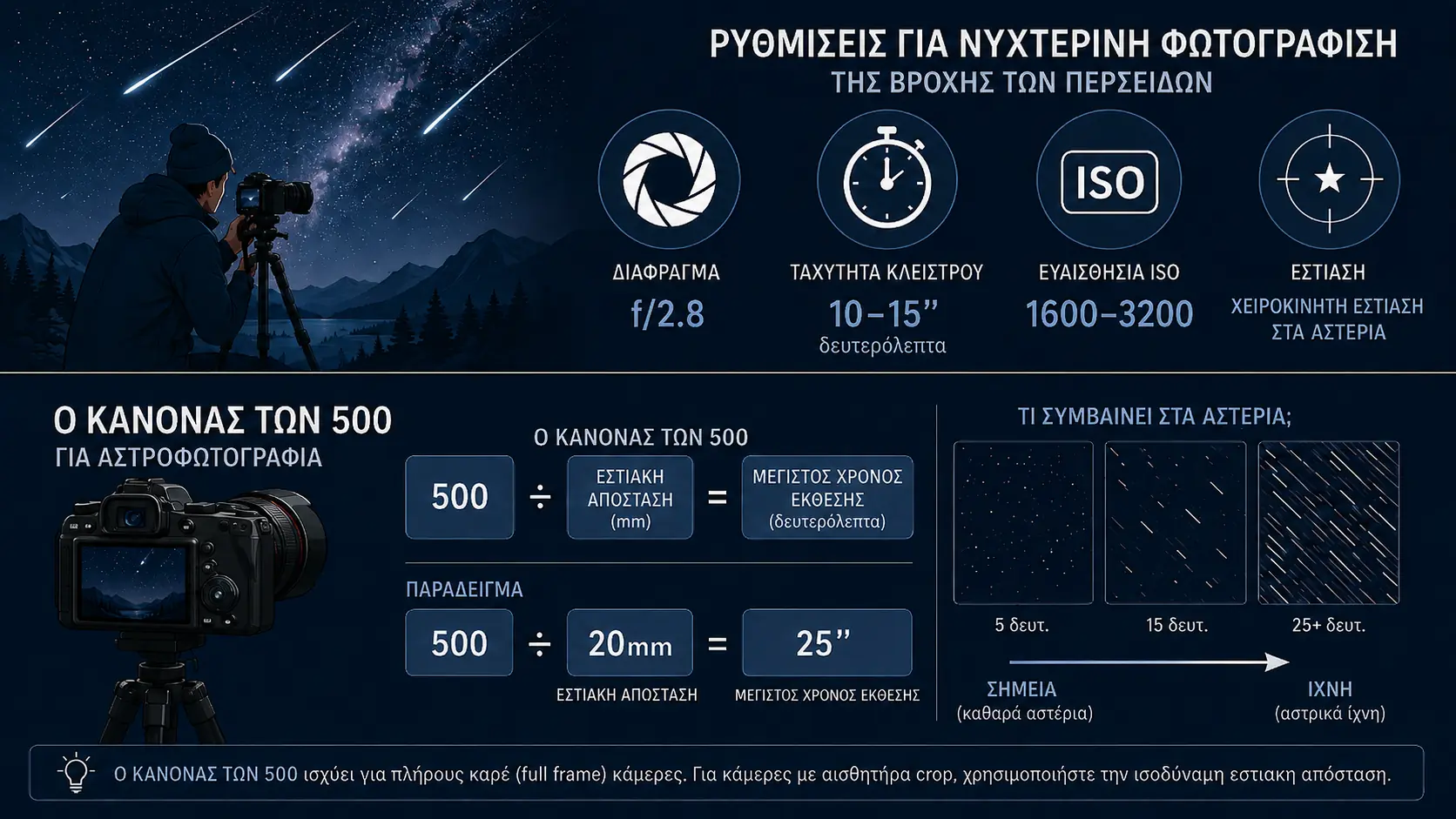
Meteor photography requires a stable camera, a wide-angle lens and relatively long exposures. NASA recommends a tripod, a wide-angle lens, manual focus and either a timer or remote shutter release to minimize vibration.
A practical starting point is:
Aperture: f/2.8 or as wide as the lens allows
Shutter speed: roughly 10 to 20 seconds as a starting point
ISO: 1600 to 3200
Focus: Manual, carefully checked on a bright star
Focal length: around 14 to 24mm on full frame, or an equivalent field of view
White Balance: around 3,500 to 4,000 K as a starting point
File format: RAW, where supported
These values are not absolute. Lens speed, light pollution, the sensor’s high-ISO performance and pixel density all affect the ideal settings.
Do not trust autofocus in the dark
Autofocus can struggle badly with the night sky. NASA recommends manual focus and checking a bright star using magnification on the rear screen or electronic viewfinder.
The infinity mark on a lens does not necessarily guarantee perfect focus. Small adjustments should be made until the star appears as small and sharp as possible.
Why a wide-angle lens matters
The Perseids appear to radiate from the area of the constellation Perseus, but individual meteors can appear almost anywhere in the sky. NASA therefore recommends a wide-angle lens: the more sky included in the frame, the greater the chance of a meteor crossing the photograph.
Including a mountain, tree or building in the foreground can also provide scale and create a stronger composition.
The 500 Rule: The formula
The 500 Rule was developed as a quick way to estimate the longest exposure that can be used with a stationary camera before the apparent movement of stars caused by Earth’s rotation becomes visible. NASA still presents it as a simple practical rule, while PhotoPills notes that it can produce excessively long exposures on modern cameras.
The basic full-frame formula is:
Maximum exposure time in seconds = 500 ÷ focal length in mm
For example:
500 ÷ 20mm = 25 seconds
With a 20mm lens on full frame, the 500 Rule therefore gives a theoretical maximum exposure of about 25 seconds. This is also the example used by NASA.
For sensors smaller than full frame, crop factor should also be considered:
Maximum exposure time = 500 ÷ (focal length × crop factor)
With a 20mm lens on an APS-C camera with a 1.5x crop factor:
500 ÷ (20 × 1.5) = 16.7 seconds
PhotoPills uses this effective-focal-length approach in its 500 Rule calculation.
Why the 500 Rule is no longer enough
The problem is that the 500 Rule does not know how many megapixels a camera has, how small the sensor pixels are or what aperture is being used.
On a very high-resolution camera, even a tiny amount of stellar movement is recorded across more pixels and can become obvious when the photograph is viewed at 100% or printed at a large size.
A 25-second exposure that appears acceptable under the 500 Rule may therefore already produce visible short star trails on a modern 40, 50 or 60-megapixel camera.
PhotoPills describes the 500 Rule as less accurate and uses the NPF Rule as a more modern way to estimate shutter speed.
The more modern NPF Rule
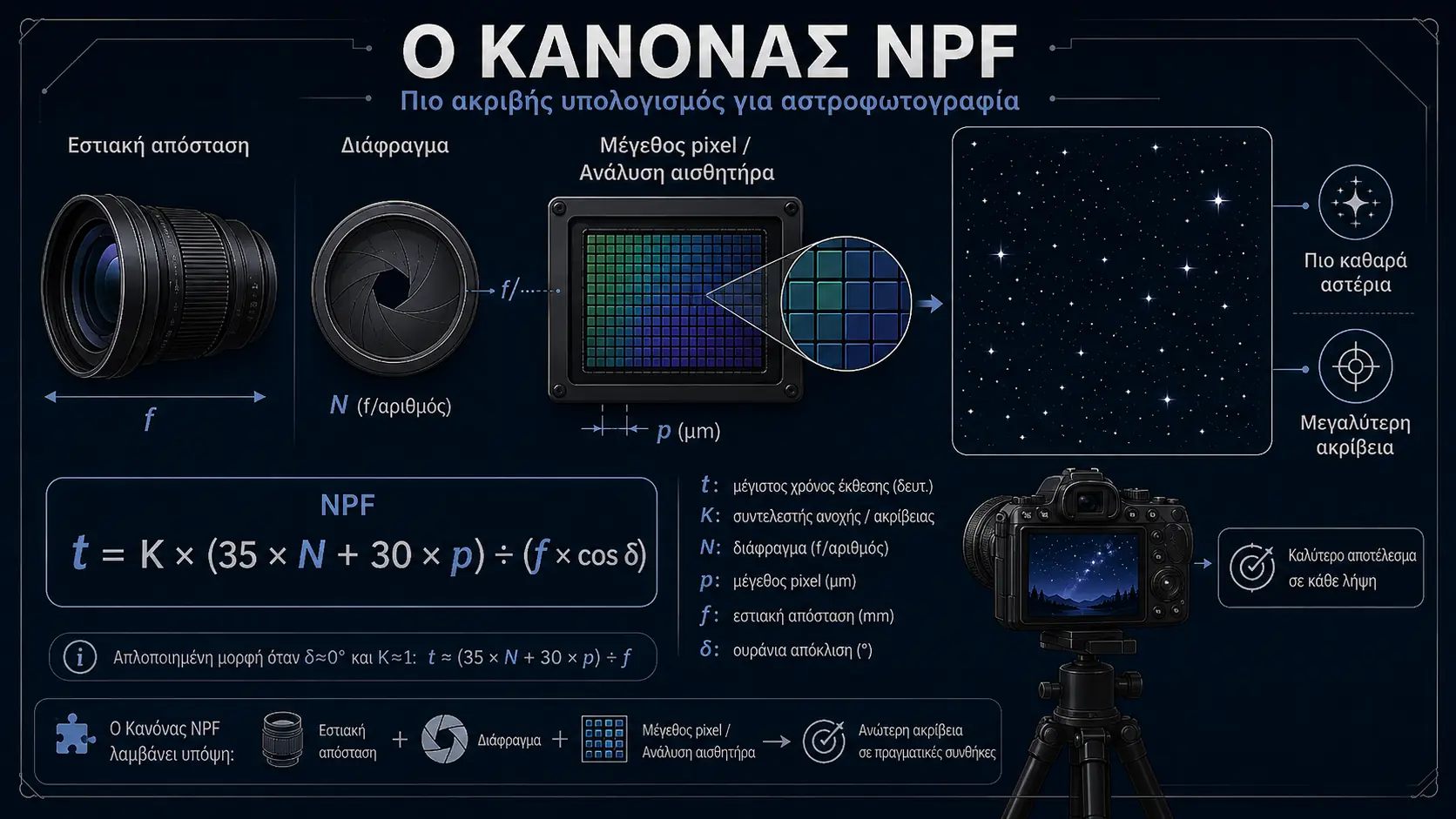
The NPF Rule was developed by Frédéric Michaud of the Société Astronomique du Havre to provide a more realistic maximum exposure time for digital cameras. Unlike the 500 Rule, it accounts for aperture, focal length and sensor pixel pitch.
A widely used simplified version of the NPF formula is:
Exposure time = (35 × N + 30 × p) ÷ f
where:
N = aperture f-number, for example 2.8
p = pixel pitch in micrometers
f = focal length in millimeters
Pixel pitch can be estimated as:
p = sensor width in mm ÷ horizontal pixel count × 1000
The NPF Rule is not simply a “400 Rule” or “300 Rule.” The 400 and 300 Rules are merely more conservative versions of the same basic approach as the 500 Rule, whereas NPF uses characteristics of the actual camera and lens.
Example: 500 Rule versus NPF
Consider a roughly 24-megapixel full-frame camera with about 6,000 horizontal pixels, a 20mm lens and an aperture of f/2.8.
Pixel pitch is approximately:
36 ÷ 6000 × 1000 = 6 μm
Using the 500 Rule:
500 ÷ 20 = 25 seconds
Using the simplified NPF Rule:
(35 × 2.8 + 30 × 6) ÷ 20
= (98 + 180) ÷ 20
= about 13.9 seconds
The difference is substantial: roughly 14 seconds instead of 25.
On a roughly 45-megapixel full-frame camera, where the pixels are smaller, the same lens and aperture can result in an NPF exposure of around 11-12 seconds.
This illustrates why the 500 Rule can be overly optimistic on today’s high-resolution cameras.
Is there an even more accurate version of NPF?
Yes. The simplified equation is useful for quick calculations, but more complete implementations of NPF can also take the declination of the stars into account.
PhotoPills, for example, uses the camera model, focal length, aperture, minimum stellar declination and a chosen accuracy level. It calculates pixel pitch from sensor size and resolution and returns a separate NPF value.
Declination matters because the apparent rate at which stars move through the frame is not identical across every part of the sky. If declination is unknown, PhotoPills recommends using 0 degrees as a conservative scenario.
For a modern high-resolution mirrorless camera, NPF is therefore a better starting point than the 500 Rule when the goal is genuinely pinpoint stars.
What this means specifically for the Perseids
Meteor-shower photography involves a compromise. Longer exposures increase the amount of time during which a meteor can cross the frame, but they also increase the chance of visible star movement.
Shorter exposures keep stars cleaner but require a higher ISO or a faster lens.
For a modern camera with a wide-angle lens, 10 to 15 seconds is often a safer starting point than 20 to 30 seconds, particularly when the final image will be inspected at high resolution. The exact limit should still be calculated for the specific camera and lens.
The secret is continuous shooting
A meteor appears without warning and there is no way to predict the exact second when it will cross the frame.
The most practical technique is therefore to use an interval timer or intervalometer and capture repeated exposures with the smallest possible gap between frames.
This avoids constantly touching the shutter button and also reduces vibration. NASA similarly recommends using a timer or remote shutter release for meteor photography.
How to photograph the Perseids with a smartphone
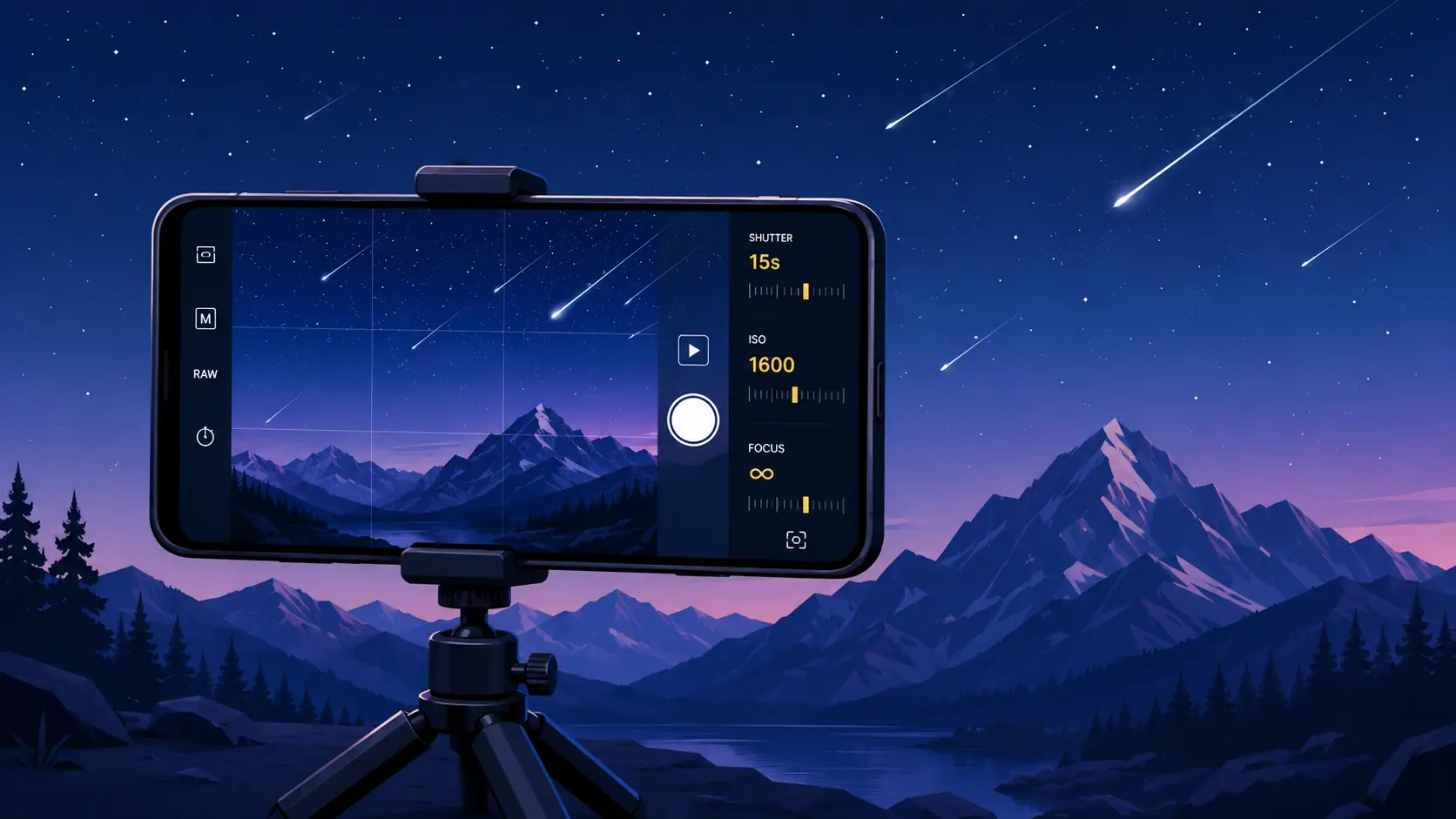
Modern smartphones can capture the night sky, especially when they include Night Mode, Astrophotography Mode or a manual Pro Mode.
The phone should be placed on a tripod or completely stable surface. Apple allows longer Night Mode capture times when the iPhone remains steady, Google enables Astrophotography through Night Sight on compatible Pixel devices when the phone is stationary, and Samsung offers Astrophotography through Expert RAW on compatible Galaxy devices.
On smartphones with a genuine Pro or Manual Mode, photographers can experiment with roughly 10 to 20-second exposures while adjusting ISO and focus according to the device and conditions.
Be careful with computational Astro modes
Smartphone Night and Astro modes do not always operate as one simple long exposure. They often build the final image by combining multiple frames.
This is extremely useful for stationary stars and landscapes, but a meteor is a brief, fast-moving streak of light. It can therefore be worth testing Manual or Pro Mode as well, where available, to gain more control over the actual exposure time of each frame.
Find genuinely dark skies
Location can influence the final result more than a small change in ISO.
NASA recommends getting away from city lights and choosing a dark, open location. For visual observation, it also recommends allowing roughly 20 to 30 minutes for the eyes to adapt to the darkness.
For photography, streetlights, car headlights and illuminated buildings can significantly reduce the contrast between the sky and fainter meteors.
The most common mistakes
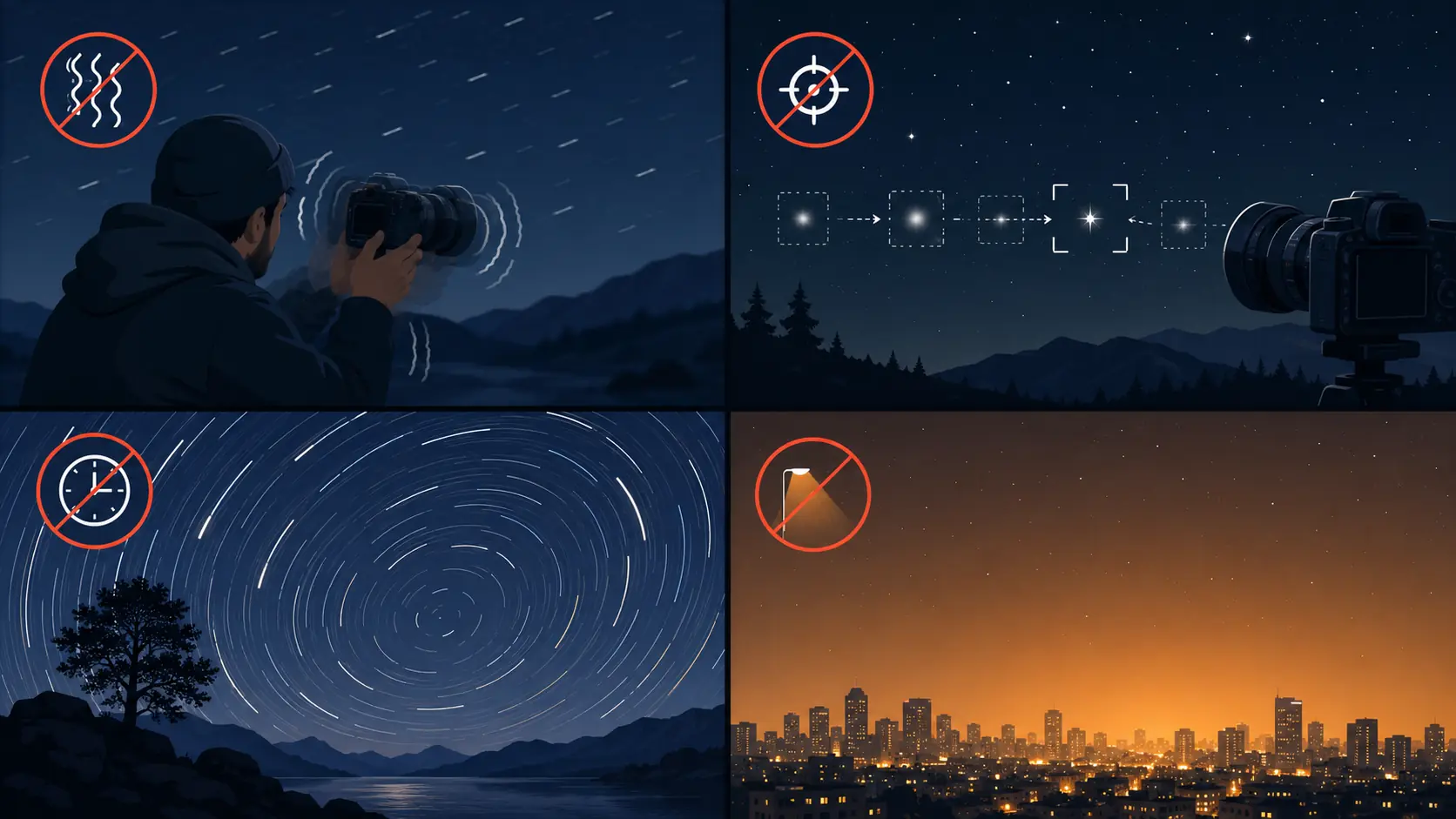
One of the biggest mistakes is shooting without a stable tripod. Even small movements become visible when the shutter remains open for several seconds.
Other common problems include autofocus, an excessively narrow telephoto field of view, exposures that are too long, heavy light pollution and constantly moving the camera in an attempt to chase every meteor.
Modern cameras introduce another potential mistake: blindly applying the 500 Rule without considering the sensor’s actual resolution. For genuinely clean stars, NPF provides a better starting point.
What we think
The 2026 Perseids are one of the best opportunities in recent years to try meteor photography, mainly because the peak coincides with a New Moon.
The 500 Rule remains useful for a quick field calculation, but the era of very high-resolution sensors has made it less reliable when truly pinpoint stars are the goal. NPF is the more logical choice for modern mirrorless and DSLR cameras because it takes more of the real characteristics of the imaging system into account.
In practice, a fast wide-angle lens, accurate manual focus, a stable tripod and hundreds of consecutive frames matter more for the Perseids than trying to use every second theoretically permitted by the 500 Rule.
Frequently asked questions
When do the Perseids peak in 2026?
The peak is expected on the night of August 12 into the early morning of August 13, 2026. The New Moon on August 12 creates particularly favorable dark-sky conditions.
What is the 500 Rule formula?
On full frame, the basic formula is 500 divided by the lens focal length. On a smaller sensor, 500 can be divided by focal length multiplied by crop factor. With a 20mm lens on full frame, the result is 25 seconds.
What is the NPF Rule?
NPF is a more modern calculation for maximum exposure time without obvious star trails. It takes focal length, aperture and pixel pitch into account, while more advanced implementations can also include stellar declination.
Is NPF better than the 500 Rule?
For modern high-resolution cameras, it is generally a more accurate starting point. The 500 Rule can produce considerably longer exposures and therefore small but visible star trails.
Can the Perseids be photographed with a smartphone?
Yes, particularly with a smartphone that includes Night, Pro or Astrophotography Mode, provided the phone is kept completely stable and used under dark skies.