

Summary
- NASA’s August 18 APOD features a Perseid composition captured from Jizerka in the Czech Republic
- Jakub Kuřák’s image combines observations from several nights and reveals the radiant in Perseus
- The August 12-13 peak coincided with a New Moon and exceptionally dark skies
- The Perseids originate from debris left by Comet 109P/Swift-Tuttle and travel at about 59 km/s
- The shower remains active through August 24, 2026
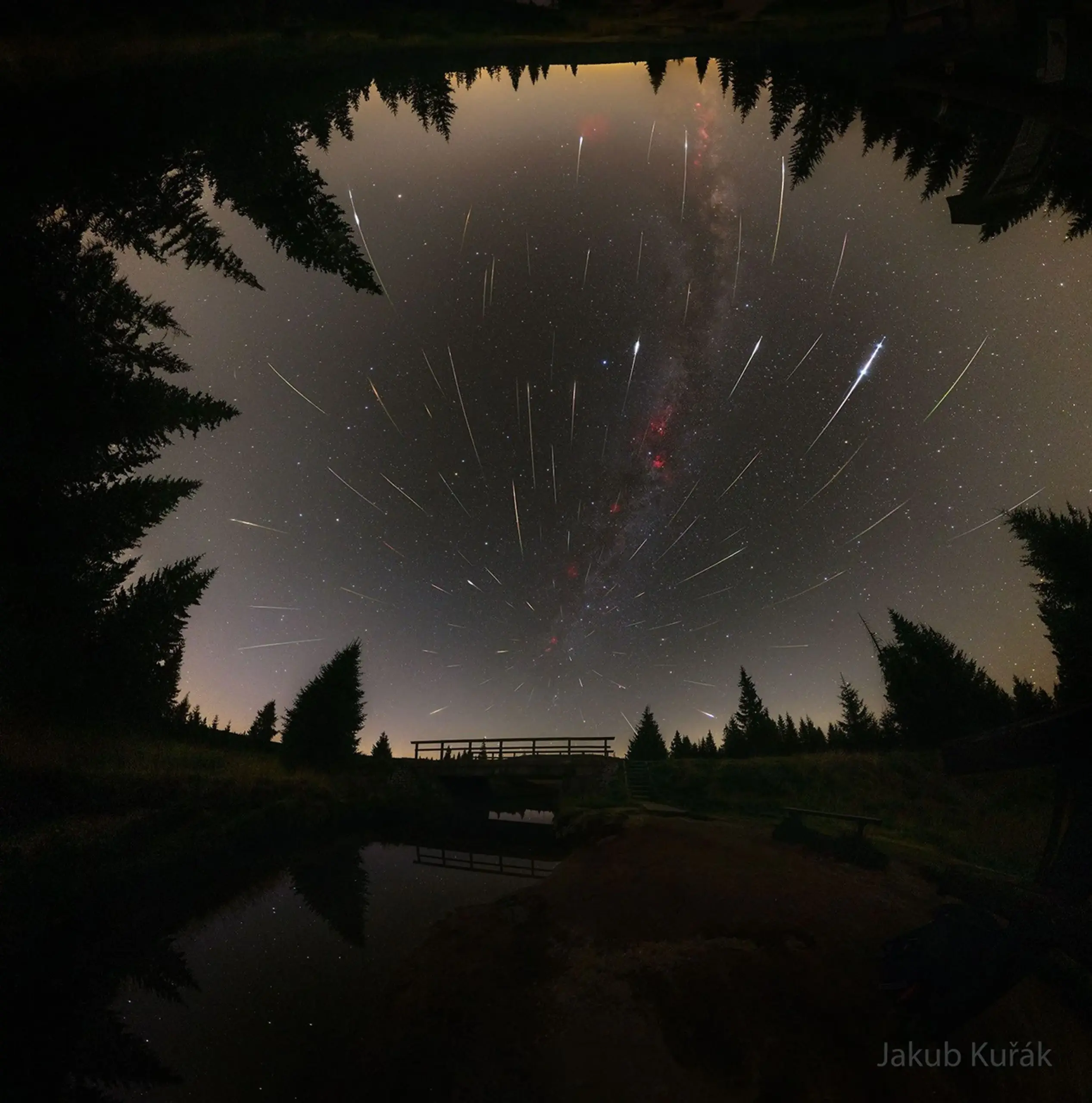
NASA’s Astronomy Picture of the Day for August 18, 2026 brings together the Perseids in a striking composition over the Czech Republic, visually revealing their radiant point in the constellation Perseus.
The image was created from exposures accumulated over several nights at Jizerka in the Czech Republic and is credited to Jakub Kuřák. When the bright meteor trails are traced backward, they appear to converge on one area of the sky within Perseus, the shower’s so-called radiant.
2026 was particularly favorable for observing the Perseids because their August 12-13 peak coincided with a New Moon. The absence of strong moonlight produced a much darker sky than in years with a bright Moon, allowing more faint meteors to become visible.
What the image actually shows
NASA’s composition should not be interpreted as a single exposure in which all of the meteors appeared simultaneously. It combines material accumulated over several nights in order to make the geometry of the Perseid meteor shower clearly visible.
The streaks do not actually originate in the constellation Perseus. The radiant is a perspective effect: meteoroids travel along nearly parallel trajectories, but from Earth they appear to diverge from a common point on the celestial sphere. The name “Perseids” comes from the fact that this apparent point lies in Perseus.
Why 2026 was such a favorable year
NASA had noted ahead of the peak that the New Moon on August 12 would provide ideally dark conditions for the Perseids on the night of August 12 into the morning of August 13. A total solar eclipse also occurred that day, with the path of totality crossing parts of northern Russia, Greenland, Iceland, northern Spain and a small part of Portugal.
The connection between the two events is simple but striking: the Moon that moved between Earth and the Sun during the eclipse was simultaneously in its New Moon phase. A few hours later, therefore, there was no bright lunar disk in the night sky to wash out the fainter meteors.
Where the Perseids come from
The shower is associated with Comet 109P/Swift-Tuttle. As Earth passes through the stream of particles left behind along the comet’s orbit each year, small pieces of material enter the atmosphere at very high speed and produce the bright streaks known as meteors.
According to NASA, Perseid meteors enter at around 59 kilometers per second and are known both for their bright trails and for producing particularly luminous fireballs. Swift-Tuttle takes roughly 133 years to complete one orbit around the Sun, while its nucleus is about 26 kilometers across.
What observations predicted for 2026
The International Meteor Organization’s calendar listed the Perseids as active from July 17 through August 24, 2026, with the main maximum on August 13 and a characteristic velocity of 59 km/s. The New Moon was described as providing excellent conditions for optical observations.
The IMO also noted that models for 2026 indicated possible encounters with older sections of the Swift-Tuttle debris stream, although there was no certainty that these would produce unusually strong additional activity. The year’s most important advantage remained the dark sky around the main maximum.
The Perseids continue after the peak
The peak has already passed, but the shower’s activity does not end immediately. NASA lists the Perseids as remaining active through August 24, 2026, although rates decline after maximum.
A telescope offers no real advantage for visual meteor watching because meteors can appear across a wide area of the sky. NASA recommends a dark, open location and around 30 minutes for the eyes to adapt to darkness, with conditions improving as Perseus rises higher in the sky.
What we think
This APOD has value beyond its visual impact because it demonstrates in a particularly intuitive way what a meteor shower’s “radiant” actually means. The 2026 Perseids also provide a clear example of how decisive the Moon’s phase can be for real-world meteor visibility: even without an extreme outburst, a genuinely dark sky can transform the observing experience.
Frequently asked questions
When did the Perseids peak in 2026?
The main peak occurred on the night of August 12 into the morning of August 13, 2026, under exceptionally favorable conditions created by the New Moon.
Why do all the Perseids appear to come from Perseus?
It is a perspective effect. From Earth, the particle trajectories appear to converge toward a common point in the sky, known as the radiant, which for the Perseids lies in the constellation Perseus.
Which comet produces the Perseids?
Their source is the debris stream of Comet 109P/Swift-Tuttle, through which Earth passes every year.
Can the Perseids still be seen after August 18?
Yes. NASA lists the shower as active through August 24, 2026, although activity is lower than around the peak.