Summary
- NASA selected a Lucy Yunxi Hu image composite for the October 23, 2026 APOD.
- The photographs were taken on October 10–11 in New South Wales, Australia.
- Tracked and stacked sky exposures were combined with a separate foreground photograph.
- The finished image reveals detail that cannot be seen with the unaided eye.
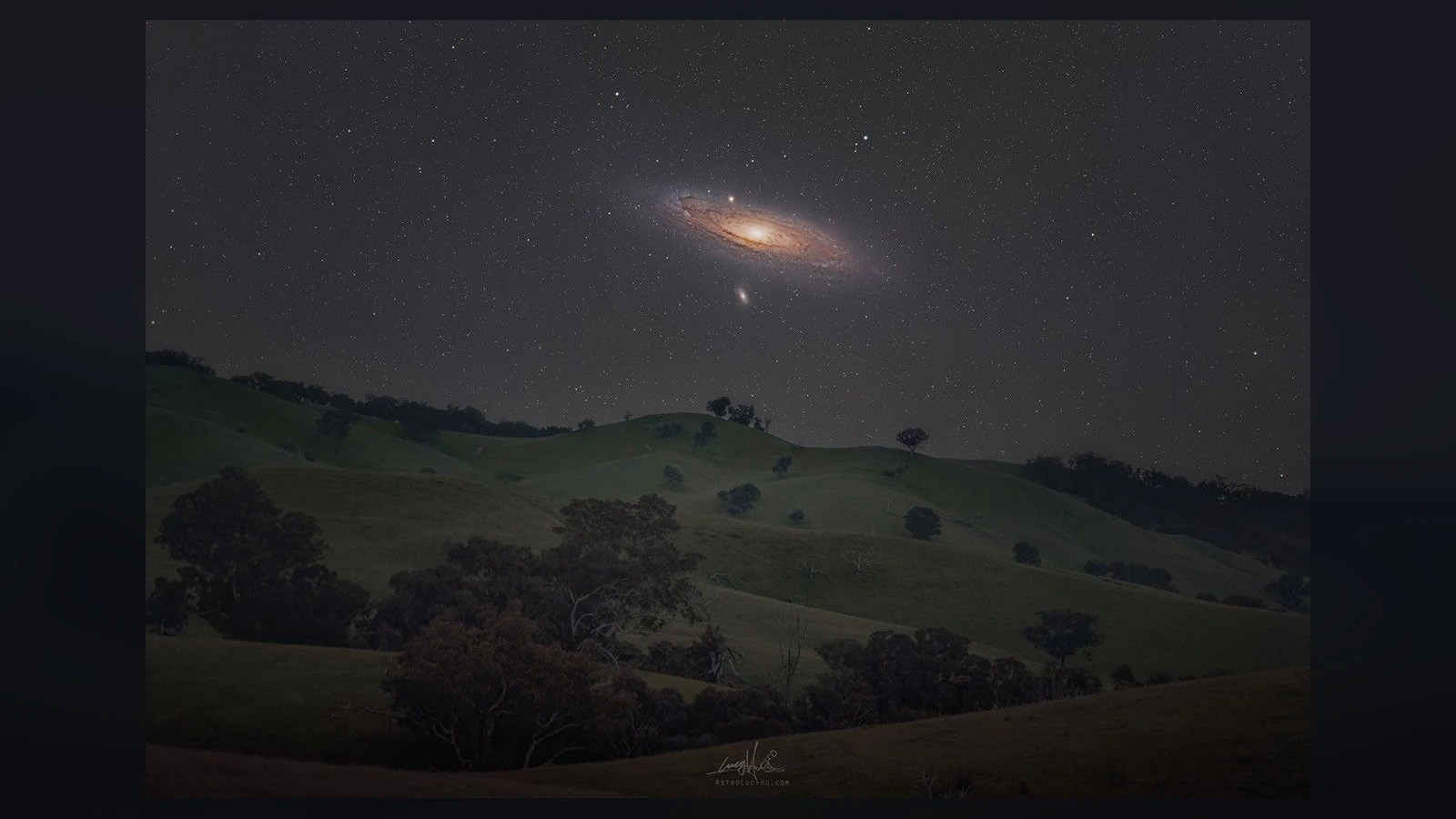
Could Andromeda really look this large and bright above the Australian hills? The image selected by NASA is authentic astrophotographic work, but the finished scene is a composite built from multiple exposures.
Lucy Yunxi Hu photographed the landscape near Mullion, New South Wales, on the night of October 10–11, 2026. Her image, “Andromeda in Southern Spring,” was selected as NASA’s Astronomy Picture of the Day (APOD) for October 23, showing the galaxy above the region’s rolling hills.
How the image was created
NASA describes a telephoto scene assembled from multiple sky exposures. Digitally tracked frames were stacked to bring out the galaxy’s structure, then combined with a separately photographed foreground to complete the night landscape.
That distinction matters. Tracking compensates for the apparent movement of the stars during an exposure, but the ground does not follow that motion in the frame. A separate landscape exposure lets both elements appear sharp. NASA does not specify the exact focal length, number of frames, exposure times or equipment in its description, so those settings cannot be attributed to the photographer.
A related before-and-after comparison of Andromeda processing, based on 223 exposures, shows how stacking and image cleanup are distinct steps in an astrophotography workflow.
Why Andromeda sits so low over Australia
From Mullion, M31 never rises more than a few degrees above the northern horizon. During the Southern Hemisphere’s spring it reaches its highest position around midnight, according to NASA. That low angle allows the galaxy to share the frame with the hills.
Andromeda is among the brightest Messier objects, yet to the unaided eye it appears as a small, faint, fuzzy patch. NASA says its wider apparent extent in the final image approaches the width of six full moons. Large apparent size does not mean that a viewer could see the composite’s brightness or intricate details without a camera.
Photographic capture and digital compositing
The finished picture shows a real galaxy and a real terrestrial landscape, but it is not a single exposure. NASA explicitly calls it a deep astro-image composite. Understanding that technique does not diminish the photographer’s achievement; it explains the craft behind the result.
The public description does not include RAW files or a complete edit history, so the exact scale relationship and every processing operation cannot be independently audited. The documented method is a combination of tracked and stacked sky frames with a separate foreground.
What we think
What works beautifully here is the sense of place. Andromeda is not isolated against a blank sky; the hills give the galaxy a horizon and a meaningful scale reference. Its unusually low position from this part of Australia makes the framing particularly striking.
For night-sky photographers, the interesting lesson is the workflow. Once you track the stars, the ground moves relative to the tracked image. Planning a separate foreground exposure is often the technically sensible solution rather than a shortcut.
The important distinction is in how we describe the finished result. Photographing a real sky and a real landscape is not the same as reproducing exactly what someone saw with their eyes. A composite can be both carefully crafted and clearly labelled; that transparency is part of good photographic practice.
Frequently asked questions
Is this a single photograph?
No. NASA describes a composite made from tracked and stacked sky exposures combined with a separate foreground photograph.
Can Andromeda look like this to the naked eye?
No. Under favorable conditions it appears as a faint fuzzy patch; multiple exposures and processing reveal the detailed galactic structure.