

Summary
- The M31 comparison is based on 223 exposures of 300 seconds each.
- Processing mainly reduces terrestrial and technical artifacts in the captured data.
An image of the Andromeda Galaxy covered in bright streaks shows something we rarely see: how much work can happen before a deep-sky astrophotograph reaches its final form.
NASA’s Astronomy Picture of the Day for 27 September 2026 presents the same view of the Andromeda Galaxy (M31) before and after unwanted traces were greatly reduced. The base image is a stack of 223 exposures, each 300 seconds long, captured from a garden observatory in Portugal in 2019 — a total exposure time of 18 hours and 35 minutes.
The key point is that the “before” version is not a single RAW frame or a completely untouched file. It is already a combined stack of many exposures; what remains highly visible are terrestrial and technical artifacts that later processing is intended to reduce.
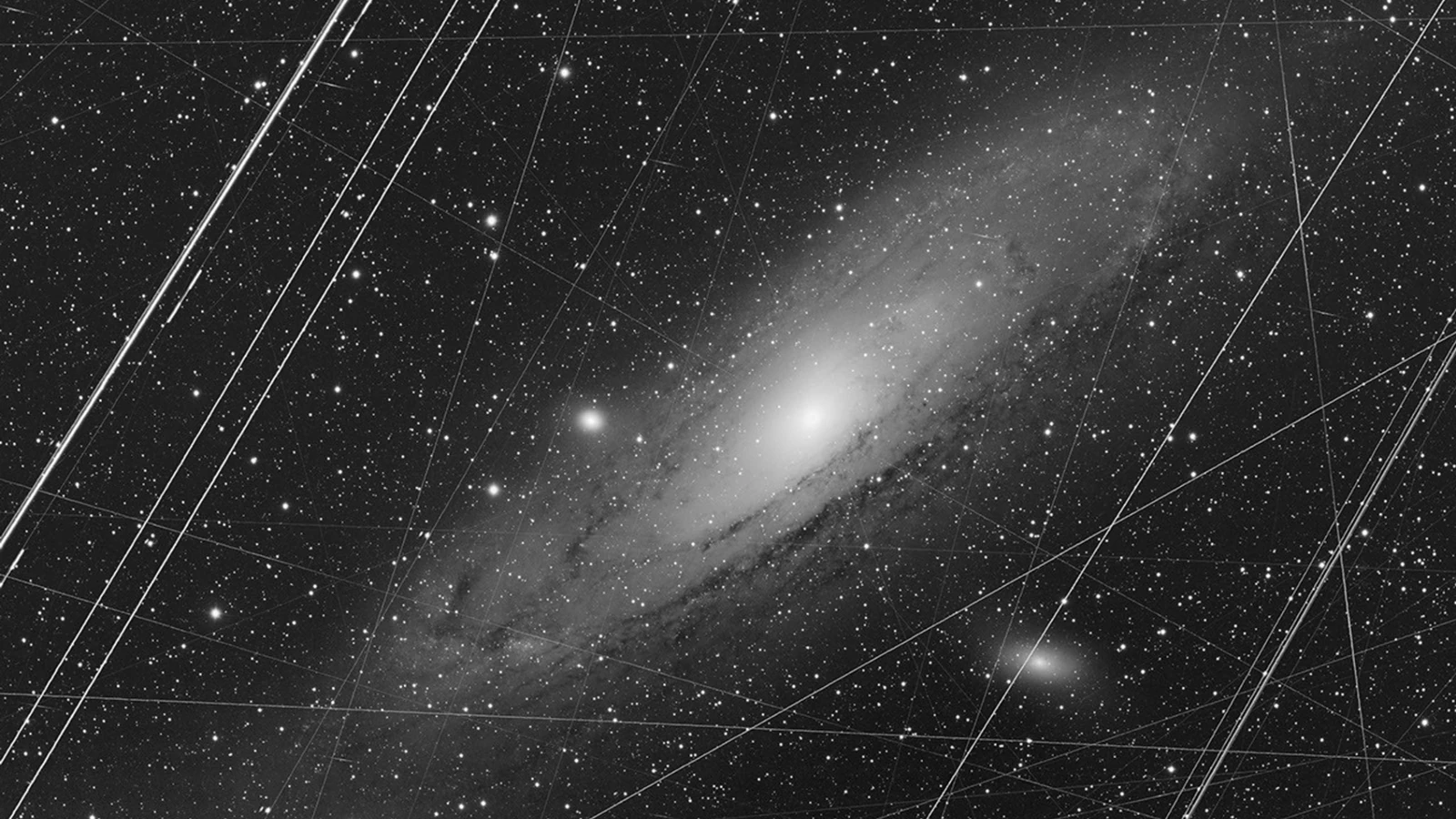
It is not a single RAW frame — it is a stack of 223 exposures
Each of the 223 exposures lasted 300 seconds. Combining them reveals far more information than a single exposure, but unwanted traces from objects crossing the camera’s view or from the sensor are also retained.
That makes the comparison especially useful for people who are new to astrophotography: the final image is not simply the result of one extremely long exposure. It comes from collecting multiple files and processing the data they contain.
What are all those lines?
NASA identifies four main types of problems in the “before” image: bright parallel aircraft trails, long continuous satellite trails, shorter cosmic-ray streaks and bad pixels. In other words, much of what makes the frame look dramatically chaotic does not belong to the galaxy itself.
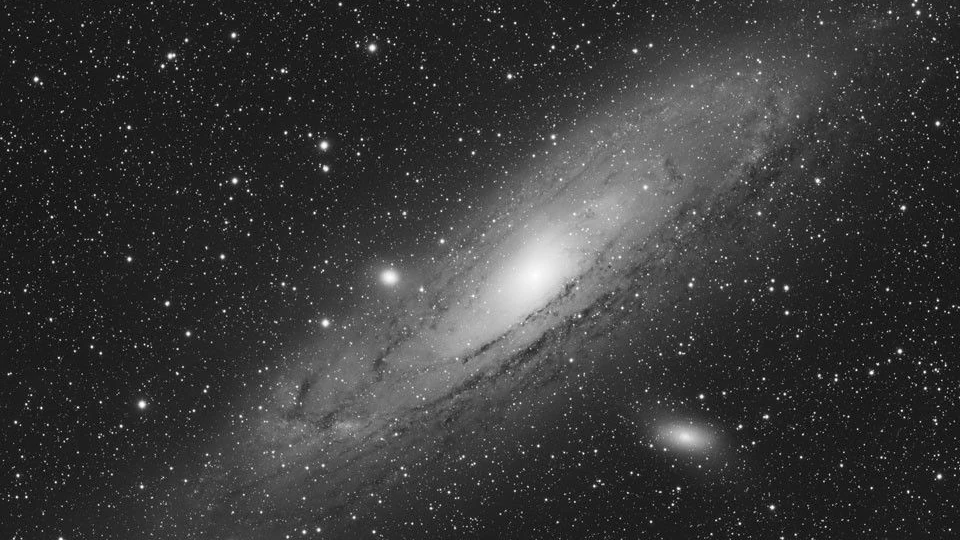
The “after” image was not cleaned up with Photoshop
Although the APOD title uses “Photoshop” as a familiar shorthand, NASA explicitly says that these imperfections were not removed with Adobe Photoshop. A series of specialist applications was used instead, including Astro Pixel Processor, DeepSkyStacker and PixInsight.
According to NASA’s explanation, the goal was not to create a digital fantasy, but to minimise terrestrial and technical artifacts that have nothing to do with M31 so that the galaxy itself is reproduced more clearly.
The same image was already an APOD in 2019
Kees Scherer’s work is not appearing for the first time now. “Andromeda before Photoshop” was selected as Astronomy Picture of the Day on 14 October 2019. The 2026 presentation places the before and processed versions side by side, making the difference much easier to understand.
What we think
The value of this comparison is that it separates two different stages: capturing the data and cleaning it up. For an astrophotographer, a processing workflow is expected; for a wider audience, this before-and-after view shows why the absence of satellite or aircraft trails from the final image does not mean they were never present in the captured data.
Frequently asked questions
Is the “before” image a RAW file?
No. NASA says it is already a stack of 223 separate 300-second exposures.
What is the total exposure time?
223 exposures × 300 seconds equals 66,900 seconds, or 18 hours and 35 minutes in total.
What was removed from the final image?
NASA describes a major reduction in aircraft and satellite trails, cosmic-ray streaks and bad pixels. It does not describe the process as removing real structures from Andromeda.
Was Photoshop used?
Not for the specific cleanup described by NASA. The applications named are Astro Pixel Processor, DeepSkyStacker and PixInsight.
Who created the image?
The image is credited to Kees Scherer. The observations were made in Portugal in 2019.