

Summary
- NASA highlights four major skywatching events for August 2026
- The total solar eclipse will not be visible from Greece
- A very small partial eclipse will appear only in northwestern Greece
- The Perseids peak during the night of August 12-13
- Venus will shine low in the west after sunset
- The partial lunar eclipse will be visible before dawn on August 28
NASA presents the major celestial events of August 2026, while the best observing opportunities for Greece mainly involve the Perseids, Venus and the partial lunar eclipse.
NASA’s new monthly skywatching guide includes the August 12 total solar eclipse, the peak of the Perseids, Venus at greatest eastern elongation and a deep partial lunar eclipse at the end of the month.
The concentration of four different astronomical events within a few weeks creates opportunities for naked-eye observations or the use of simple equipment. However, the visibility of each event depends on geographic location, meaning NASA’s advice requires some adjustment for observers in Greece.
The total solar eclipse on August 12
NASA reports that on August 12, 2026, a total solar eclipse will cross northern Russia, Greenland, Iceland and northern Spain, while a small part of Portugal will also lie within the path of totality. In other areas of the Northern Hemisphere, the eclipse will be partial.
The total phase will not be visible from Greece. An extremely small partial eclipse may only be observed from parts of northwestern Greece and for a very short period, as the Sun will already be setting.
In Corfu, for example, the partial phase is calculated to last from 8:33 p.m. to 8:40 p.m., with approximately 2.34% of the solar disk covered at 8:37 p.m. A completely unobstructed western horizon will be required, while the event will not be visible from Athens or most of the country.
Observing the Sun requires certified eclipse glasses or an appropriate solar filter. Regular sunglasses do not provide protection, while cameras, binoculars and telescopes must not be pointed toward the Sun without a dedicated filter installed in front of their optics.
The Perseids peak under dark skies
Later that same night, the Perseid meteor shower will approach its peak. According to NASA, maximum activity is expected from the evening of August 12 into the early morning hours of August 13.
The New Moon on August 12 will leave the sky without strong moonlight, creating particularly favorable conditions for observing even fainter meteors. The Perseids appear as Earth passes through a stream of particles left behind by Comet Swift-Tuttle.
NASA’s advice also applies to Greece. Observers should choose a dark, open location away from city lights and begin observing after the sky becomes fully dark. The best chances are expected after midnight and until shortly before dawn on August 13.
The constellation Perseus will be toward the northeast, but meteors can appear in any part of the sky. Binoculars or a telescope are not required, as they restrict the field of view. NASA also recommends allowing about 30 minutes for the eyes to adjust to the darkness and avoiding bright screens.
Venus will shine after sunset
From August 14 to 16, Venus will reach its greatest eastern elongation, meaning its widest apparent angular separation from the Sun during this evening appearance.
NASA reports that the planet will be visible low in the western sky shortly after sunset and will be easy to identify because it will appear brighter than any surrounding star. Through a telescope, it will look approximately half illuminated, resembling a small lunar phase.
The same advice applies in Greece. The best observing position will be a location with a clear western horizon, without buildings, hills or trees. Binoculars or a telescope should only be used after the Sun has fully set.
The partial lunar eclipse at the end of the month
During the night of August 27-28, the Full Moon will pass through Earth’s shadow, producing a deep partial lunar eclipse. NASA reports that at the worldwide maximum, approximately 93% of the Moon’s diameter will be inside Earth’s dark central shadow.
The covered section of the Moon may appear dramatically darkened and take on a rusty or copper-colored tint. Unlike a solar eclipse, a lunar eclipse is safe to observe with the naked eye.
From Greece, the event will be visible before dawn on August 28, but the Moon will be low toward the west-southwest and will set before the true worldwide maximum. In Athens, the penumbral phase begins at 4:23 a.m. and the visible partial phase begins at 5:33 a.m.
The best visible moment for Athens is calculated to occur at approximately 6:50 a.m., when the Moon will be only 0.4 degrees above the horizon, shortly before moonset at 6:54 a.m. An elevated location or completely unobstructed view toward the west-southwest will therefore be necessary.
Conditions will be slightly better in western Greece because the Moon will set a little later. In Corfu, the best visible phase is expected at approximately 7:06 a.m., with the Moon almost directly on the horizon.
The key dates according to NASA
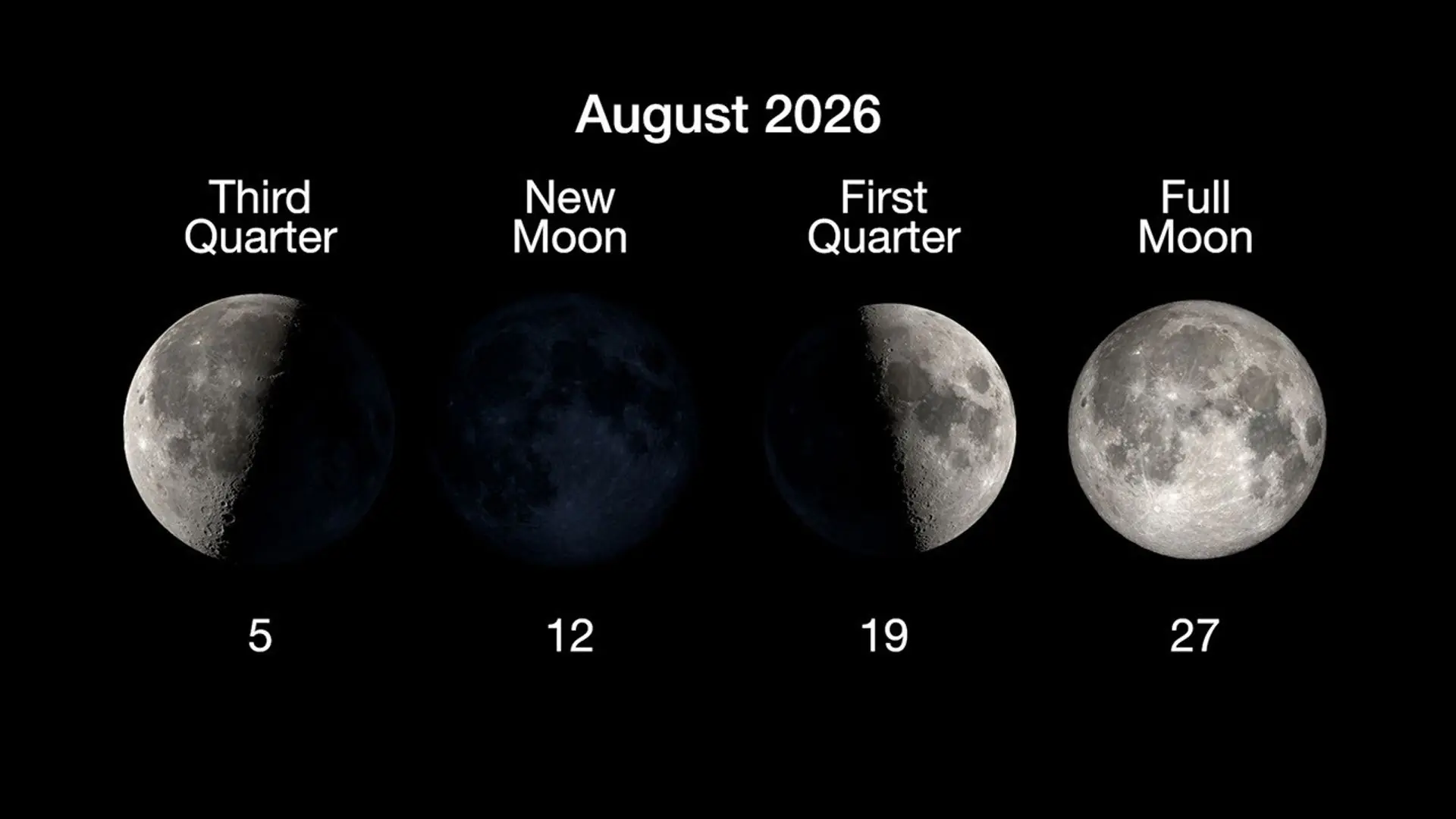
On August 5, the Moon reaches its last-quarter phase. The total solar eclipse and New Moon occur on August 12, while the Perseids peak during the night of August 12-13.
From August 14 to 16, Venus will be favorably positioned in the evening sky, while the deep partial lunar eclipse will follow on August 27 and 28.
For Greece, the most accessible and impressive event is expected to be the peak of the Perseids. Venus will also be easy to identify, while the lunar eclipse will require a clear horizon and an early-morning observation. The solar eclipse only concerns a limited section of northwestern Greece.
What we think
NASA’s guide shows that August 2026 is particularly rich in celestial events, although not all of them are equally visible from every region. For Greece, the Perseids under the dark skies of the New Moon represent the main event, while Venus and the partial lunar eclipse complete an interesting observing schedule without requiring specialized equipment.
Frequently asked questions
What is the most important event for Greece?
The Perseids offer the best observing opportunity because they will be visible throughout Greece and peak close to the New Moon, without strong moonlight.
Will the total solar eclipse be visible from Greece?
No. The total phase will not be visible from Greece. Only a very small partial eclipse may be observed from areas in the northwest, including Corfu.
What is the best time to observe the Perseids?
Observations can begin after the sky becomes fully dark, but the best conditions are expected after midnight on August 12-13 and until dawn begins.
Will the lunar eclipse be visible from Greece?
Yes, before dawn on August 28. The Moon will be very low toward the west-southwest and will set before the worldwide maximum of the eclipse.
Is special equipment required?
The Perseids, Venus and the lunar eclipse can be observed with the naked eye. Special eye protection is only required for observing the solar eclipse.