

Summary
- NASA has released new imagery from the Aug.
- 12, 2026 total solar eclipse
- Ground-based images from Spain show the eclipse progression, corona and solar prominences, while Maine provided an ISS transit across the partially eclipsed Sun
- Jessica Meir photographed the partial eclipse from the ISS at an altitude of about 422 kilometers
- NASA’s WB-57F flew at roughly 15 kilometers and imaged the corona in visible and infrared wavelengths
- The next total solar eclipse on Aug.
- 2, 2027 will reach a maximum totality of about 6 minutes and 23 seconds
- The eclipse through Bill Ingalls’ lens in Spain
- The ISS crossed the partially eclipsed Sun
- Jessica Meir photographed the eclipse from the ISS
- The WB-57F climbed above the clouds
- Balloons recorded what happened in the atmosphere
- The corona prediction versus the real image
- The next major eclipse arrives in 2027
- Captions for NASA images
- What we think
- Frequently asked questions
NASA has released new imagery and scientific observations from the Aug. 12, 2026 total solar eclipse, combining views from the ground, the International Space Station, a WB-57F research aircraft and scientific balloons.
The eclipse crossed northern Russia, Greenland, Iceland, the North Atlantic, Spain and a small part of Portugal. On Aug. 21, NASA brought together some of the event’s most distinctive observations, ranging from Bill Ingalls’ photographs in Spain to the International Space Station transiting the partially eclipsed Sun in Maine.
The significance of these images goes beyond their visual impact. Totality reveals the Sun’s faint outer atmosphere, the corona, while different observing platforms allow scientists to investigate solar prominences, the corona’s relationship with the solar wind and the atmospheric changes caused by the sudden loss of sunlight.
The eclipse through Bill Ingalls’ lens in Spain
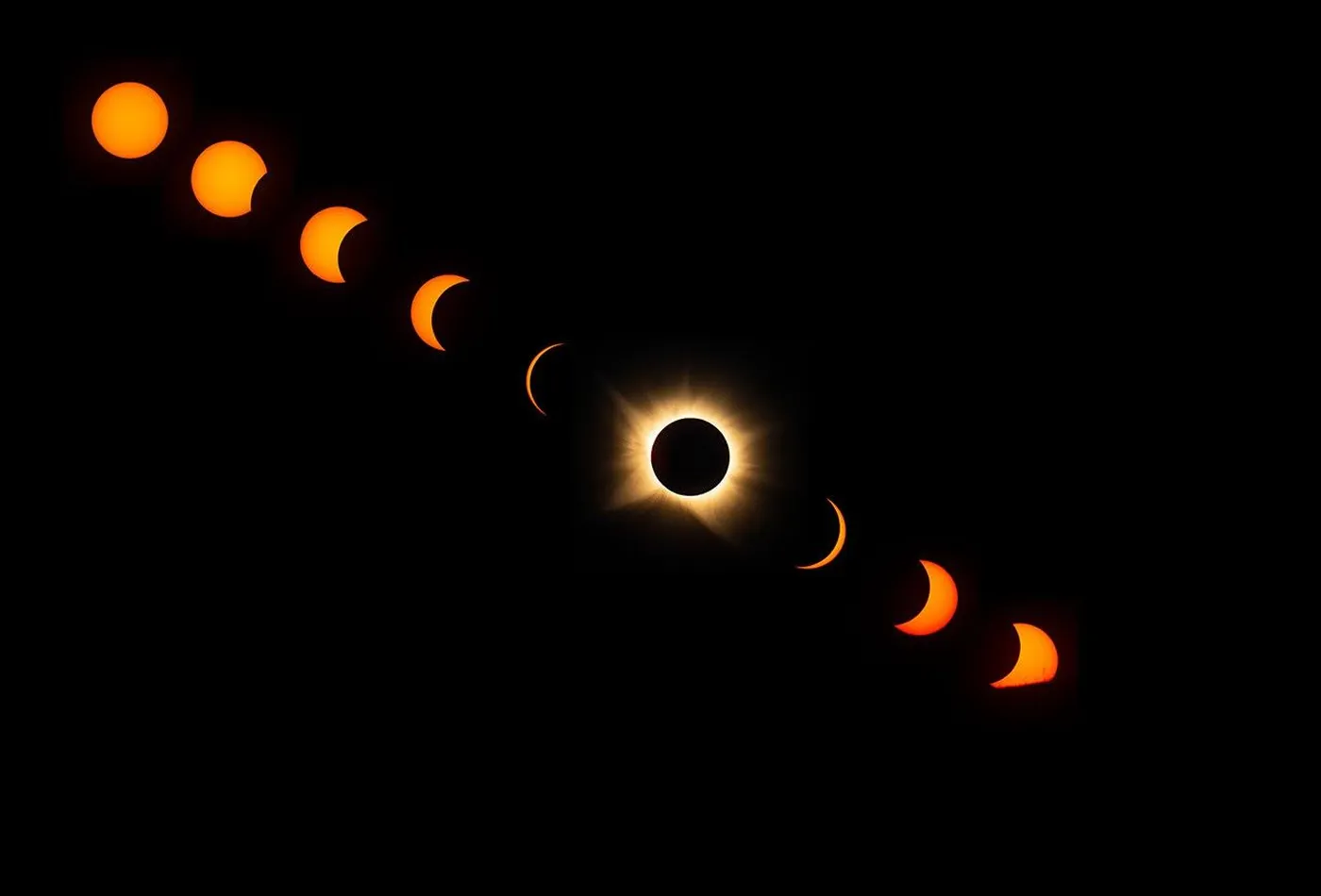
NASA photographer Bill Ingalls was positioned at San Millán de los Caballeros, around 40 kilometers south of León, where he documented the eclipse as the Sun approached the western horizon. One of the most distinctive composites places the successive eclipse phases above a field of sunflowers, while other photographs isolate the corona and a prominent solar prominence.
The maximum duration of totality anywhere along the eclipse path was approximately 2 minutes and 18 seconds, with a maximum path width of about 294 kilometers.
The situation in Greece was very different: there was no totality, and only a tiny part of the partial eclipse was visible for a few minutes from western and northwestern areas. PTTL had previously covered the eclipse’s visibility from Greece and NASA’s live broadcast.
The ISS crossed the partially eclipsed Sun
In Maine, the eclipse was only partial, but NASA photographer Joel Kowsky captured a very different view: the silhouette of the International Space Station moving across the solar disk through thin clouds, with sunspots also visible.
NASA says the ISS was traveling at roughly five miles per second, or nearly 8 km/s. A 12-frame sequence makes clear just how brief the available window was for such an image.
Jessica Meir photographed the eclipse from the ISS
The same eclipse was also recorded from the opposite perspective. NASA astronaut Jessica Meir photographed the partial eclipse from the ISS while the station was flying approximately 262 miles, or 422 kilometers, above southern Québec, Canada.
From that location, the Moon covered around 18% of the solar disk at the peak of the eclipse. NASA therefore obtained both images in which the ISS appears in front of the Sun and photographs of the eclipse taken from the ISS itself.
The WB-57F climbed above the clouds
One of the most important scientific experiments involved NASA’s WB-57F, which flew at approximately 50,000 feet, or 15.2 kilometers, off the coast of Iceland. Cameras aboard the aircraft recorded the corona and solar prominences at different visible and infrared wavelengths.
The mission was designed for the aircraft to move along with the Moon’s shadow at roughly 460 mph, or about 740 km/h, extending the available observing time toward three minutes. Its altitude also placed the cameras above the clouds and above much of the atmosphere that absorbs certain infrared wavelengths.
NASA says the science team led by the Southwest Research Institute will now analyze the data to study dynamic structures in the corona and solar prominences. Final scientific results have not yet been released.
Balloons recorded what happened in the atmosphere
Student teams participating in the NASA-funded Nationwide Eclipse Ballooning Project also operated in Iceland and Spain. Their scientific balloons carried cameras and instruments designed to record the Moon’s shadow and investigate how the sudden reduction in light and heat affects the lower atmosphere.
Clouds in Iceland made observations difficult from the ground but did not prevent the balloon instruments from collecting atmospheric measurements. In Spain, a camera carried by a scientific balloon recorded the Moon’s shadow moving across the atmosphere.
The corona prediction versus the real image
NASA also published an interesting comparison between a Predictive Science Inc. forecast of the solar corona and a processed real-world composite produced by the DEB Initiative near León.
The simulation was generated before the eclipse using observations from spacecraft and ground-based solar telescopes. Comparing it with the actual images allows researchers to assess how accurately the models reproduce the corona’s large-scale structures.
The next major eclipse arrives in 2027
The next total solar eclipse will occur on Aug. 2, 2027, crossing southern Spain, North Africa, Saudi Arabia and Yemen. NASA GSFC calculations give a maximum totality of approximately 6 minutes and 23 seconds, almost three times the 2026 maximum.
For photographers and filmmakers, it will be an especially important event, and PTTL has already examined the photographic and filmmaking significance of the 2027 total solar eclipse.
Captions for NASA images
- Composite image showing the total solar eclipse progressing toward sunset over San Millán de los Caballeros, Spain, on Aug. 12, 2026. Credit: NASA/Bill Ingalls
- The eclipse progresses above a field of sunflowers in San Millán de los Caballeros before and after totality. Credit: NASA/Bill Ingalls
- The solar corona becomes visible around the Moon’s dark disk during totality in Spain. Credit: NASA/Bill Ingalls
- A pink solar prominence appears along the Sun’s edge during totality at San Millán de los Caballeros. Credit: NASA/Bill Ingalls
- The International Space Station crosses the partially eclipsed Sun in silhouette as viewed near Hodgdon, Maine. Credit: NASA/Joel Kowsky
- NASA astronaut Jessica Meir photographs the partial solar eclipse from the ISS about 422 kilometers above southern Québec. Credit: NASA/Jessica Meir
- Cameras aboard NASA’s WB-57F record the solar corona and prominences at different visible and infrared wavelengths. Credit: NASA/SwRI/Will Ashfield
- Nationwide Eclipse Ballooning Project students prepare a scientific balloon in Mosfellsbær, Iceland, during the eclipse. Credit: NASA/Abbey Interrante
- At left is the predicted solar corona and at right the processed observation obtained near León during the eclipse. Credits: Predictive Science Inc. / DEB Initiative Team/Zack Stockbridge
What we think
The new imagery is particularly valuable because it presents the same event from radically different observing platforms. Ground photography captures the visual experience of the eclipse and the complex structure of the corona, while the WB-57F, scientific balloons and the ISS turn the same event into a scientific laboratory. The next meaningful step will be the analysis of the collected data, which NASA says will continue over the coming months.
Frequently asked questions
Why is the solar corona visible during a total eclipse?
The Sun’s bright visible surface normally overwhelms the much fainter corona. When the Moon completely covers the solar disk, the corona becomes visible around the Moon’s dark silhouette.
How long did totality last on Aug. 12, 2026?
The maximum duration of totality anywhere along the eclipse path was approximately 2 minutes and 18 seconds.
What did the WB-57F provide that ground observations could not?
The aircraft flew at roughly 15.2 kilometers, above the clouds and much of Earth’s atmosphere, allowing cleaner observations and access to infrared wavelengths that are absorbed lower in the atmosphere.
Is a solar filter required when observing an eclipse?
During the partial phases, appropriate eye protection and proper solar filters are required for direct viewing or photography of the Sun. Unprotected direct viewing is only possible during the brief period of complete totality when the bright solar disk is fully covered.
When is the next total solar eclipse?
The next total solar eclipse will occur on Aug. 2, 2027, with the path of totality crossing southern Spain, North Africa and parts of the Middle East.