

Summary
- IC 5146 lies about 2,500 light-years away in Cygnus.
- Its bright head spans about 10 light-years and its dark tail nearly 100.
- Piotr Czerski captured the image in July from Death Valley.
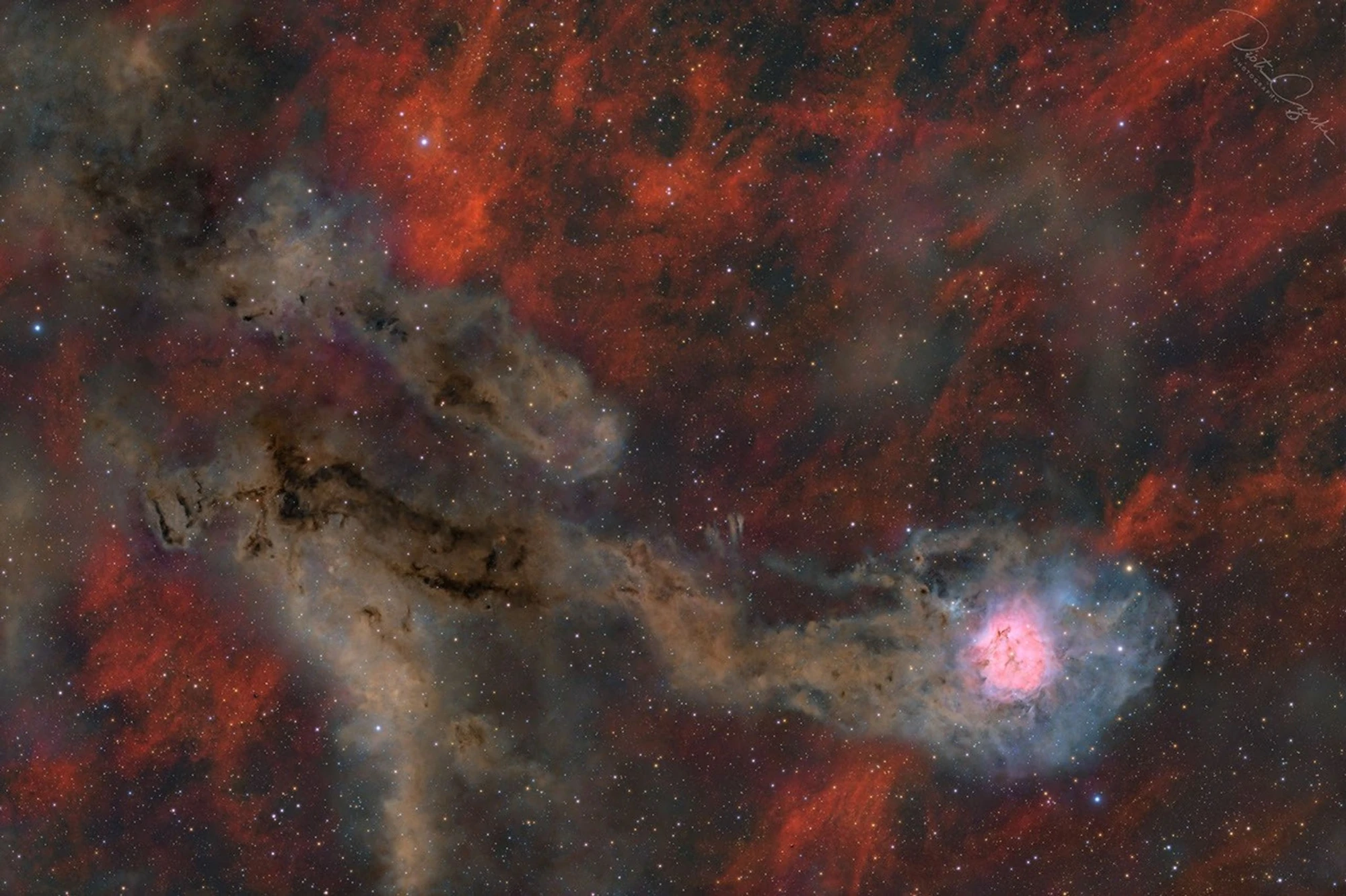
NASA’s Astronomy Picture of the Day (APOD) for today shows the Cocoon Nebula, or IC 5146, in the constellation Cygnus: a star-forming region that, in this wide-field view, looks strikingly like a comet.
The nebula’s bright “head” spans about 10 light-years, while its dark trail of interstellar dust stretches nearly 100 light-years. Both lie about 2,500 light-years from Earth. Piotr Czerski captured the image in July from Death Valley, California.
The dark tail hides stars in formation
Near the colorful center of the nebula is a bright star that, according to NASA, likely powers the region’s glow and helps clear a cavity in the surrounding material. At the same time, the dark filaments in the tail are not empty regions: in this visible-light image they conceal stars that are still forming.
Why the wide field changes the view of IC 5146
The frame covers more than two degrees of sky. This makes the bright emission and reflection region on one side visually connect with the long trail of dust clouds on the other, producing the overall comet-like appearance. The composition shows not only the bright Cocoon Nebula, but also the much larger environment around it.
What we think
The strength of this APOD lies mainly in its framing: the wide field makes the relationship between the bright nebula and the dark structure trailing away from it immediately readable. It is an image in which composition helps communicate the object’s true scale rather than simply providing visual impact.
Frequently asked questions
Is the Cocoon Nebula a comet?
No. It is a star-forming region cataloged as IC 5146. Its comet-like appearance comes from the combination of the bright head and the long dark dust tail.
How long is the dark tail?
NASA says it extends nearly 100 light-years, while the nebula’s bright head spans about 10 light-years.
How far away is IC 5146?
The nebula and its dark dust tail lie about 2,500 light-years from Earth in the constellation Cygnus.
Who captured the photograph?
The photograph is by Piotr Czerski and was captured in July from Death Valley, California.
Read more on the official NASA/APOD page.