Summary
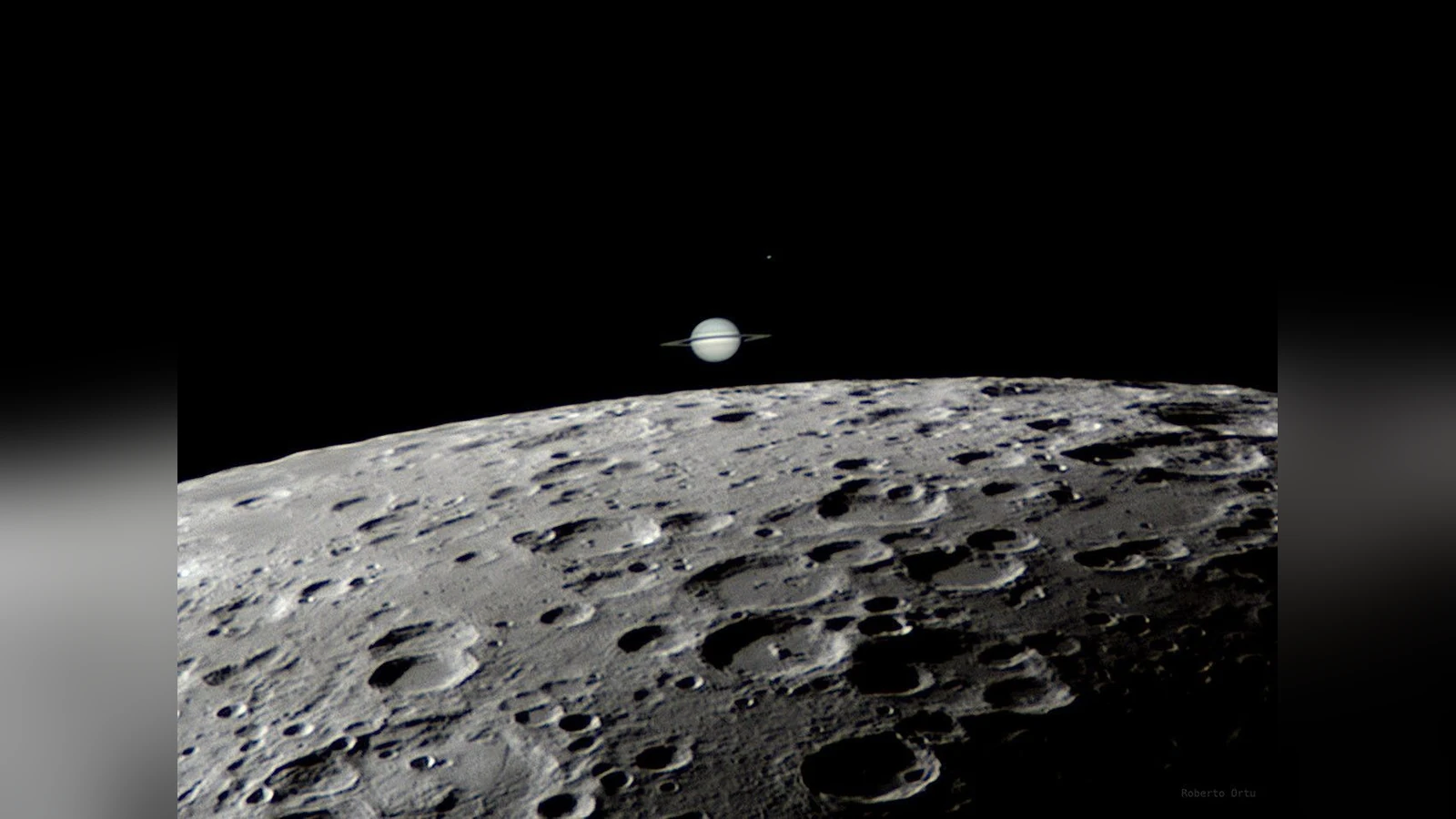
The Moon is about to hide Saturn, its rings hovering above a rugged landscape of lunar craters, in Roberto Ortu’s striking photograph selected by NASA as its Astronomy Picture of the Day for November 10, 2026.
The image was captured in Sardinia in early 2025. The news today is NASA’s selection of the photograph, not a new occultation taking place in November 2026.
When the Moon passes in front of Saturn
The event is an astronomical occultation. As the Moon moves across the sky, it blocks our view of a more distant celestial body. Saturn does not actually vanish; it is temporarily hidden from observers in the right part of the world.
NASA says this occultation was visible from a relatively narrow band of Earth stretching from Greenland through central Europe to northern Africa. Ortu photographed it after sunset in Sardinia, Italy. NASA says the next lunar occultation of Saturn visible from somewhere on Earth will occur in 2031.
Three exposures, one finished photograph
The picture is not a single shutter release. According to NASA, Ortu assembled a digital composite of three exposures: one of Saturn before it disappeared and two of the Moon made with different exposure lengths.
There is a clear photographic reason for this approach. The bright lunar surface needs a different exposure from the much dimmer planet. Separate captures make it possible to preserve detail in the craters while also showing Saturn and its rings.
A related approach to managing differing brightness levels appears in lunar-eclipse photography using bracketing and stacking, although Ortu’s final image is a particular three-frame composite rather than simply stacking identical exposures to reduce noise.
The bright dot is not one of Saturn’s moons
A tiny point of light sits just above Saturn. Although it might look like one of the planet’s moons, it is actually the star 85 Aquarii, much farther from Earth than Saturn itself. Their apparent proximity is a line-of-sight effect.
Photographic composite or AI image?
This is a photographic composite: its elements come from real astronomical captures combined digitally. That is fundamentally different from generating celestial objects with a generative AI model.
That distinction does not make the composite a single untouched instant. The three exposures were not one simultaneous frame, and explaining the process is an important part of photographic transparency—especially when readers want to understand what actually happened in the sky.
What we think
What makes this image so compelling is the scale. The Moon’s rough surface fills the foreground while a whole ringed planet hangs above it. It is exactly the kind of alignment that makes you wish your telescope were already set up.
We also appreciate that the technique is clearly disclosed. Three different exposures were used to render a scene that a camera sensor cannot handle in the same way at every brightness level. For photographers, it is a useful reminder that editing can support an accurate depiction—provided we explain what has been combined.
There is a practical takeaway too: for an occultation, timing and observing location matter every bit as much as the equipment. You need the right frames in the first place; the editing comes afterwards.
Frequently asked questions
Did Saturn disappear behind the Moon on November 10, 2026?
No. The occultation was photographed in early 2025. NASA published the image as its Astronomy Picture of the Day on November 10, 2026.
Was the image made with artificial intelligence?
NASA describes it as a digital composite of three real photographic exposures, rather than an AI-generated image.