Summary
A comet with two striking tails and a multicolored meteor appear to meet in a photograph selected by NASA as its Astronomy Picture of the Day for November 3, 2026.
The image was captured by Eddy Metais in April 2026 from Hautacam, France. Near the bottom of the frame, the bright head of Comet C/2025 R3 (PanSTARRS) stands out, while a thin white-and-green streak cuts diagonally across the star-filled sky.
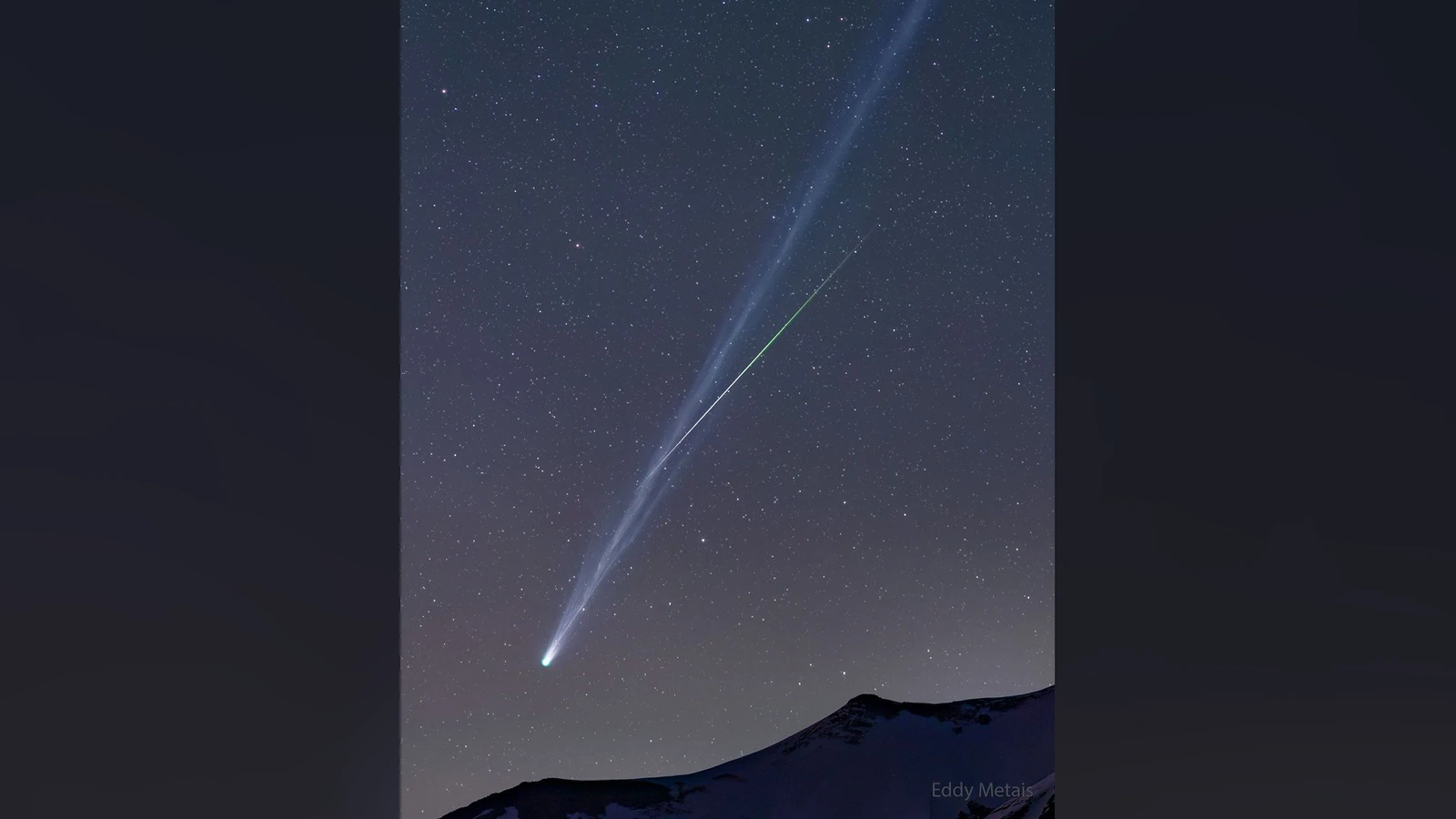
A meteor in front of a much more distant comet
The photograph makes the meteor appear to cross the comet’s tail. In reality, the two objects are at entirely different distances: the comet is much farther away, while the meteor is the flash of light produced when a small particle enters Earth’s atmosphere.
NASA says there is no good reason to link this particular meteor to PanSTARRS. Many meteors do originate from debris left by comets, but identifying the parent body requires more than the apparent alignment of two streaks in one photograph.
PanSTARRS’ two tails and the colors of the meteor
C/2025 R3 displays two distinct tails. Its blue ion tail contains charged gas influenced by the solar wind. Its dust tail is made of tiny particles reflecting sunlight. Those structures can differ in direction and appearance.
The bright foreground streak shifts between white and green. NASA suggests that its colors could indicate a complex composition, but the APOD description does not identify specific chemical elements from this image.
The same comet had already appeared in NASA’s April 2026 skywatching guide as a potentially notable object for observers on Earth. Metais photographed that spring appearance.
What do the Taurids and Leonids have to do with the image?
NASA published this APOD selection in November, when several familiar meteor showers peak. It points to the Southern and Northern Taurids, associated with Comet 2P/Encke, and the Leonids, associated with debris from 55P/Tempel–Tuttle.
That does not mean the meteor in this photograph belongs to either shower. The photograph was taken in April, not November, and NASA does not assign its meteor streak to a known shower.
What we think
What grabs us here is not merely the presence of two spectacular sky phenomena in one frame. It is the way the diagonal lines work together: the comet’s long, soft tail and the meteor’s much sharper, colorful streak create a composition that keeps your eye moving through the scene.
For anyone who shoots the night sky, this is a reminder that even a carefully planned composition can gain something completely unexpected. You can predict where the comet will appear, but a meteor flashes across the sky and disappears in an instant. Being in the right place with the sky properly framed makes all the difference.
We also like that NASA’s explanation takes nothing away from the photograph. The meteor does not need to have come from the comet for the image to work. Perspective is enough.
Frequently asked questions
Did the meteor originate from Comet C/2025 R3?
There is no evidence establishing such a connection. The comet is much farther away; the two phenomena simply line up in the photographer’s field of view.
Why does the meteor have different colors?
Meteor colors can depend on the particle’s composition and conditions in the atmosphere. NASA notes a potentially complex composition but does not identify specific elements in this photograph.