Summary
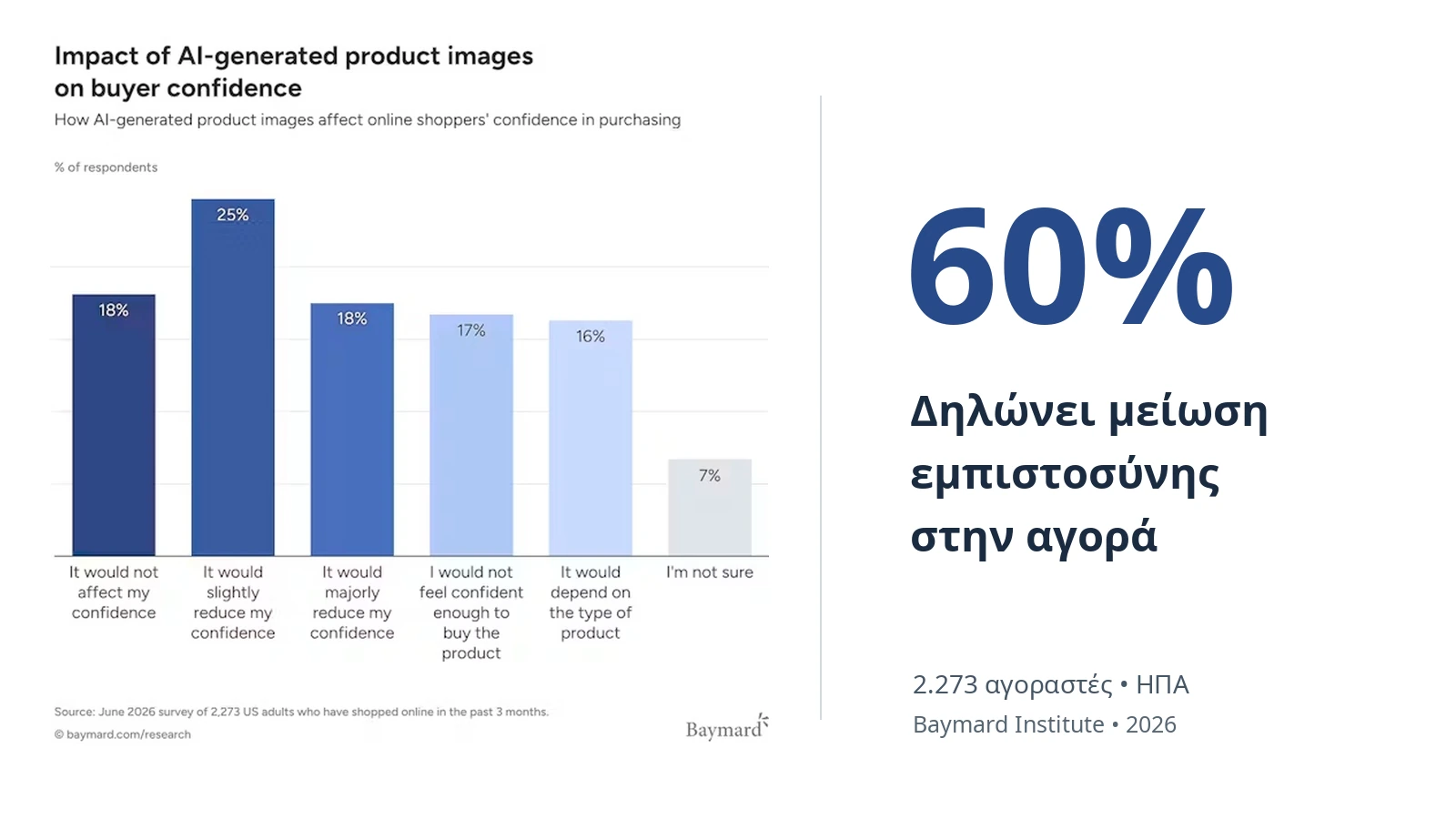
- Sixty percent of shoppers say AI-generated product imagery reduces their purchase confidence.
- Baymard surveyed 2,273 people in the United States.
- Seventeen percent say they would not feel confident enough to buy.
- The results reflect stated attitudes rather than measured sales.
An AI-generated product image may save time and money, but for many shoppers it introduces a problem that attractive pixels alone cannot solve: reduced confidence.
A Baymard Institute study found that 60% of US online shoppers say they would feel less confident about buying a product if they knew its image was AI-generated. The survey was conducted in June 2026 among 2,273 people who had shopped online in the preceding three months, and the findings were published on October 27, 2026.
What shoppers actually said
The loss of confidence varies. 25% said AI-generated product images would slightly reduce their confidence, 18% said they would greatly reduce it, and 17% said they would not feel confident enough to buy the product at all. Together, those groups account for 60%.
In contrast, 18% said AI would not affect their confidence, 16% said it depended on the type of product, and 7% were unsure. The published figures are rounded, which is why the percentages add up to 101%.
Product photography is information, not just decoration
Online shoppers use pictures to answer practical questions: What is the actual color? What does the material look like? How large is the item, and which details will they find when they open the package? A fully synthetic image can be aesthetically convincing without being reliable evidence of those characteristics.
Baymard recommends prioritizing authentic photography for a product’s core views. It does not rule out AI-generated supporting lifestyle scenes or backgrounds, but it stresses that retailers must address skepticism through transparency and ways to verify what is being sold.
What this means for photographers and retailers
For professional product photographers, the findings offer a concrete point to discuss with clients: accurate materials, consistent color, detailed views, and truthful representation all matter to the shopping experience. Image production is not only about a campaign’s visual style; it also affects how well customers can evaluate a purchase.
Brands are already navigating that distinction. Mango’s campaign featuring AI-generated imagery showed how photographs of actual garments can become part of a broader synthetic image-making process. But a creative campaign scene serves a different purpose from the main product image that shoppers rely on to check an item’s appearance.
One distinction is essential: the research records what participants say they would feel when they know an image is AI-generated. It does not measure actual sales, changes in conversion rates, or whether shoppers can identify synthetic imagery without being told.
What we think
Product photographers have a good reason to pay attention to this result. Not because it means AI is going away, but because it highlights something a prompt does not automatically deliver: confidence that the product on screen is the product that will arrive at your door.
There is demanding work behind a reliable product shoot that a client may never notice: lighting reflective surfaces, keeping colors consistent across an entire catalog, showing scale correctly, and recording textures accurately. These are tangible services worth explaining to businesses instead of relying on a beautiful portfolio alone.
AI can be useful for advertising variations and creative environments. For a product page’s primary images, though, we would rather see a straightforward, truthful photograph than a flawless render that leaves us guessing what is actually for sale. If a brand uses synthetic images, clear labeling alongside real product views is the more responsible approach.
Frequently asked questions
Does the study show that AI images cause a 60% decline in actual sales?
No. The 60% figure is the share of respondents who said knowing an image was AI-generated would reduce their confidence. It is not a sales-loss figure.
Does this also apply to real photographs edited with AI tools?
The survey question concerns AI-generated product images. It does not separately measure reactions to genuine photographs that have received limited AI-assisted editing.