Summary
- Grandmaslop is an informal term for synthetic family images made by older relatives.
- One account describes grandchildren depicted together even though they had never met.
- Nostalgia and the desire for connection are possible explanations, not established motives.
- Using real children’s faces also raises serious consent and privacy questions.
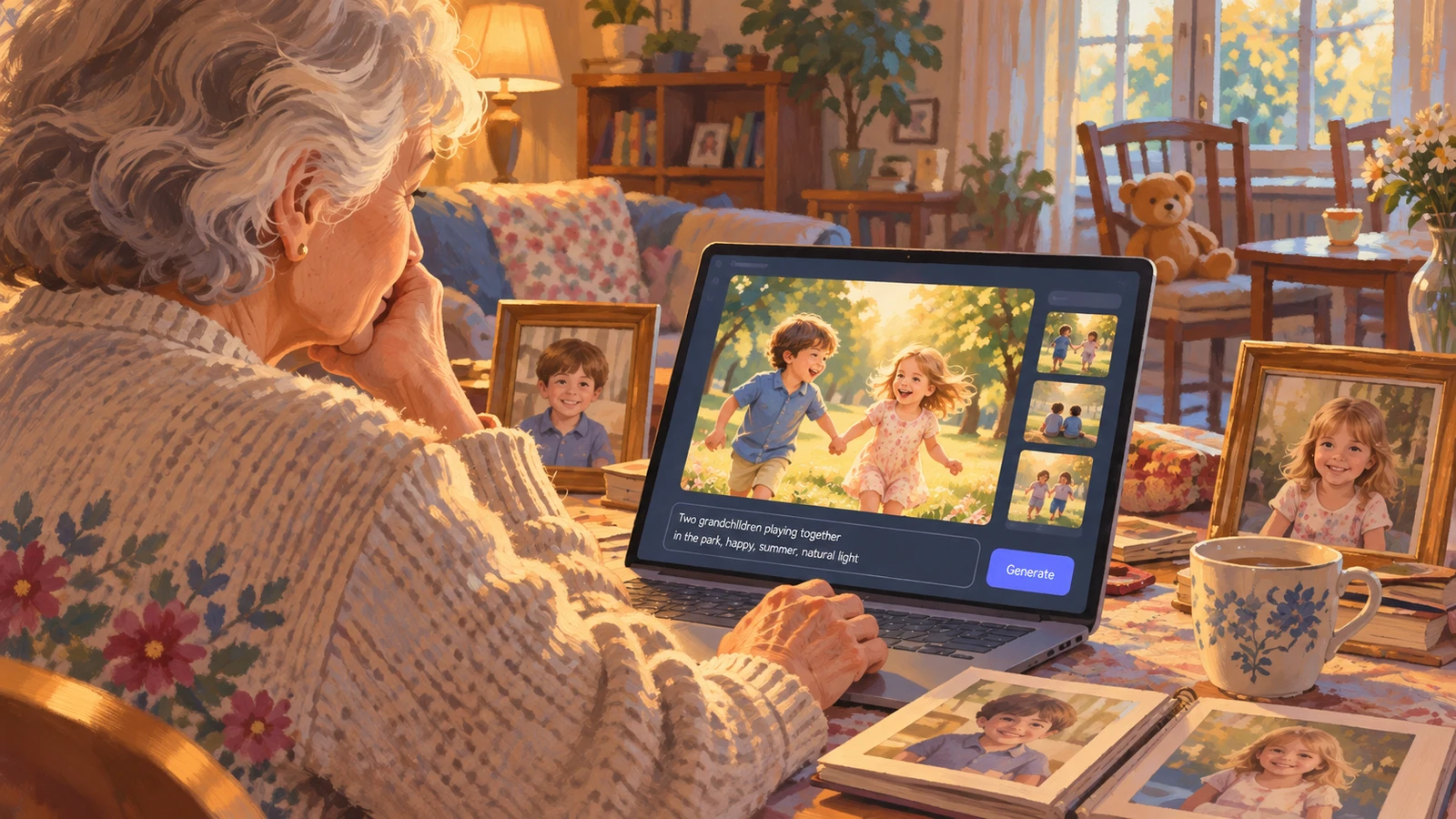
Picture a grandmother looking at a computer screen where her two grandchildren run together through a sunlit park. The children are laughing, and the image looks like a family photograph worth keeping forever. There is one important detail: the two children have never met.
No one photographed the scene. It never took place. Artificial intelligence created it.
This is one of the stories behind the term “Grandmaslop,” used online for AI-generated pictures and videos that older relatives make featuring the faces of people they love. Personal accounts and reporting have brought an unusual family disagreement into public view.
The interesting question is not merely how easy it has become to manufacture a convincing family picture. It is why someone would want to manufacture a memory they never lived.
A family album gains an imaginary past
In an account discussed on Reddit, a commenter said their grandmother had generated pictures of a grandson and a newborn granddaughter together even though the children had not met in real life.
For the grandmother, the result may have represented a lovely family wish. For the relative who discovered it, the image was unsettling: a fabricated shared experience using the faces of real children.
That story cannot establish how common the practice is among older people. It does, however, reveal the disagreement at its heart. One family member sees a sweet keepsake; another sees a child’s likeness being manipulated without permission.
Tensions grow when parents have already set limits on sharing their children’s pictures. Uploading an existing photo to create a new synthetic scene is a different act from simply keeping the original on a phone.
Why invent a memory of something that never happened?
This is the most human part of the story. We cannot know the personal motives of every grandparent who makes these images. We can, however, consider several possible psychological needs that might make such a tool appealing.
Distance and the desire for connection. When grandchildren live far away or family meetings are rare, a synthetic image can give form to an experience someone wishes they had shared. It need not be an attempt to deceive. It may be a way to picture the togetherness that is missing.
Nostalgia and the passing of time. Photography is closely tied to memory and the wish to preserve moments. Generative AI changes that relationship: it can depict not just what happened but what a person wishes had happened, particularly when precious family opportunities seem to be slipping away.
The family as we imagine it. Cousins living in different countries, siblings who have never met, or grandchildren growing up apart can suddenly appear together. AI can make an idealized family scene without the real-world circumstances needed for it to occur.
The pleasure of making things. Not every AI family picture is evidence of loneliness or emotional distress. Some people may simply enjoy a new creative activity, much as others enjoyed making photo collages. The important difference is how closely a generated scene can resemble a record of a real event.
These are plausible interpretations, not psychological diagnoses of people mentioned in reporting. The available accounts do not establish a single motivation for Grandmaslop.
The more difficult question is what happens when a private fantasy begins to be treated as an authentic family memory.
When a wish starts to look like evidence
Despite the limitations of photography as proof, a conventional family picture normally shows people who were together in front of a camera at a particular moment. An AI-generated image does not have the same connection to an event.
That does not mean viewers will automatically believe every synthetic image. It means family albums can now mix records of actual experiences with pictures built entirely out of wishes.
A child growing up with such an album may not immediately know which scenes were lived and which were invented. We do not need to claim that false memories are inevitable to recognize the difference between “this happened” and “we wish it had happened.”
For photographers, this touches the very purpose of family photography. The issue is not whether AI can produce something attractive but how pictures relate to the histories they appear to preserve.
Who gets to decide how a child’s face is used?
Consent is the other major issue raised by Grandmaslop.
To generate a recognizable fictional scene with real grandchildren, a relative may need to upload photographs of those children to an AI service. That raises questions about where those pictures go, how the particular provider handles them and who has the right to authorize their use.
AI services have different policies on retention, model training and privacy. It would be wrong to assume that every uploaded photo is treated in exactly the same way.
But a relative’s good intentions do not replace parental or guardian consent. If parents have explicitly asked family members not to publish or upload pictures of their child, generating a new AI picture does not make that boundary disappear.
Nor does hiding a face necessarily resolve every privacy issue. The surroundings, caption and other details may still identify a child. That is also relevant to tools such as AI-powered face pixelation in Instagram Stories: protecting a child’s image involves more than applying a visual effect.
Does family photography lose its role as a record?
Family photography has never been perfectly neutral. We choose the moment, the composition and the picture that goes into the album. People have long arranged family scenes to make them look their best.
Yet even in a posed family photograph, the people really stood together in front of the lens. AI removes even that requirement.
That makes the origin of an image more important than ever. A generated family picture can have emotional or artistic value, but it should not be presented as photographic documentation of a meeting that never occurred.
Technical labels help, but they are not foolproof. As the discussion about genuine photographs incorrectly labelled as AI on Instagram demonstrates, a platform badge alone cannot always settle where a picture came from.
Within the family, the clearest explanation may be the simplest: “This picture was made with AI. It is not a moment we actually shared.”
What we think
It would be easy to dismiss Grandmaslop as another peculiar story about older people discovering artificial intelligence. It would also be unfair to presume that everyone making these images wants to mislead anyone. There is something deeply understandable about wanting to see loved ones together when life has not made that possible.
But understandable wishes do not make every way of expressing them acceptable. When real children’s faces are involved, parents must have a say in what is created and where it goes. Loving a grandchild does not grant unlimited control over that child’s image.
There is also a question here for photography itself. Family pictures matter not merely because everyone looks happy in an attractive setting. They matter because they are connected to experiences we really shared, including imperfect, ordinary and unremarkable moments. Replacing those moments with prettier inventions risks overlooking what made the original photographs meaningful.
AI can be a powerful way to imagine and create. But a wish is not a memory. Perhaps the best response to an imaginary picture of two grandchildren playing together is to help them actually meet — and, with their parents’ agreement, make a genuine photograph of that day.
Frequently asked questions
What is Grandmaslop?
Grandmaslop is an informal online term for AI-generated images and videos of loved ones, especially children and grandchildren, created by older relatives. It is not a scientific or clinical category.
Is generating AI pictures of children dangerous?
The risks depend on the tool, source images, privacy settings and how the output is shared. Check the service’s policies and take particular care with recognizable children.
Can an AI family picture create a false memory?
Confusion between real and fabricated pictures is a reasonable concern. The specific accounts reported here do not establish that children developed false memories. Clearly identifying generated images preserves the distinction.
Do all grandparents use AI this way?
No. These are individual accounts, not evidence about an entire age group or its psychological motives.