Summary
- Perseverance reached 45.22 kilometers of driving on Mars on October 11, 2026.
- It surpassed Opportunity’s previous 45.16-kilometer record.
- NASA released a Navcam image from the historic day and an animation of the rover’s route.
- AutoNav autonomous navigation has been used for more than 90% of the total distance.
NASA’s Perseverance has made history on Mars, driving farther across the surface of another world than any vehicle before it.
On October 11, 2026, the rover’s odometer reached 45.22 kilometers (28.10 miles) on the mission’s 2,006th Martian day, or sol. That surpassed the 45.16-kilometer record established by Opportunity, which explored Mars from 2004 until 2018. NASA announced the milestone on October 12.
The announcement comes with a striking visual record: a photograph from Perseverance’s navigation camera showing wheel tracks carved into the Martian ground, as well as an animated overview of its journey since landing in 2021.
The photograph from the record-breaking day
NASA image PIA26812 was captured by one of the rover’s navigation cameras on October 11. Its frame shows a rocky slope with tracks running across the sandy terrain. This is not an illustration: it is an actual view of Mars recorded on the day the record changed hands.
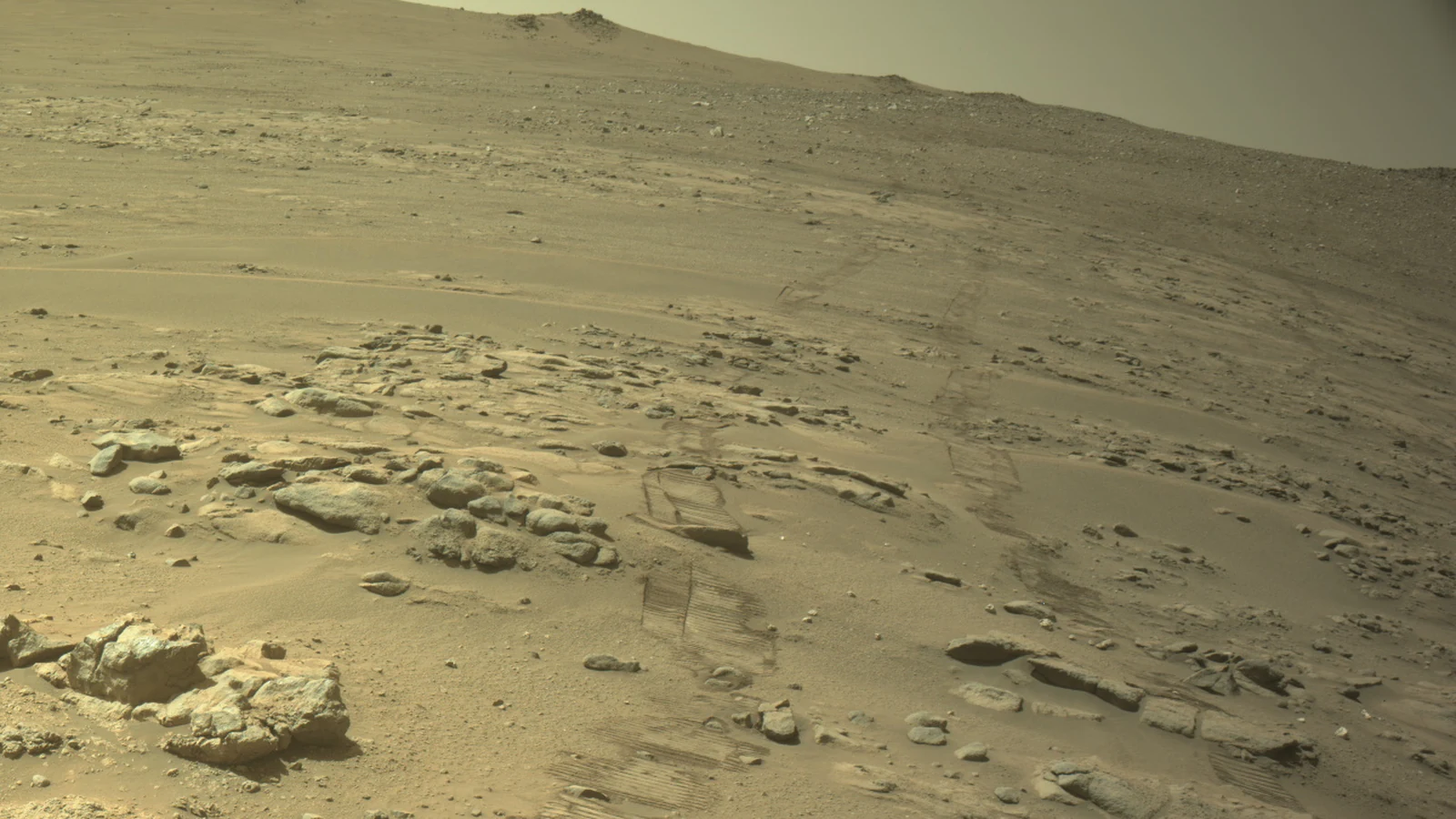
Perseverance drove 91.31 meters (299.6 feet) that day. That might sound insignificant by terrestrial standards, but travelling safely across unfamiliar rocks and slopes without a human driver demands careful navigation and hazard avoidance.
How Perseverance overtook Opportunity
Perseverance reached this milestone about five and a half years after landing in February 2021. Opportunity accumulated its total distance over a mission that lasted nearly 15 years. The contrast highlights how far robotic mobility has progressed.
NASA says Perseverance has driven more than 90% of its distance using AutoNav, its autonomous terrain-analysis and path-planning system. Only around 5% of the driving by Spirit and Opportunity used their earlier autonomous navigation system. The original Mars rover, Sojourner, evaluated 20 points ahead; Perseverance processes about 600,000 points with each look.
NASA says the six-wheeled vehicle can travel as far as 412 meters (1,351 feet) in a single sol under suitable conditions. Autonomy does not mean a rover operating without oversight: mission controllers still establish scientific destinations and operational limits.
Back in June, a HiRISE image from orbit caught Perseverance just before it completed a marathon-distance journey of 42.195 kilometers. It added more than three kilometers over the following months on its way to the new record.
Why the mission keeps moving
Distance itself is not the primary scientific objective. Perseverance explores the geological history of Jezero Crater and investigates environments that may once have supported microbial life. NASA says the rover has collected 29 rock and regolith samples across several distinct geological settings.
Its route has taken it from an ancient lakebed through a fossilized river system, where the rock known as “Cheyava Falls” revealed what NASA considers a potential biosignature — not proof of life. Around the crater rim, the rover is examining very ancient rocks and preparing to investigate areas that may show evidence of hydrothermal alteration.
The rover also carries instruments designed for scientific imaging. In a separate observation, Mastcam-Z photographed Earth passing behind the Martian moon Phobos. Photography, terrain mapping, and autonomous navigation all contribute to finding routes and investigating new locations.
What we think
From a photographic perspective, the most interesting part of this announcement may be the understated Navcam image. It does not show a spectacular sky or a carefully staged portrait of the rover. It shows wheel tracks and rocks. Yet those marks document a genuine engineering and exploration achievement.
Perseverance’s cameras are not simply there to send us pictures from another planet. They are fundamental tools that help the vehicle understand the terrain, avoid hazards, and reach rocks worth examining. On Mars, the link between imaging and movement could hardly be more direct.
The record matters because better mobility supports science rather than being the mission’s end goal. Travelling safely between sites means scientists can investigate more varied geological environments while the instruments remain operational. That matters more than the few dozen meters by which Perseverance eventually passed its predecessor.
Frequently asked questions
What is the new off-world driving record?
As of October 11, 2026, Perseverance had covered 45.22 kilometers on Mars, exceeding Opportunity’s previous 45.16-kilometer record.
How does Perseverance drive without a human at the wheel?
Mission controllers define its goals and constraints, while AutoNav analyses nearby terrain and helps the rover navigate around hazards. More than 90% of Perseverance’s total driving distance has been covered using this system.