

Summary
- NASA selected Curiosity’s panoramic selfie at Vera Rubin Ridge as the APOD for October 3, 2026.
- The mosaic was created from 61 MAHLI exposures on Sol 1943.
- The robotic arm was edited out of the composite, while the background was extended with Mastcam imagery.
- The APOD also notes that Curiosity reached a total elevation gain of 1 kilometer in August 2026.
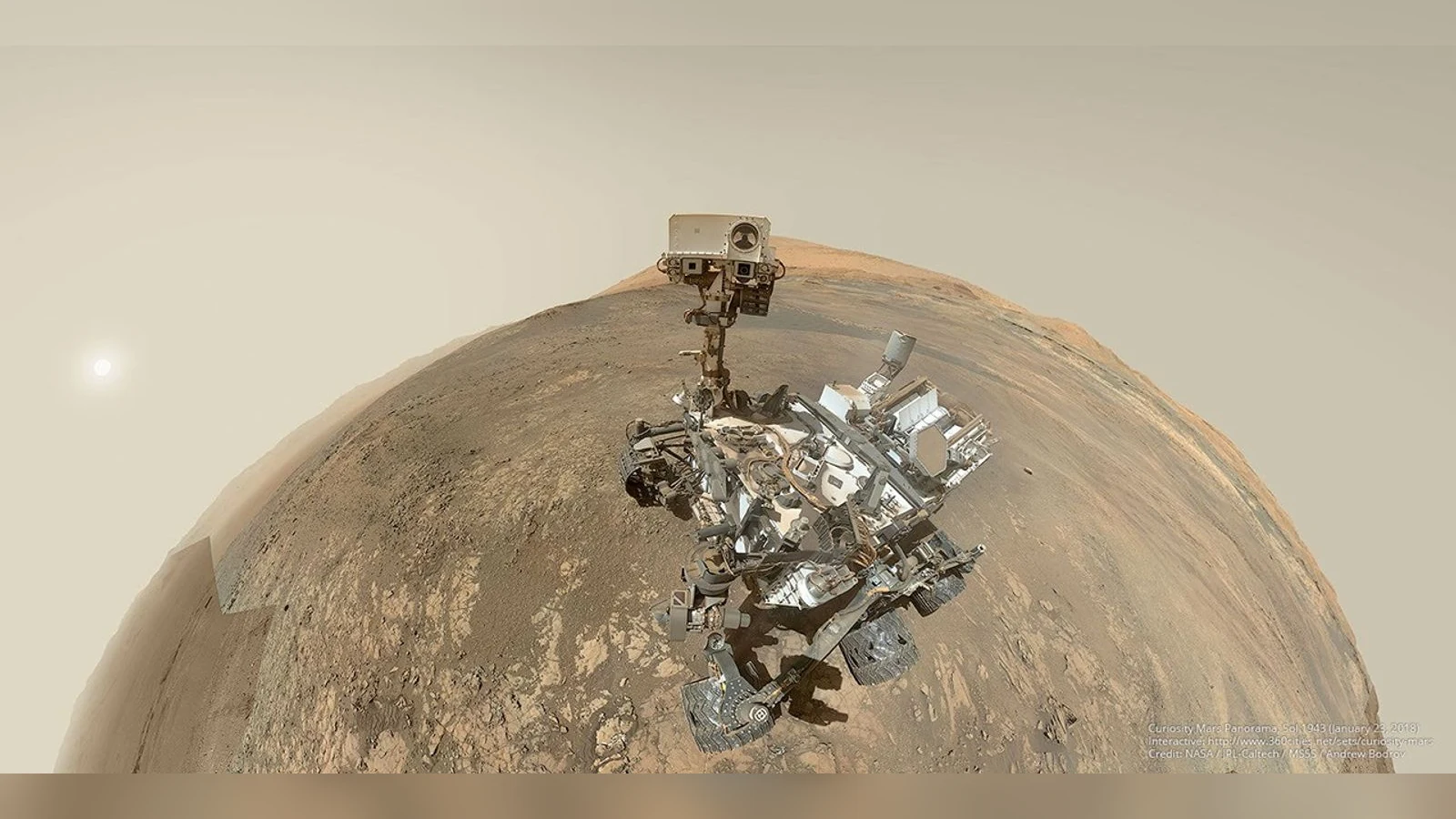
NASA selected a striking Curiosity “selfie” from Vera Rubin Ridge as the Astronomy Picture of the Day for October 3, 2026, bringing a Martian panoramic mosaic created in 2018 back into view.
The image corresponds to mission Sol 1943, January 23, 2018 on Earth. The finished panorama combines 61 exposures from the Mars Hand Lens Imager (MAHLI), the camera mounted at the end of the rover’s robotic arm.
How the “selfie” was made without showing the arm
The image is not a single exposure. It is a mosaic of multiple MAHLI frames combined into a panoramic view. Portions showing the robotic arm were edited out during assembly, making the result look as though Curiosity had been photographed by an external camera.
The extended background also uses Mastcam imagery acquired on Sol 1903. At the top of the rover’s mast, the ChemCam housing blocks part of the distant summit of Mount Sharp.
Vera Rubin Ridge and Mount Sharp
At the time of the selfie, Curiosity was at the south rim of Vera Rubin Ridge inside Gale Crater. Mount Sharp, about 5 kilometers high, rises from the center of the crater and is the central geological destination of the rover’s long traverse.
NASA’s 2026 APOD presentation also notes a newer milestone: on August 26, 2026, Curiosity reached a total elevation gain of 1 kilometer in its trek from the floor of Gale Crater up the slope of Mount Sharp.
Why the image still stands out
For image makers, the panorama is a clear example of how a series of individual frames can become a seemingly seamless photograph. The compositing process does more than expand the field of view: it removes the structure holding the camera, creating the visual illusion of a third-person observer on Mars.
What we think
The panorama’s return as an APOD shows how an image can retain its impact years after it was created when it combines technical interest with a strong sense of place. It is also a useful reminder that a “selfie” from another planet can be the product of dozens of frames and careful compositing.
Frequently asked questions
When were the selfie images taken?
The MAHLI images were acquired on Curiosity Sol 1943, corresponding to January 23, 2018 on Earth.
How many exposures were used?
The panoramic mosaic combines 61 exposures from the MAHLI camera.
Why is the robotic arm not visible?
Frames or portions of frames containing the arm were edited out during assembly of the mosaic.
What is Vera Rubin Ridge?
It is a geological feature on the slopes of Mount Sharp inside Gale Crater that Curiosity explored during its long ascent.