

Summary
NASA’s Curiosity rover continues its climb up Mount Sharp on Mars, exploring successive geological bands with distinct characteristics.
In its latest mission update, the science team describes how the rover is moving through regions with visible differences in rock texture and color, collecting data that help researchers understand the geological history of the planet.
This work is particularly important because each geological unit may reveal clues about the conditions that existed on Mars billions of years ago, when its environment was very different from today.
Researching Dark-Toned Rocks
During sols 4920 and 4921, Curiosity was positioned within an area containing rough-textured and dark-toned bedrock. The terrain did not allow the use of the rover’s dust-removal brush, but chemical analyses and microscopic imaging were performed directly on rock surfaces.
Scientists used the APXS and MAHLI instruments to study targets named “Salto La Cascada” and “Puerto de Rosas,” while ChemCam conducted spectroscopic observations of additional rock targets in the area.
Panoramic Imaging and Geological Mapping
Alongside these analyses, Curiosity captured a series of panoramic images and detailed observations of the surrounding landscape. These include the “Valle Grande” channel, the “Kimsa Chata” butte, nearby troughs and other rocky formations that help scientists map the geology of the region.
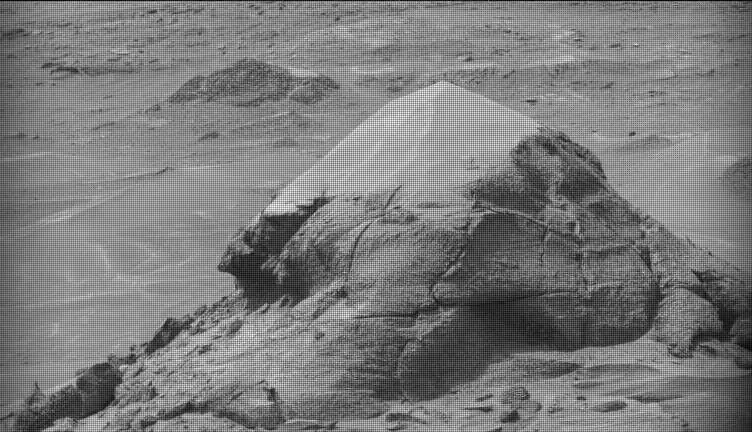
Particular interest has focused on the “Miraflores” rock formation, photographed by Mastcam and notable for its distinctive appearance within the Martian landscape.
Continuing the Ascent of Mount Sharp
Curiosity’s mission has long focused on studying the layers of Mount Sharp, a mountain located inside Gale Crater. As the rover climbs higher, it encounters different geological units that serve as a natural record of Mars’ history.
The latest observations are expected to help researchers better understand the processes that shaped the region’s rocks and identify clues about the planet’s ancient environment.
What We Think
Curiosity may have been operating on Mars since 2012, but it continues to deliver valuable scientific data. The systematic exploration of Mount Sharp’s geological layers keeps revealing new details about the evolution of the Red Planet and whether conditions suitable for life once existed there.